Ustrell Xavier, Pellisé Anna
Stroke Unit, Neurology Department, Joan XXIII University Hospital, Tarragona, Catalonia, Spain.
Curr Cardiol Rev. 2010 Aug;6(3):175-83. doi: 10.2174/157340310791658721.
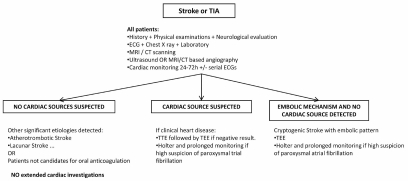
Stroke is the leading cause of disability in developed countries and the third cause of mortality. Up to 15-30% of ischemic strokes are caused by cardiac sources of emboli being associated with poor prognosis and high index of fatal recurrence. In order to establish an adequate preventive strategy it is crucial to identify the cause of the embolism. After a complete diagnostic workup up to 30% of strokes remain with an undetermined cause, and most of them are attributed to an embolic mechanism suggesting a cardiac origin.There is no consensus in the extent and optimal approach of cardiac workup of ischemic stroke. Clinical features along with brain imaging and the study of the cerebral vessels with ultrasonography or MRI/CT based angiography can identify other causes or lead to think about a possible cardioembolic origin.Atrial fibrillation is the most common cause of cardioembolic stroke. Identification of occult atrial fibrillation is essential. Baseline ECG, serial ECG('s), cardiac monitoring during the first 48 hours, and Holter monitoring have detection rates varying from 4 to 8% each separately. Extended cardiac monitoring with event loop recorders has shown higher rates of detection of paroxysmal atrial fibrillation.Cardiac imaging with echocardiography is necessary to identify structural sources of emboli. There is insufficient data to determine which is the optimal approach. Transthoracic echocardiography has an acceptable diagnostic yield in patients with heart disease but transesophageal echocardiography has a higher diagnostic yield and is necessary if no cardiac sources have been identified in patients with cryptogenic stroke with embolic mechanism.
中风是发达国家致残的主要原因和第三大死因。高达15%-30%的缺血性中风由心脏栓子源引起,预后较差且致命复发率高。为制定适当的预防策略,确定栓塞原因至关重要。经过全面的诊断检查后,高达30%的中风病因仍未明确,其中大多数归因于提示心脏起源的栓塞机制。对于缺血性中风的心脏检查范围和最佳方法尚无共识。临床特征、脑成像以及超声或基于MRI/CT的血管造影对脑血管的研究可以识别其他病因或引发对可能的心源性栓塞起源的思考。心房颤动是心源性栓塞性中风最常见的原因。识别隐匿性心房颤动至关重要。基线心电图、系列心电图、最初48小时的心脏监测以及动态心电图监测的检出率分别为4%至8%不等。使用事件环记录仪进行延长心脏监测显示阵发性心房颤动的检出率更高。用超声心动图进行心脏成像对于识别栓子的结构来源很有必要。目前尚无足够数据确定哪种方法是最佳方法。经胸超声心动图对患有心脏病的患者有可接受的诊断率,但经食管超声心动图的诊断率更高,对于具有栓塞机制的不明原因中风患者,如果未发现心脏栓子源则有必要进行经食管超声心动图检查。