Department of Pathology, Academic Medical Center, PO Box 22660, 1100 DD, Amsterdam, The Netherlands.
Fam Cancer. 2011 Sep;10(3):437-46. doi: 10.1007/s10689-011-9469-3.
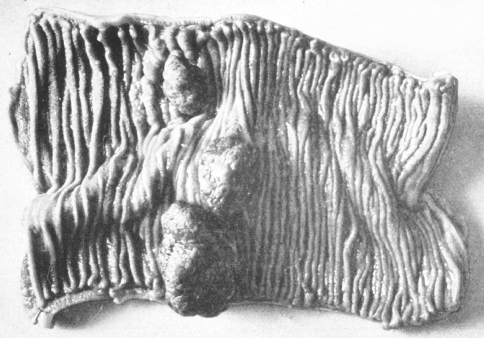
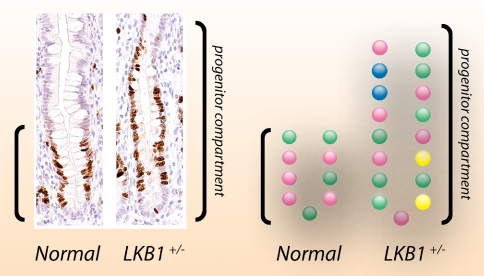
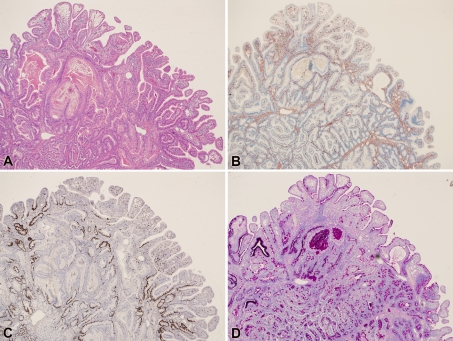
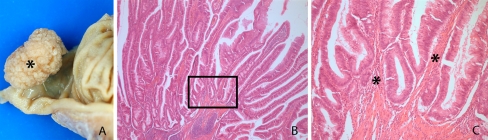
Familial cancer syndromes present rare insights into malignant tumor development. The molecular background of polyp formation and the cancer prone state in Peutz-Jeghers syndrome remain enigmatic to this day. Previously, we proposed that Peutz-Jeghers polyps are not pre-malignant lesions, but an epiphenomenon to the malignant condition. However, Peutz-Jeghers polyp formation and the cancer-prone state must both be accounted for by the same molecular mechanism. Our contribution focuses on the histopathology of the characteristic Peutz-Jeghers polyp and recent research on stem cell dynamics and how these concepts relate to Peutz-Jeghers polyposis. We discuss a protracted clonal evolution scenario in Peutz-Jeghers syndrome due to a germline LKB1 mutation. Peutz-Jeghers polyp formation and malignant transformation are separately mediated through the same molecular mechanism played out on different timescales. Thus, a single mechanism accounts for the development of benign Peutz-Jeghers polyps and for malignant transformation in Peutz-Jeghers syndrome.
家族性癌症综合征为恶性肿瘤的发展提供了罕见的见解。迄今为止,Peutz-Jeghers 综合征中息肉形成和癌症易感性的分子背景仍然是个谜。此前,我们提出 Peutz-Jeghers 息肉不是癌前病变,而是恶性状态的一种表现。然而,Peutz-Jeghers 息肉的形成和癌症易感性必须由相同的分子机制来解释。我们的研究重点是 Peutz-Jeghers 息肉的组织病理学和最近关于干细胞动力学的研究,以及这些概念与 Peutz-Jeghers 息肉病的关系。我们讨论了由于种系 LKB1 突变导致的 Peutz-Jeghers 综合征中持续的克隆进化情况。Peutz-Jeghers 息肉的形成和恶性转化是通过相同的分子机制在不同的时间尺度上分别介导的。因此,单一机制解释了良性 Peutz-Jeghers 息肉的发展和 Peutz-Jeghers 综合征中的恶性转化。