• 文献检索
  • 文档翻译
  • 深度研究
  • 学术资讯
  • Suppr Zotero 插件Zotero 插件
  • 邀请有礼
  • 套餐&价格
  • 历史记录
应用&插件
Suppr Zotero 插件Zotero 插件浏览器插件Mac 客户端Windows 客户端微信小程序
定价
高级版会员购买积分包购买API积分包
服务
文献检索文档翻译深度研究API 文档MCP 服务
关于我们
关于 Suppr公司介绍联系我们用户协议隐私条款
关注我们

Suppr 超能文献

核心技术专利:CN118964589B侵权必究
粤ICP备2023148730 号-1Suppr @ 2026

文献检索

告别复杂PubMed语法,用中文像聊天一样搜索,搜遍4000万医学文献。AI智能推荐,让科研检索更轻松。

立即免费搜索

文件翻译

保留排版,准确专业,支持PDF/Word/PPT等文件格式,支持 12+语言互译。

免费翻译文档

深度研究

AI帮你快速写综述,25分钟生成高质量综述,智能提取关键信息,辅助科研写作。

立即免费体验

基于数据驱动的空间扫描统计推断。

Data-driven inference for the spatial scan statistic.

机构信息

Campus Alto Paraopeba, Universidade Federal de São João del Rei, Ouro Branco/MG, Brazil.

出版信息

Int J Health Geogr. 2011 Aug 2;10:47. doi: 10.1186/1476-072X-10-47.

DOI:10.1186/1476-072X-10-47
PMID:21806835
原文链接:https://pmc.ncbi.nlm.nih.gov/articles/PMC3161833/
Abstract

BACKGROUND

Kulldorff's spatial scan statistic for aggregated area maps searches for clusters of cases without specifying their size (number of areas) or geographic location in advance. Their statistical significance is tested while adjusting for the multiple testing inherent in such a procedure. However, as is shown in this work, this adjustment is not done in an even manner for all possible cluster sizes.

RESULTS

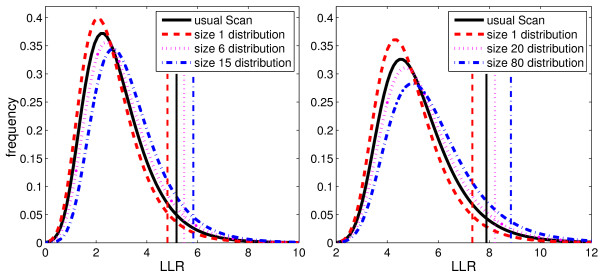
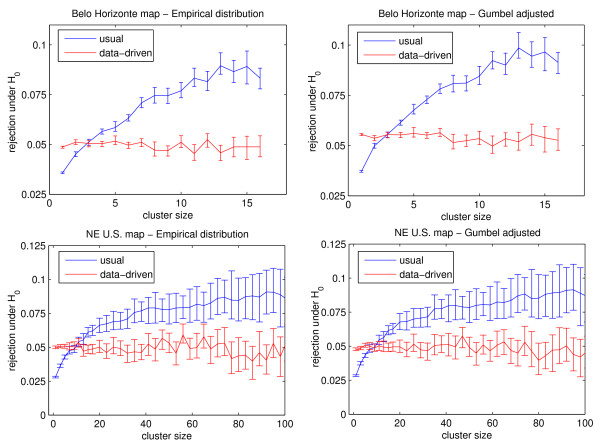
A modification is proposed to the usual inference test of the spatial scan statistic, incorporating additional information about the size of the most likely cluster found. A new interpretation of the results of the spatial scan statistic is done, posing a modified inference question: what is the probability that the null hypothesis is rejected for the original observed cases map with a most likely cluster of size k, taking into account only those most likely clusters of size k found under null hypothesis for comparison? This question is especially important when the p-value computed by the usual inference process is near the alpha significance level, regarding the correctness of the decision based in this inference.

CONCLUSIONS

A practical procedure is provided to make more accurate inferences about the most likely cluster found by the spatial scan statistic.

摘要

背景

库尔多夫的聚集区域地图空间扫描统计量在事先不指定病例集群的大小(区域数量)或地理位置的情况下搜索病例集群。在对这种程序固有的多次检验进行调整的同时,对其统计显著性进行检验。然而,正如本工作所示,对于所有可能的集群大小,这种调整并非以均匀的方式进行。

结果

针对空间扫描统计量的常用推断检验提出了一种修正方法,纳入了关于所发现最大可能集群大小的额外信息。对空间扫描统计量的结果进行了新的解释,提出了一个修正的推断问题:在考虑仅根据零假设找到的大小为 k 的最大可能集群的情况下,对于原始观察到的病例地图,对于大小为 k 的最大可能集群,零假设被拒绝的概率是多少?当通常的推断过程计算出的 p 值接近α显著性水平时,这个问题尤其重要,这涉及到基于这种推断的决策的正确性。

结论

为空间扫描统计量发现的最大可能集群提供了更准确的推断方法。

https://cdn.ncbi.nlm.nih.gov/pmc/blobs/0bc3/3161833/7cb7e7dd5312/1476-072X-10-47-6.jpg
https://cdn.ncbi.nlm.nih.gov/pmc/blobs/0bc3/3161833/8a71bcd59a0f/1476-072X-10-47-1.jpg
https://cdn.ncbi.nlm.nih.gov/pmc/blobs/0bc3/3161833/c9c014e2f383/1476-072X-10-47-2.jpg
https://cdn.ncbi.nlm.nih.gov/pmc/blobs/0bc3/3161833/de028b041fa0/1476-072X-10-47-3.jpg
https://cdn.ncbi.nlm.nih.gov/pmc/blobs/0bc3/3161833/fcafc9cef97f/1476-072X-10-47-4.jpg
https://cdn.ncbi.nlm.nih.gov/pmc/blobs/0bc3/3161833/009e999424a2/1476-072X-10-47-5.jpg
https://cdn.ncbi.nlm.nih.gov/pmc/blobs/0bc3/3161833/7cb7e7dd5312/1476-072X-10-47-6.jpg
https://cdn.ncbi.nlm.nih.gov/pmc/blobs/0bc3/3161833/8a71bcd59a0f/1476-072X-10-47-1.jpg
https://cdn.ncbi.nlm.nih.gov/pmc/blobs/0bc3/3161833/c9c014e2f383/1476-072X-10-47-2.jpg
https://cdn.ncbi.nlm.nih.gov/pmc/blobs/0bc3/3161833/de028b041fa0/1476-072X-10-47-3.jpg
https://cdn.ncbi.nlm.nih.gov/pmc/blobs/0bc3/3161833/fcafc9cef97f/1476-072X-10-47-4.jpg
https://cdn.ncbi.nlm.nih.gov/pmc/blobs/0bc3/3161833/009e999424a2/1476-072X-10-47-5.jpg
https://cdn.ncbi.nlm.nih.gov/pmc/blobs/0bc3/3161833/7cb7e7dd5312/1476-072X-10-47-6.jpg

相似文献

1
Data-driven inference for the spatial scan statistic.基于数据驱动的空间扫描统计推断。
Int J Health Geogr. 2011 Aug 2;10:47. doi: 10.1186/1476-072X-10-47.
2
Gumbel based p-value approximations for spatial scan statistics.基于 Gumbel 的空间扫描统计量的 p 值逼近。
Int J Health Geogr. 2010 Dec 17;9:61. doi: 10.1186/1476-072X-9-61.
3
A flexibly shaped spatial scan statistic for detecting clusters.一种用于检测聚类的形状灵活的空间扫描统计量。
Int J Health Geogr. 2005 May 18;4:11. doi: 10.1186/1476-072X-4-11.
4
An extended power of cluster detection tests.聚类检测测试的扩展功效
Stat Med. 2006 Mar 15;25(5):841-52. doi: 10.1002/sim.2419.
5
A scan statistic for binary outcome based on hypergeometric probability model, with an application to detecting spatial clusters of Japanese encephalitis.基于超几何概率模型的二项结局扫描统计量及其在检测日本脑炎空间聚集性中的应用。
PLoS One. 2013 Jun 13;8(6):e65419. doi: 10.1371/journal.pone.0065419. Print 2013.
6
Nonparametric intensity bounds for the delineation of spatial clusters.空间聚类划分的非参数强度界限。
Int J Health Geogr. 2011 Jan 7;10:1. doi: 10.1186/1476-072X-10-1.
7
Geovisual analytics to enhance spatial scan statistic interpretation: an analysis of U.S. cervical cancer mortality.用于增强空间扫描统计解释的地理可视化分析:美国宫颈癌死亡率分析
Int J Health Geogr. 2008 Nov 7;7:57. doi: 10.1186/1476-072X-7-57.
8
A generalized linear models approach to spatial scan statistics for covariate adjustment.一种用于协变量调整的空间扫描统计量的广义线性模型方法。
Stat Med. 2009 Mar 30;28(7):1131-43. doi: 10.1002/sim.3535.
9
A workflow spatial scan statistic.一种工作流程空间扫描统计量。
Stat Med. 2006 Mar 15;25(5):743-54. doi: 10.1002/sim.2403.
10
Searching for space-time clusters: The CutL method compared to Kulldorff's scan statistic.寻找时空聚集:CutL方法与Kulldorff扫描统计量的比较
Geospat Health. 2019 Nov 6;14(2). doi: 10.4081/gh.2019.791.

引用本文的文献

1
International society for disease surveillance conference 2011: building the future of public health surveillance.2011年国际疾病监测大会:构建公共卫生监测的未来
Emerg Health Threats J. 2011 Dec 6;4:11702. doi: 10.3402/ehtj.v4i0.11702.

本文引用的文献

1
Gumbel based p-value approximations for spatial scan statistics.基于 Gumbel 的空间扫描统计量的 p 值逼近。
Int J Health Geogr. 2010 Dec 17;9:61. doi: 10.1186/1476-072X-9-61.
2
Penalized likelihood and multi-objective spatial scans for the detection and inference of irregular clusters.惩罚似然和多目标空间扫描用于不规则集群的检测和推断。
Int J Health Geogr. 2010 Oct 29;9:55. doi: 10.1186/1476-072X-9-55.
3
An elliptic spatial scan statistic.一种椭圆空间扫描统计量。
Stat Med. 2006 Nov 30;25(22):3929-43. doi: 10.1002/sim.2490.
4
Spatial disease clusters: detection and inference.空间疾病聚集:检测与推断
Stat Med. 1995 Apr 30;14(8):799-810. doi: 10.1002/sim.4780140809.