Academic Department of Trauma & Orthopaedics, School of Medicine, University of Leeds, UK.
Bone. 2012 Feb;50(2):510-7. doi: 10.1016/j.bone.2011.07.016. Epub 2011 Jul 23.
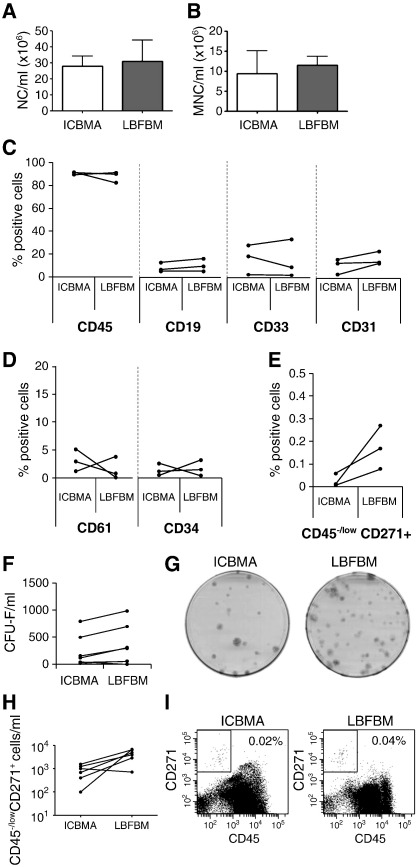
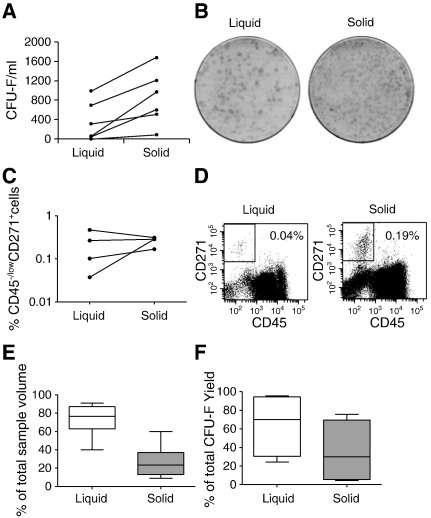
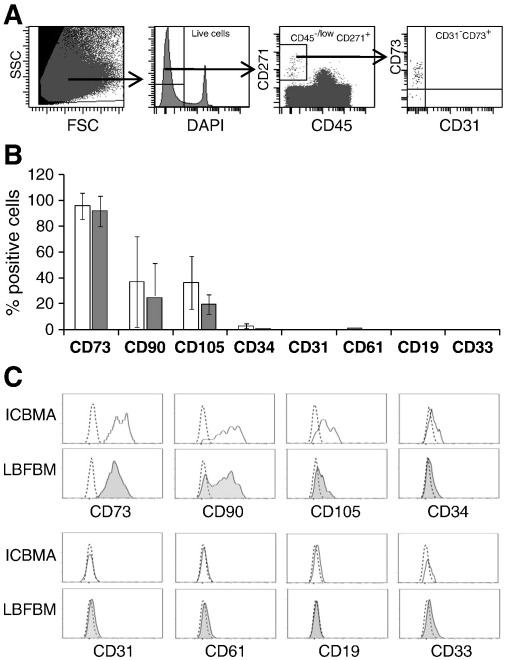
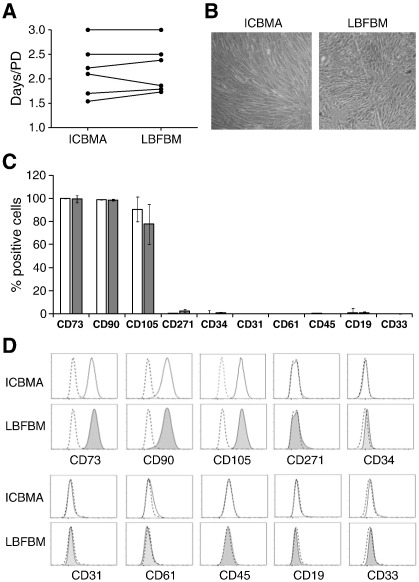
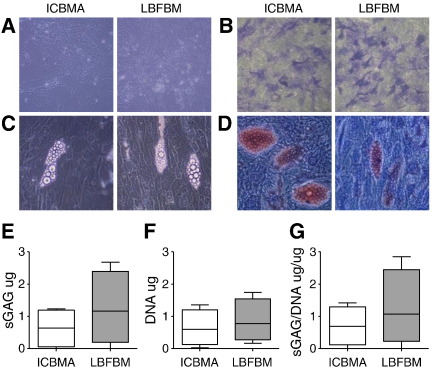
Aspiration of iliac crest bone marrow (ICBM) remains the most frequent technique used in harvesting multipotential stromal cells (MSCs) for bone regeneration. Although this tissue type is easily accessed by a surgeon, it has a low frequency of MSCs, which is significant given the high cell numbers required for bone regeneration strategies. Lipoaspirates possess higher MSC frequencies, albeit cells with a differentiation profile less suited to orthopaedic interventions. Intra-medullary cavities of long bones have previously been shown to harbour MSCs in animals, however evaluation of their frequency, differentiation capacity and phenotype in humans had not previously been performed. Long bone fatty bone marrow (LBFBM) was collected prior to harvesting bone graft. Basic cellular compositions of donor-matched LBFBM and ICBM aspirates, including the numbers of CD34(+) hematopoietic stem cells and CD31(+) endothelial cells, were similar. MSCs were enumerated using colony-forming-unit-fibroblast assays and flow cytometry for the presence of a resident LBFBM CD45(-/low) CD271(+) MSC population and revealed a trend for higher MSC numbers (average 5 fold, n=6) per millilitre of LBFBM compared to donor-matched ICBM. Functional characteristics of resident MSCs, including their growth rates, differentiation potentials and surface phenotypes (CD73(+)CD105(+)CD90(+)) before and after culture-amplification, were similar. Enhanced numbers of MSCs could be recovered following brief enzymatic treatment of solid fragments of LBFBM. Our findings therefore reveal that the intramedullary cavity of the human femur is a depot of MSCs, which, although closely associated with fat, have a differentiation profile equivalent to ICBM. This anatomical site is frequently accessed by the orthopaedic/trauma surgeon and aspiration of the intramedullary cavity represents a 'low-tech' method of harvesting potentially large numbers of MSCs for regenerative therapies and research.
髂嵴骨髓抽吸(ICBM)仍然是最常用于收获多能基质细胞(MSCs)用于骨再生的技术。尽管这种组织类型很容易被外科医生获取,但它的 MSCs 频率较低,考虑到骨再生策略所需的高细胞数量,这一点非常重要。脂肪抽吸物具有更高的 MSC 频率,尽管其分化谱不太适合骨科干预。先前已经在动物中证明长骨的骨髓腔内含有 MSC,但是以前尚未对其在人类中的频率、分化能力和表型进行评估。在采集骨移植物之前,从长骨采集脂肪骨髓(LBFBM)。供体匹配的 LBFBM 和 ICBM 抽吸物的基本细胞成分,包括 CD34(+)造血干细胞和 CD31(+)内皮细胞的数量,相似。使用集落形成单位-成纤维细胞测定法和流式细胞术对 MSC 进行计数,以检测驻留 LBFBM 的 CD45(-/低)CD271(+)MSC 群体的存在,并显示出每毫升 LBFBM 中 MSC 数量(平均 5 倍,n=6)的趋势高于供体匹配的 ICBM。驻留 MSC 的功能特性,包括其在培养扩增前后的生长速度、分化潜能和表面表型(CD73(+)CD105(+)CD90(+)),相似。对 LBFBM 固体碎片进行短暂酶处理后,可回收更多的 MSC。因此,我们的发现表明,人类股骨的骨髓腔是 MSC 的储存库,尽管与脂肪密切相关,但具有与 ICBM 相当的分化谱。该解剖部位经常被骨科/创伤外科医生触及,骨髓腔抽吸术代表了一种“低技术”方法,可用于收获大量潜在的 MSC 用于再生治疗和研究。