Université de Bourgogne, Campus Universitaire, BP 27877, F-21078 Dijon, France.
PLoS One. 2011;6(7):e20732. doi: 10.1371/journal.pone.0020732. Epub 2011 Jul 26.
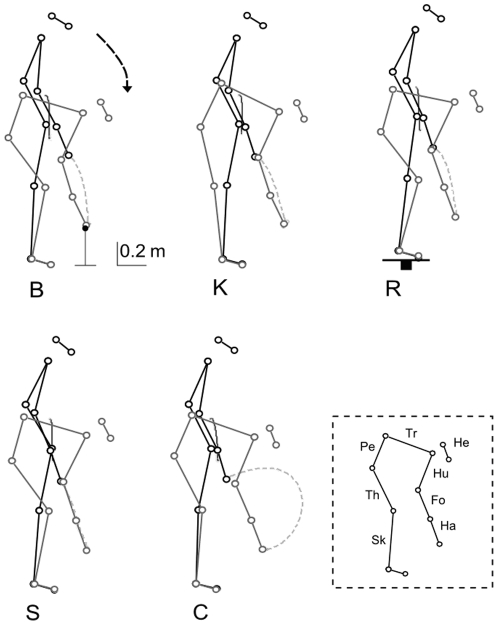
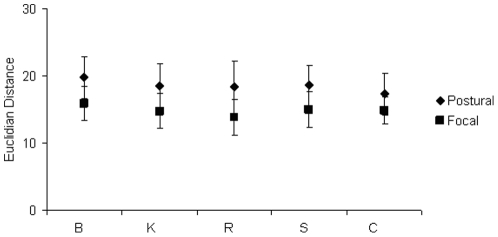
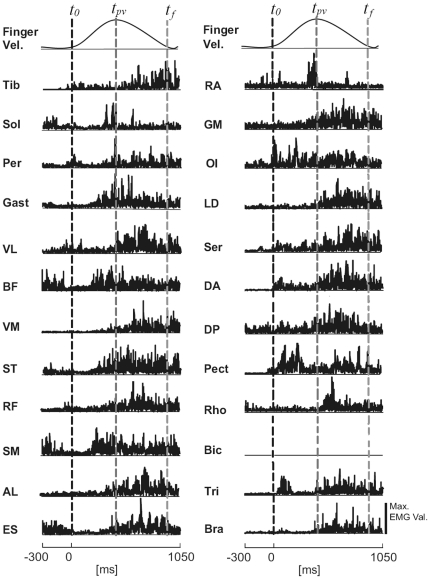
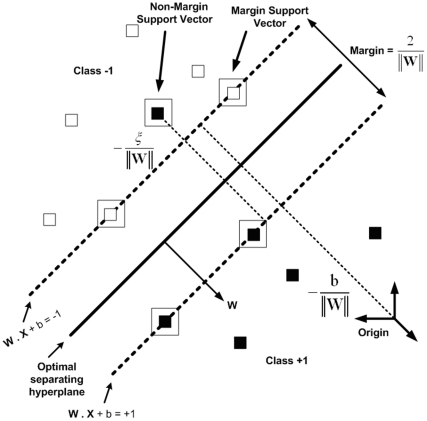
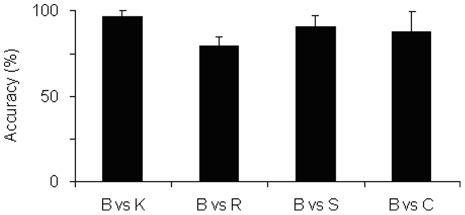
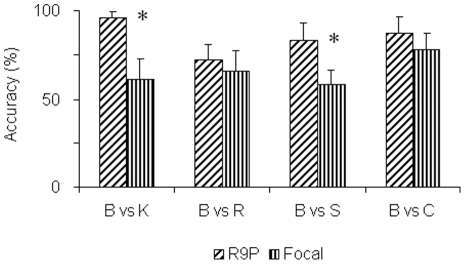
We explored the use of support vector machines (SVM) in order to analyze the ensemble activities of 24 postural and focal muscles recorded during a whole body pointing task. Because of the large number of variables involved in motor control studies, such multivariate methods have much to offer over the standard univariate techniques that are currently employed in the field to detect modifications. The SVM was used to uncover the principle differences underlying several variations of the task. Five variants of the task were used. An unconstrained reaching, two constrained at the focal level and two at the postural level. Using the electromyographic (EMG) data, the SVM proved capable of distinguishing all the unconstrained from the constrained conditions with a success of approximately 80% or above. In all cases, including those with focal constraints, the collective postural muscle EMGs were as good as or better than those from focal muscles for discriminating between conditions. This was unexpected especially in the case with focal constraints. In trying to rank the importance of particular features of the postural EMGs we found the maximum amplitude rather than the moment at which it occurred to be more discriminative. A classification using the muscles one at a time permitted us to identify some of the postural muscles that are significantly altered between conditions. In this case, the use of a multivariate method also permitted the use of the entire muscle EMG waveform rather than the difficult process of defining and extracting any particular variable. The best accuracy was obtained from muscles of the leg rather than from the trunk. By identifying the features that are important in discrimination, the use of the SVM permitted us to identify some of the features that are adapted when constraints are placed on a complex motor task.
我们探索了支持向量机(SVM)的使用,以便分析在整个身体指向任务中记录的 24 个姿势和焦点肌肉的整体活动。由于运动控制研究中涉及的变量数量众多,因此这种多变量方法在检测修改方面比当前在该领域使用的标准单变量技术有很大的优势。SVM 用于揭示任务的几个变体的基本差异。使用了五种任务变体。一种无约束的伸展,两种在焦点水平上受限,两种在姿势水平上受限。使用肌电图(EMG)数据,SVM 证明能够以大约 80%或更高的成功率区分所有无约束和约束条件。在所有情况下,包括具有焦点约束的情况,集体姿势肌肉 EMG 与焦点肌肉一样或更好地用于区分条件。这是出乎意料的,特别是在焦点约束的情况下。在尝试对姿势 EMG 的特定特征的重要性进行排序时,我们发现最大幅度而不是发生的时刻更具区分性。使用一次一个肌肉的分类允许我们识别出一些在条件之间发生显著变化的姿势肌肉。在这种情况下,使用多变量方法也允许使用整个肌肉 EMG 波形,而不是定义和提取任何特定变量的困难过程。最好的准确性来自腿部肌肉,而不是来自躯干。通过识别在区分中重要的特征,SVM 的使用使我们能够识别出在对复杂运动任务施加约束时适应的一些特征。