Department of Physics and Astronomy, Georgia State University, Atlanta, Georgia, United States of America.
PLoS One. 2011;6(7):e21782. doi: 10.1371/journal.pone.0021782. Epub 2011 Jul 21.
Multistability of oscillatory and silent regimes is a ubiquitous phenomenon exhibited by excitable systems such as neurons and cardiac cells. Multistability can play functional roles in short-term memory and maintaining posture. It seems to pose an evolutionary advantage for neurons which are part of multifunctional Central Pattern Generators to possess multistability. The mechanisms supporting multistability of bursting regimes are not well understood or classified.
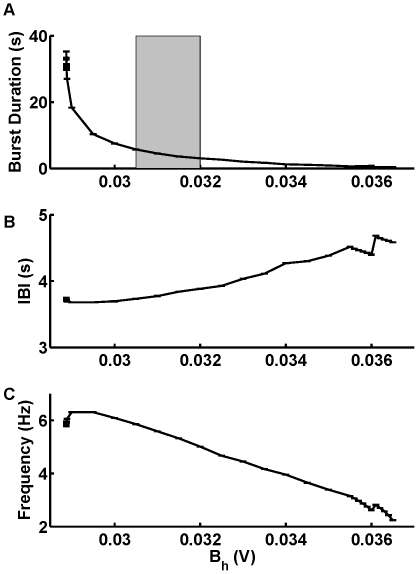
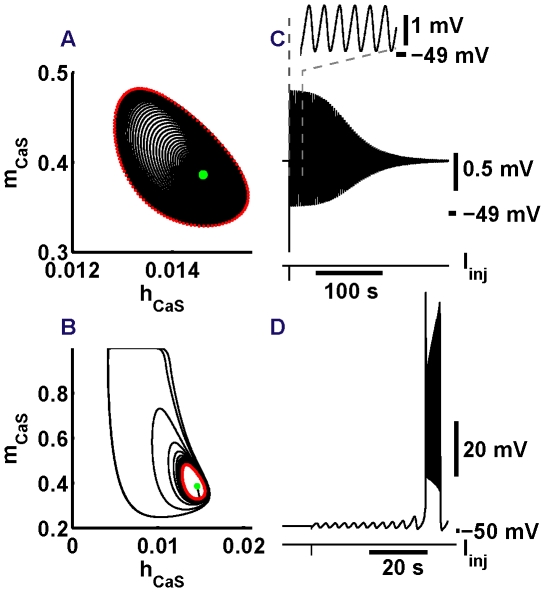
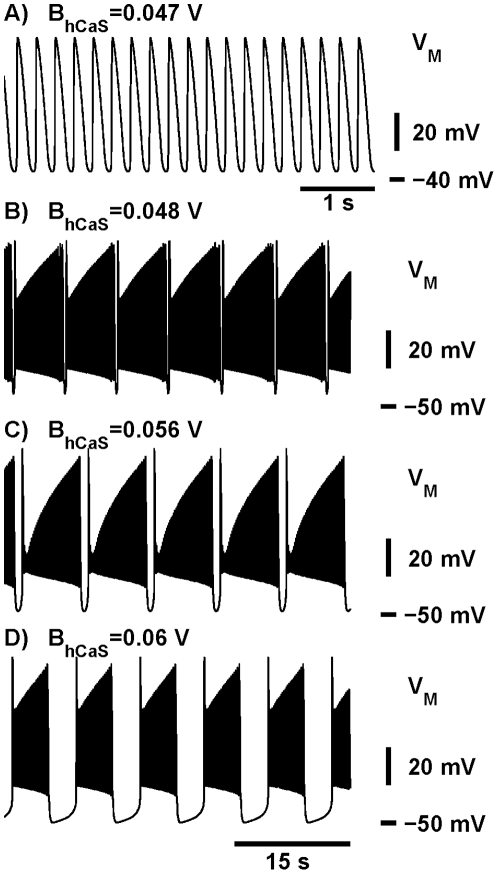
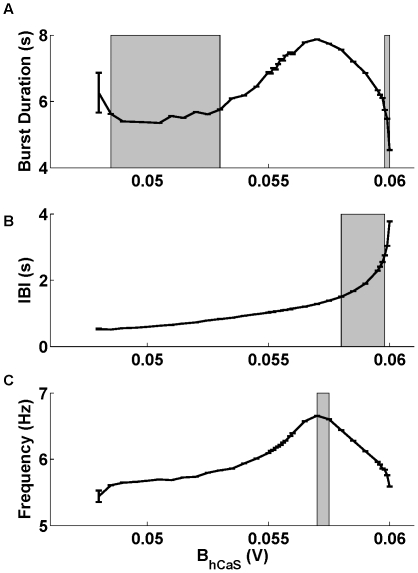
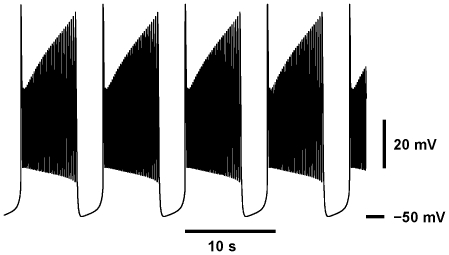
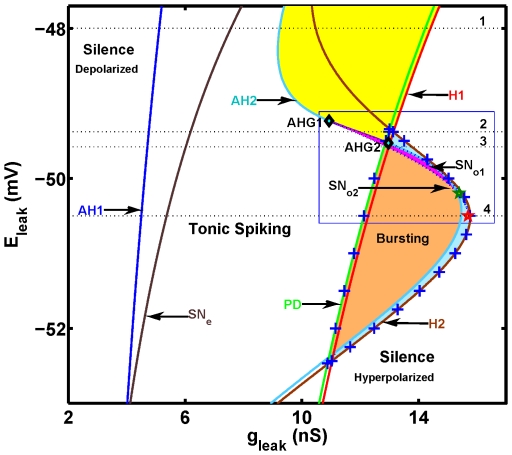
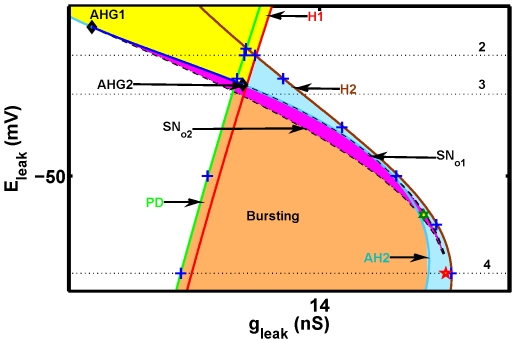
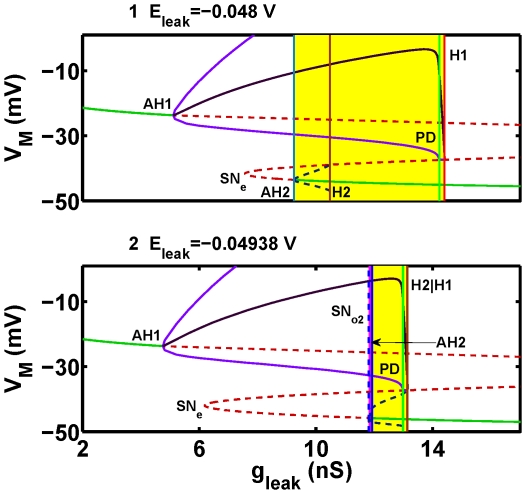
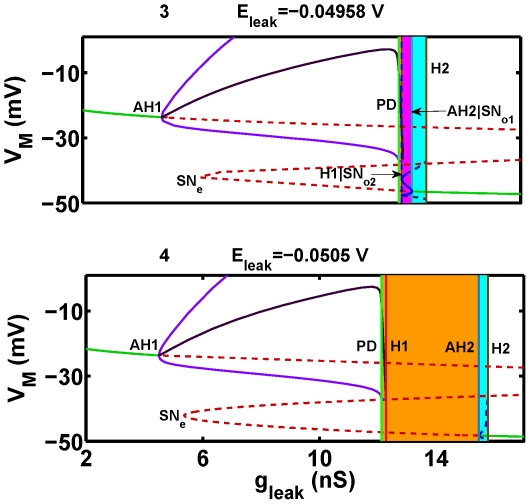
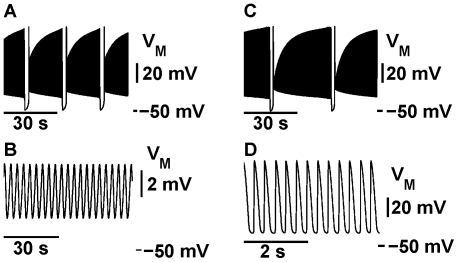
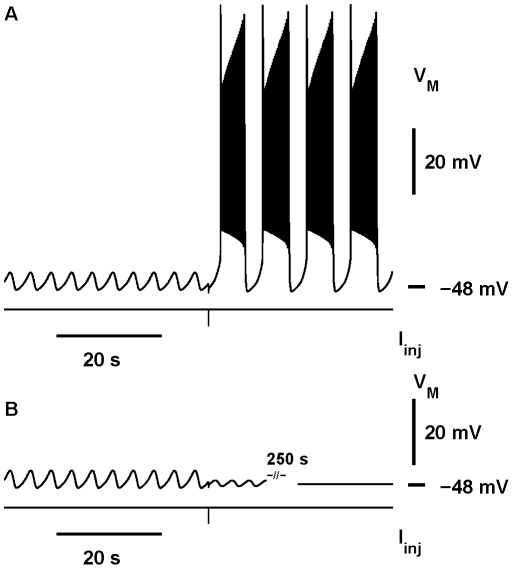
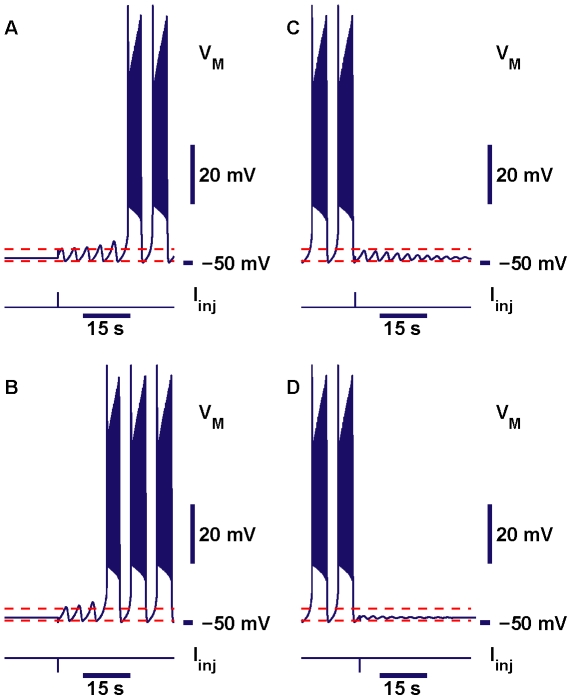
METHODOLOGY/PRINCIPAL FINDINGS: Our study is focused on determining the bio-physical mechanisms underlying different types of co-existence of the oscillatory and silent regimes observed in a neuronal model. We develop a low-dimensional model typifying the dynamics of a single leech heart interneuron. We carry out a bifurcation analysis of the model and show that it possesses six different types of multistability of dynamical regimes. These types are the co-existence of 1) bursting and silence, 2) tonic spiking and silence, 3) tonic spiking and subthreshold oscillations, 4) bursting and subthreshold oscillations, 5) bursting, subthreshold oscillations and silence, and 6) bursting and tonic spiking. These first five types of multistability occur due to the presence of a separating regime that is either a saddle periodic orbit or a saddle equilibrium. We found that the parameter range wherein multistability is observed is limited by the parameter values at which the separating regimes emerge and terminate.
We developed a neuronal model which exhibits a rich variety of different types of multistability. We described a novel mechanism supporting the bistability of bursting and silence. This neuronal model provides a unique opportunity to study the dynamics of networks with neurons possessing different types of multistability.
振荡和静止状态的多稳定性是兴奋系统(如神经元和心脏细胞)表现出的普遍现象。多稳定性可以在短期记忆和维持姿势中发挥功能作用。似乎对于作为多功能中枢模式发生器一部分的神经元来说,具有多稳定性具有进化优势。支持爆发状态多稳定性的机制尚未得到很好的理解或分类。
方法/主要发现:我们的研究重点是确定单个水蛭心脏中间神经元模型中观察到的振荡和静止状态共存的不同类型的生物物理机制。我们开发了一个典型的单个人类神经元动力学的低维模型。我们对模型进行了分岔分析,结果表明它具有六种不同类型的动力学状态的多稳定性。这些类型是:1)爆发和静止共存;2)紧张性爆发和静止共存;3)紧张性爆发和亚阈值振荡共存;4)爆发和亚阈值振荡共存;5)爆发、亚阈值振荡和静止共存;6)爆发和紧张性爆发共存。前五种多稳定性是由于存在分离状态而产生的,分离状态要么是鞍周期轨道,要么是鞍平衡。我们发现,多稳定性观察到的参数范围受到分离状态出现和终止的参数值的限制。
我们开发了一个表现出丰富多样的不同类型多稳定性的神经元模型。我们描述了一种支持爆发和静止双稳定性的新机制。这个神经元模型为研究具有不同类型多稳定性的神经元网络的动力学提供了一个独特的机会。