Institute for Health Metrics and Evaluation, University of Washington, 2301 Fifth Ave,, Suite 600, Seattle, WA 98121, USA.
Popul Health Metr. 2011 Aug 4;9:35. doi: 10.1186/1478-7954-9-35.
Verbal autopsy (VA) is used to estimate the causes of death in areas with incomplete vital registration systems. The King and Lu method (KL) for direct estimation of cause-specific mortality fractions (CSMFs) from VA studies is an analysis technique that estimates CSMFs in a population without predicting individual-level cause of death as an intermediate step. In previous studies, KL has shown promise as an alternative to physician-certified verbal autopsy (PCVA). However, it has previously been impossible to validate KL with a large dataset of VAs for which the underlying cause of death is known to meet rigorous clinical diagnostic criteria.
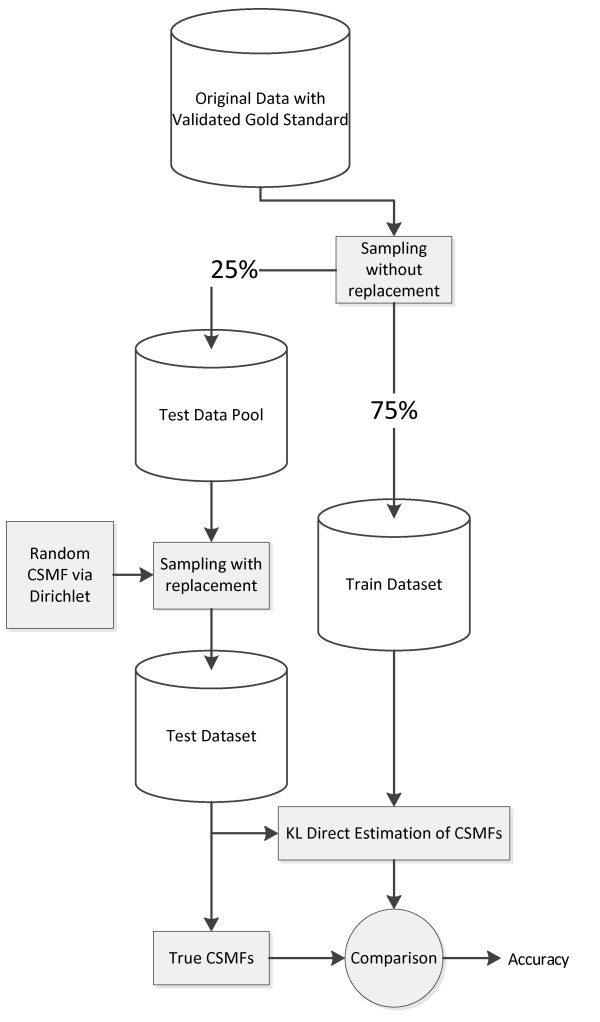
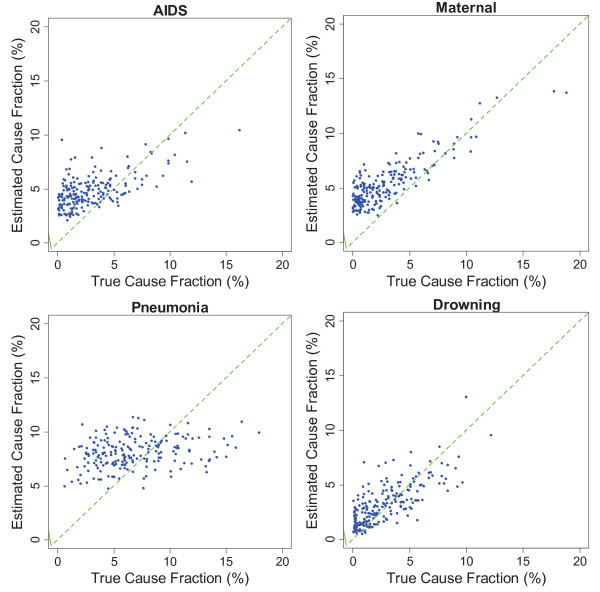
We applied the KL method to adult, child, and neonatal VA datasets from the Population Health Metrics Research Consortium gold standard verbal autopsy validation study, a multisite sample of 12,542 VAs where gold standard cause of death was established using strict clinical diagnostic criteria. To emulate real-world populations with varying CSMFs, we evaluated the KL estimations for 500 different test datasets of varying cause distribution. We assessed the quality of these estimates in terms of CSMF accuracy as well as linear regression and compared this with the results of PCVA.
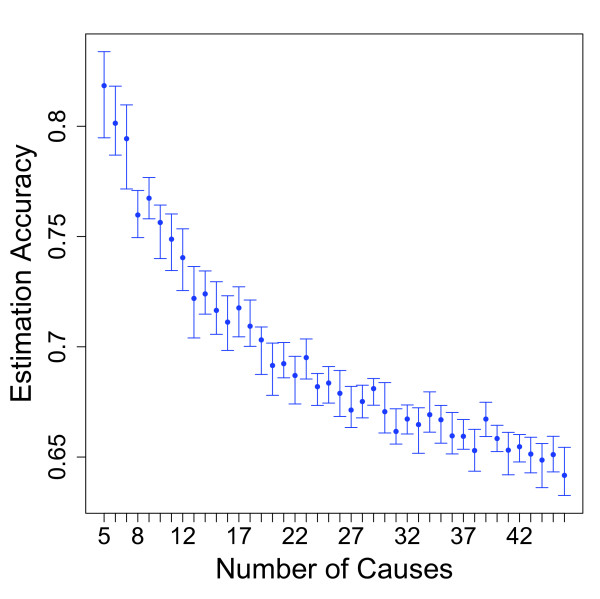
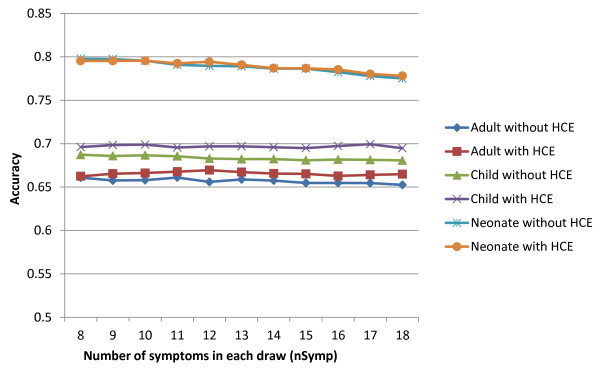
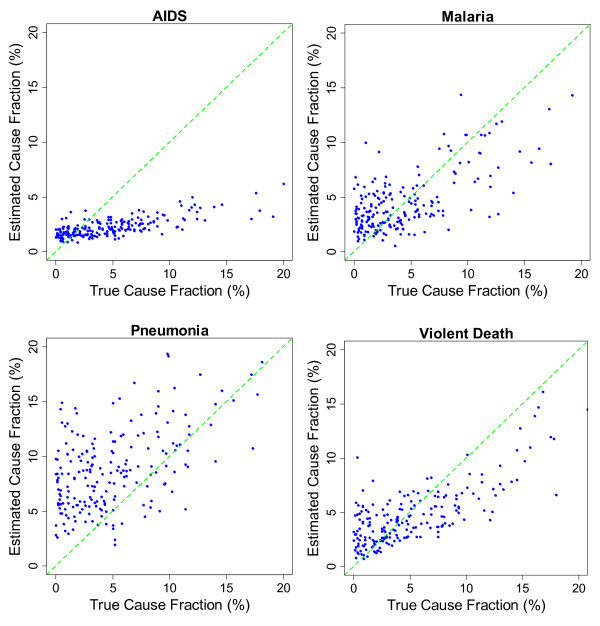
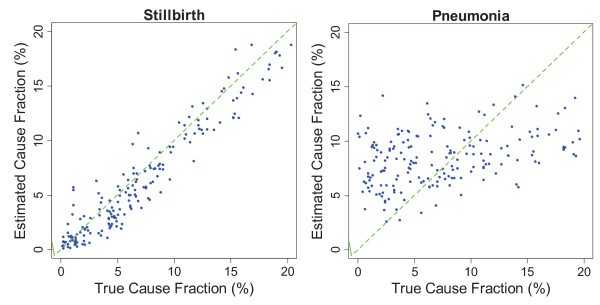
KL performance is similar to PCVA in terms of CSMF accuracy, attaining values of 0.669, 0.698, and 0.795 for adult, child, and neonatal age groups, respectively, when health care experience (HCE) items were included. We found that the length of the cause list has a dramatic effect on KL estimation quality, with CSMF accuracy decreasing substantially as the length of the cause list increases. We found that KL is not reliant on HCE the way PCVA is, and without HCE, KL outperforms PCVA for all age groups.
Like all computer methods for VA analysis, KL is faster and cheaper than PCVA. Since it is a direct estimation technique, though, it does not produce individual-level predictions. KL estimates are of similar quality to PCVA and slightly better in most cases. Compared to other recently developed methods, however, KL would only be the preferred technique when the cause list is short and individual-level predictions are not needed.
死因推断(VA)用于在生命登记系统不完善的地区估计死因。 用于从 VA 研究中直接估计特定原因死亡率分数(CSMF)的 King 和 Lu 方法(KL)是一种分析技术,它在不预测个体死亡原因作为中间步骤的情况下估计人群中的 CSMF。 在以前的研究中,KL 作为经过认证的医生死因推断(PCVA)的替代方法显示出了希望。 但是,以前不可能使用大量 VA 数据集来验证 KL,这些数据集的基础死因是已知的,符合严格的临床诊断标准。
我们将 KL 方法应用于人口健康指标研究联盟金标准死因推断验证研究的成人、儿童和新生儿 VA 数据集,这是一个多地点样本,共 12542 例 VA,其中使用严格的临床诊断标准确定了金标准死因。 为了模拟具有不同 CSMF 的真实人群,我们评估了 500 个不同的测试数据集的 KL 估计值,这些数据集的死因分布不同。 我们根据 CSMF 准确性以及线性回归来评估这些估计的质量,并将其与 PCVA 的结果进行比较。
KL 在 CSMF 准确性方面的表现与 PCVA 相似,当包含医疗保健经验(HCE)项时,分别达到 0.669、0.698 和 0.795 的值。 我们发现,死因清单的长度对 KL 估计质量有很大影响,随着死因清单长度的增加,CSMF 准确性会大幅下降。 我们发现,KL 不像 PCVA 那样依赖 HCE,没有 HCE,KL 在所有年龄组中的表现都优于 PCVA。
与所有用于 VA 分析的计算机方法一样,KL 比 PCVA 更快、更便宜。 但是,由于它是一种直接估计技术,因此它不会产生个体水平的预测。 KL 估计的质量与 PCVA 相似,在大多数情况下略好一些。 然而,与其他最近开发的方法相比,只有在死因清单较短且不需要个体水平预测时,KL 才是首选技术。