
一种改进的医师认证死因推断方法可降低差异率:布基纳法索努纳卫生和人口监测点(NHDSS)的经验。
An improved method for physician-certified verbal autopsy reduces the rate of discrepancy: experiences in the Nouna Health and Demographic Surveillance Site (NHDSS), Burkina Faso.
机构信息
Centre de Recherche en Santé de Nouna, Burkina Faso, PO BOX 02 Nouna, Burkina Faso.
出版信息
Popul Health Metr. 2011 Aug 4;9:34. doi: 10.1186/1478-7954-9-34.
BACKGROUND
Through application of the verbal autopsy (VA) approach, trained fieldworkers collect information about the probable cause of death (COD) by using a standardized questionnaire to interview family members who were present at the time of death. The physician-certified VA (PCVA), an independent review of this questionnaire data by up to three physicians trained in VA coding, is currently recommended by the World Health Organization (WHO) and is widely used in the INDEPTH Network. Even given its appropriateness in these contexts, a large percentage of causes of death assigned by VAs remains undetermined. As physicians often do not agree upon a final COD classification, there remains substantial room to improve the standard VA method, potentially leading to a reduction in physician discordance in COD coding.
METHODS
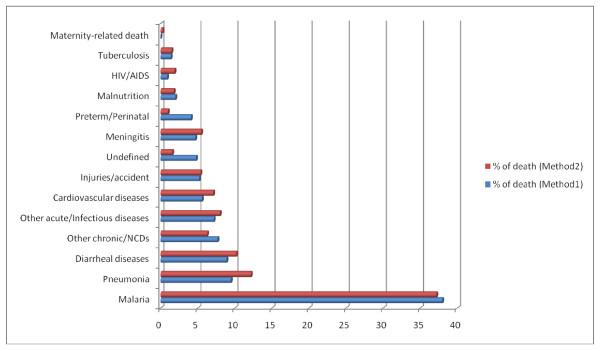
We present an extension of the current method of PCVA and compare it to the standard WHO-recommended procedure. We used VA data collected in the Nouna Health and Demographic Surveillance Site (NHDSS) between 2009 and 2010 using a locally-adapted version of an INDEPTH standard verbal autopsy questionnaire. Until 2009, physicians in the NHDSS followed the WHO method (Method 1). As an extension of Method 1, starting in 2010, the use of a panel of physicians was added to the coding process in the case where a third physician's final conclusions resulted in an undetermined COD (Method 2). Two independent samples of VA questionnaires were compared for the year 2009 (using Method 1) and the year 2010 (using Method 2).
RESULTS
The WHO-recommended method used for 2009 yielded a high level of undetermined CODs, where the final coding was "undetermined" in 50.8% of all questionnaires due to disagreement among participating physicians (Method 1). By introducing a panel of physicians in 2010 for cases where the principal physicians disagreed on the cause of death, the revised method significantly reduced the proportion of undetermined CODs to 1.5% (Method 2).
CONCLUSIONS
As the extended method of PCVA significantly improved the accuracy of the VA procedure, we suggest the adoption of this method for those countries where alternatives like computer-based VA coding are not available. Based on the results of our study, further research should be pursued.
背景
通过使用口述尸检(VA)方法,经过培训的现场工作者使用标准化问卷向在死亡时在场的家属收集可能的死因(COD)信息。由世界卫生组织(WHO)推荐的医师认证口述尸检(PCVA)是对该问卷数据进行的独立审查,目前已被广泛应用于 INDEPTH 网络。即使在这些情况下是合适的,VA 确定的死因仍有很大一部分未确定。由于医师通常对最终 COD 分类无法达成一致,因此仍有很大的空间来改进标准 VA 方法,这可能会减少医师在 COD 编码方面的分歧。
方法
我们提出了对目前 PCVA 方法的扩展,并将其与标准的 WHO 推荐程序进行了比较。我们使用了 2009 年至 2010 年在努纳健康和人口监测站点(NHDSS)收集的口述尸检数据,这些数据使用了 INDEPTH 标准口述尸检问卷的本地改编版。在 2009 年之前,NHDSS 的医师遵循世卫组织的方法(方法 1)。作为方法 1 的扩展,从 2010 年开始,在第三位医师的最终结论导致 COD 不确定的情况下,将增加一组医师参与编码过程(方法 2)。对 2009 年(使用方法 1)和 2010 年(使用方法 2)的两份独立口述尸检问卷样本进行了比较。
结果
2009 年使用的 WHO 推荐方法导致 COD 不确定的比例很高,由于参与医师之间存在分歧,导致所有问卷中有 50.8%的最终编码为“不确定”(方法 1)。通过在 2010 年为主要医师在死因上存在分歧的病例引入一组医师,修订后的方法将不确定 COD 的比例显著降低至 1.5%(方法 2)。
结论
由于 PCVA 的扩展方法显著提高了 VA 程序的准确性,我们建议在没有替代方法(如基于计算机的 VA 编码)的国家采用这种方法。基于我们的研究结果,应进一步开展研究。


 Zotero 插件