Kruschinski Carsten, Wiese Birgitt, Eberhard Jörg, Hummers-Pradier Eva
Medizinische Hochschule Hannover, Institut für Allgemeinmedizin, Hannover, Deutschland.
GMS Z Med Ausbild. 2011;28(1):Doc16. doi: 10.3205/zma000728. Epub 2011 Feb 4.
Planning a career in general practice depends on positive attitudes towards primary care. The aim of this study was to compare attitudes of medical students of a Modern Curriculum at Hannover Medical School with those of the Traditional Curriculum before (pre) and after (post) a three-week clerkship in general practice. In parallel, we aimed to analyse several other variables such as age and gender, which could influence the attitudes.
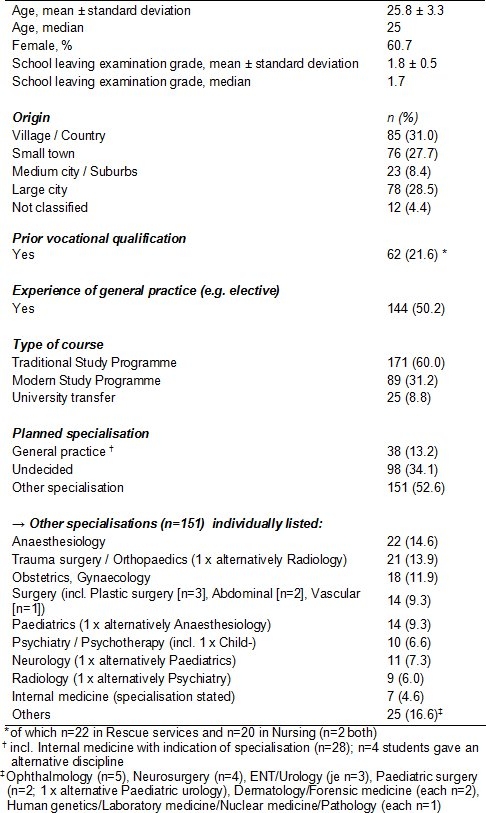
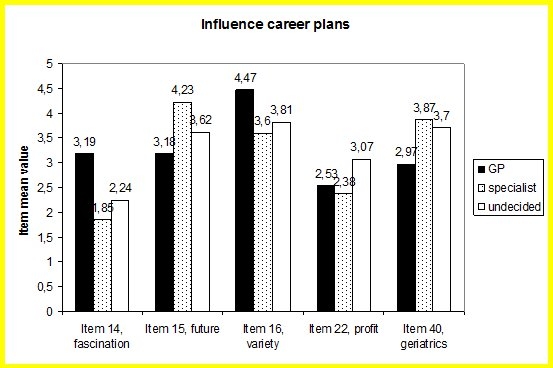
Prospective survey of n=287 5th-year students. Attitudes (dependent variable, Likert-scale items) as well as socio-demographic characteristics (age, gender, rural/urban background), school leaving examination grades, former qualifications, experiences in general practice and career plans were requested. Attitudes were analysed separately according to these characteristics (e.g. career plans: general practitioner (GP)/specialist), curriculum type and pre/post the clerkship in general practice. Bi- and multivariate statistical analysis was used including a factor analysis for grouping of the attitude items.
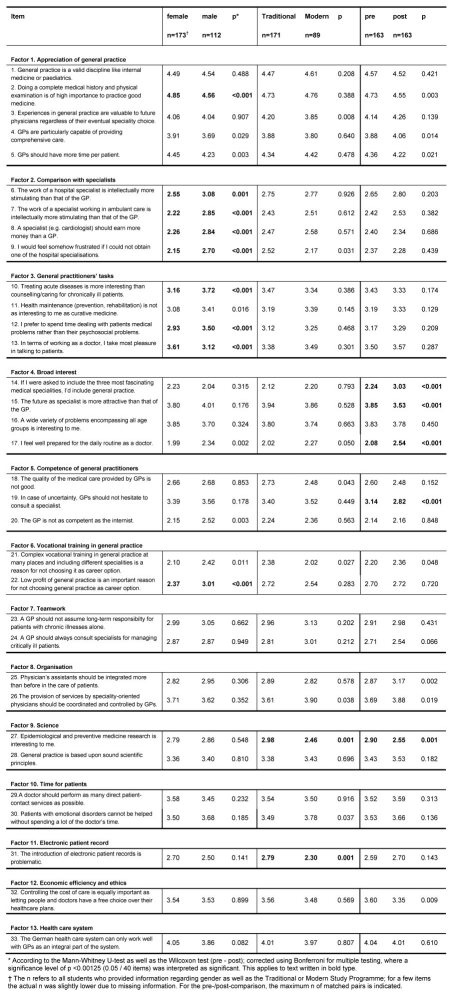
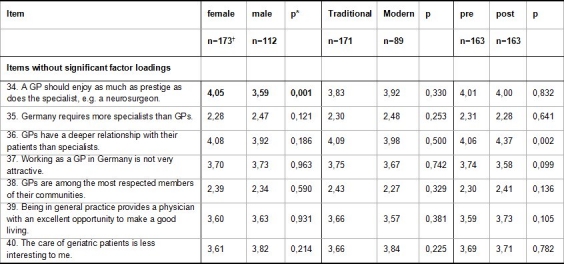
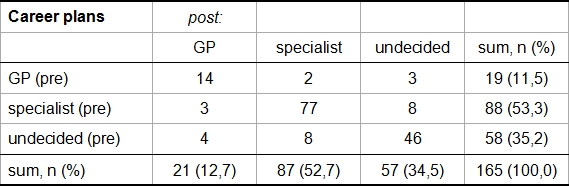
Most and remarkable differences of attitudes were seen after analysis according to gender. Women appreciated general practice more than men including a greater interest in chronic diseases, communication and psychosocial aspects. The clerkship (a total of n=165 students of the "post" survey could be matched) contributed to positive attitudes of students of both gender, whereas the different curricula did not show such effects.
Affective learning goals such as a positive attitude towards general practice have depended more on characteristics of students (gender) and effects of a clerkship in general practice than on the curriculum type (modern, traditional) so far. For the development of outcomes in medical education research as well as for the evolution of the Modern Curriculum such attitudes and other affective learning goals should be considered more frequently.
规划全科医疗职业生涯取决于对初级医疗的积极态度。本研究的目的是比较汉诺威医学院现代课程的医学生与传统课程的医学生在进行为期三周的全科医疗实习前(实习前)和实习后(实习后)的态度。同时,我们旨在分析年龄和性别等其他可能影响态度的变量。
对287名五年级学生进行前瞻性调查。调查内容包括态度(因变量,采用李克特量表项目)以及社会人口学特征(年龄、性别、城乡背景)、离校考试成绩、以前的学历、全科医疗经历和职业规划。根据这些特征(如职业规划:全科医生/专科医生)、课程类型以及全科医疗实习的实习前和实习后情况分别分析态度。采用双变量和多变量统计分析,包括对态度项目进行分组的因子分析。
根据性别进行分析后,发现态度存在最显著的差异。女性比男性更欣赏全科医疗,包括对慢性病、沟通和社会心理方面更感兴趣。实习(“实习后”调查中共有165名学生可进行匹配)对男女学生的积极态度都有促进作用,而不同课程并未显示出这样的效果。
到目前为止,诸如对全科医疗的积极态度等情感学习目标更多地取决于学生的特征(性别)和全科医疗实习的效果,而不是课程类型(现代、传统)。在医学教育研究成果的发展以及现代课程的演变中,应更频繁地考虑此类态度和其他情感学习目标。