Nanobiotechnology Research Center, Avicenna Research Institute, ACECR, Tehran, Iran.
J Nanobiotechnology. 2011 Aug 8;9:31. doi: 10.1186/1477-3155-9-31.
Several materials are available in the market that work on the principle of protein magnetic fishing by their histidine (His) tags. Little information is available on their performance and it is often quoted that greatly improved purification of histidine-tagged proteins from crude extracts could be achieved. While some commercial magnetic matrices could be used successfully for purification of several His-tagged proteins, there are some which have been proved to operate just for a few extent of His-tagged proteins. Here, we address quantitative evaluation of three commercially available Nickel nanomagnetic beads for purification of two His-tagged proteins expressed in Escherichia coli and present helpful hints for optimized purification of such proteins and preparation of nanomagnetisable matrices.
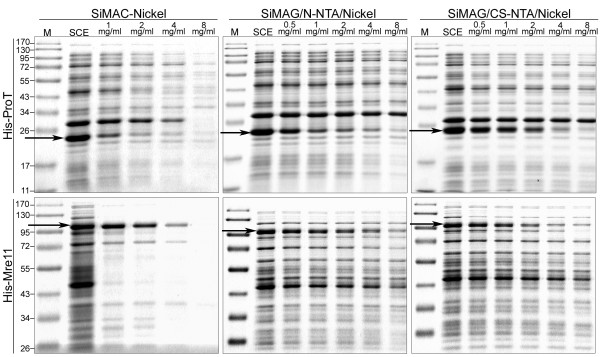
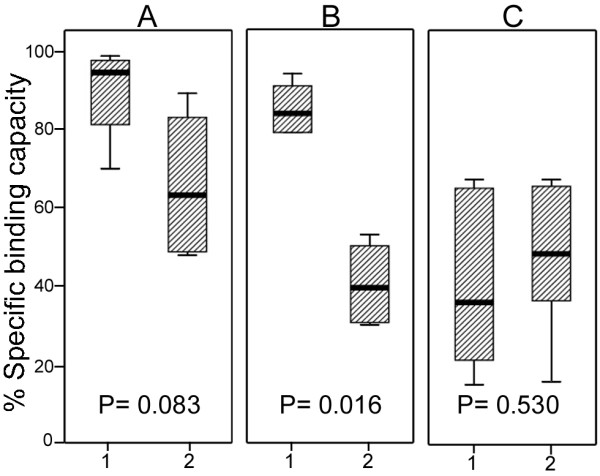
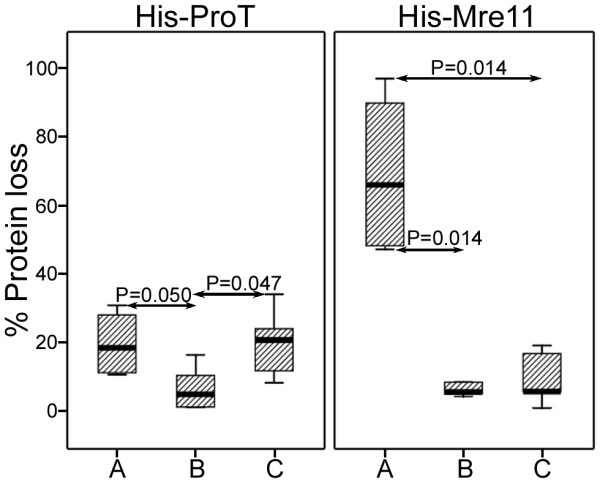
Marked differences in the performance of nanomagnetic matrices, principally on the basis of their specific binding capacity, recovery profile, the amount of imidazole needed for protein elution and the extent of target protein loss and purity were obtained. Based on the aforesaid criteria, one of these materials featured the best purification results (SiMAG/N-NTA/Nickel) for both proteins at the concentration of 4 mg/ml, while the other two (SiMAC-Nickel and SiMAG/CS-NTA/Nickel) did not work well with respect to specific binding capacity and recovery profile.
Taken together, functionality of different types of nanomagnetic matrices vary considerably. This variability may not only be dependent upon the structure and surface chemistry of the matrix which in turn determine the affinity of interaction, but, is also influenced to a lesser extent by the physical properties of the protein itself. Although the results of the present study may not be fully applied for all nanomagnetic matrices, but provide a framework which could be used to profiling and quantitative evaluation of other magnetisable matrices and also provide helpful hints for those researchers facing same challenge.
市场上有几种材料可通过其组氨酸(His)标签的原理进行蛋白质磁捕集。有关其性能的信息很少,通常引用的是可以从粗提物中极大地提高组氨酸标记蛋白的纯化效果。虽然一些商业磁性基质可以成功地用于纯化几种 His 标记蛋白,但也有一些被证明只能在一定程度上用于 His 标记蛋白的纯化。在这里,我们对三种市售的镍纳米磁珠进行了定量评估,用于纯化在大肠杆菌中表达的两种 His 标记蛋白,并为这些蛋白的优化纯化和纳米磁珠的制备提供了有用的提示。
在性能方面,纳米磁性基质存在明显差异,主要基于其特定的结合能力、回收情况、洗脱蛋白所需的咪唑量以及目标蛋白的损失和纯度。根据上述标准,其中一种材料(SiMAG/N-NTA/Nickel)在两种蛋白浓度为 4mg/ml 时具有最佳的纯化效果,而另外两种(SiMAC-Nickel 和 SiMAG/CS-NTA/Nickel)在特定结合能力和回收情况方面表现不佳。
总之,不同类型的纳米磁性基质的功能差异很大。这种可变性不仅可能取决于基质的结构和表面化学性质,这反过来又决定了相互作用的亲和力,而且还在较小程度上受到蛋白本身物理性质的影响。虽然本研究的结果可能不完全适用于所有纳米磁性基质,但为可磁化基质的分析和定量评估提供了一个框架,并为面临同样挑战的研究人员提供了有用的提示。