Choi Ehn-Kyoung, Park Dongsun, Kim Tae Kyun, Lee Sun Hee, Bae Dae-Kwon, Yang Goeun, Yang Yun-Hui, Kyung Jangbeen, Kim Dajeong, Lee Woo Ryoung, Suh Jun-Gyo, Jeong Eun-Suk, Kim Seung U, Kim Yun-Bae
College of Veterinary Medicine and Research Institute of Veterinary Medicine, Chungbuk National University, Cheongju, Republic of Korea.
Lab Anim Res. 2011 Jun;27(2):77-84. doi: 10.5625/lar.2011.27.2.77. Epub 2011 Jun 22.
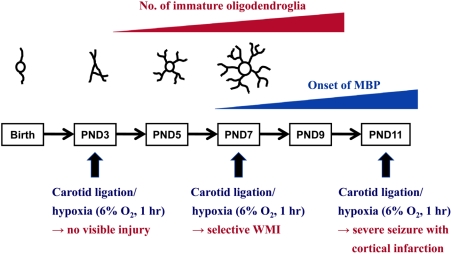
Periventricular leukomalacia, specifically characterized as white matter injury, in neonates is strongly associated with the damage of pre-myelinating oligodendrocytes. Clinical data suggest that hypoxia-ischemia during delivery and intrauterine or neonatal infection-inflammation are important factors in the etiology of periventricular leukomalacia including cerebral palsy, a serious case exhibiting neurobehavioral deficits of periventricular leukomalacia. In order to explore the pathophysiological mechanisms of white matter injury and to better understand how infectious agents may affect the vulnerability of the immature brain to injury, novel animal models have been developed using hypoperfusion, microbes or bacterial products (lipopolysaccharide) and excitotoxins. Such efforts have developed rat models that produce predominantly white matter lesions by adopting combined hypoxia-ischemia technique on postnatal days 1-7, in which unilateral or bilateral carotid arteries of animals are occluded (ischemia) followed by 1-2 hour exposure to 6-8% oxygen environment (hypoxia). Furthermore, low doses of lipopolysaccharide that by themselves have no adverse-effects in 7-day-old rats, dramatically increase brain injury to hypoxic-ischemic challenge, implying that inflammation sensitizes the immature central nervous system. Therefore, among numerous models of periventricular leukomalacia, combination of hypoxia-ischemia-lipopolysaccharide might be one of the most-acceptable rodent models to induce extensive white matter injury and ensuing neurobehavioral deficits for the evaluation of candidate therapeutics.
脑室周围白质软化症,具体表现为新生儿白质损伤,与少突胶质前体细胞的损伤密切相关。临床数据表明,分娩时的缺氧缺血以及宫内或新生儿期的感染炎症是包括脑瘫在内的脑室周围白质软化症病因中的重要因素,脑瘫是脑室周围白质软化症表现出神经行为缺陷的严重病例。为了探究白质损伤的病理生理机制,并更好地理解感染因子如何影响未成熟脑对损伤的易感性,人们利用低灌注、微生物或细菌产物(脂多糖)以及兴奋性毒素开发了新的动物模型。这些研究通过在出生后第1至7天采用联合缺氧缺血技术,建立了主要产生白质损伤的大鼠模型,即阻断动物的单侧或双侧颈动脉(缺血),随后将其置于6 - 8%氧气环境中暴露1 - 2小时(缺氧)。此外,低剂量的脂多糖本身对7日龄大鼠并无不良影响,但却会显著增加缺氧缺血刺激所致的脑损伤,这表明炎症会使未成熟的中枢神经系统更加敏感。因此,在众多脑室周围白质软化症模型中,缺氧缺血 - 脂多糖联合模型可能是诱导广泛白质损伤及随后的神经行为缺陷以评估候选治疗方法的最理想啮齿动物模型之一。