Department of Wildlife Ecology and Conservation and Center for Latin American Studies, University of Florida, Gainesville, Florida, United States of America.
PLoS One. 2011;6(8):e22937. doi: 10.1371/journal.pone.0022937. Epub 2011 Aug 3.
The dispersal ability of queens is central to understanding ant life-history evolution, and plays a fundamental role in ant population and community dynamics, the maintenance of genetic diversity, and the spread of invasive ants. In tropical ecosystems, species from over 40 genera of ants establish colonies in the stems, hollow thorns, or leaf pouches of specialized plants. However, little is known about the relative dispersal ability of queens competing for access to the same host plants.
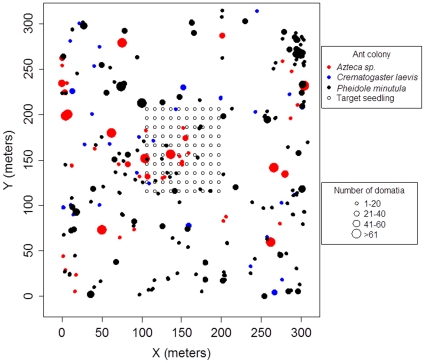
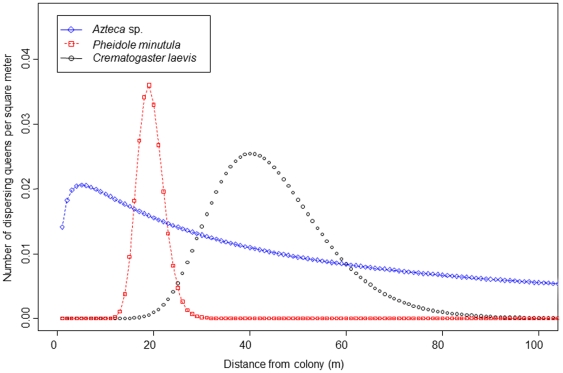
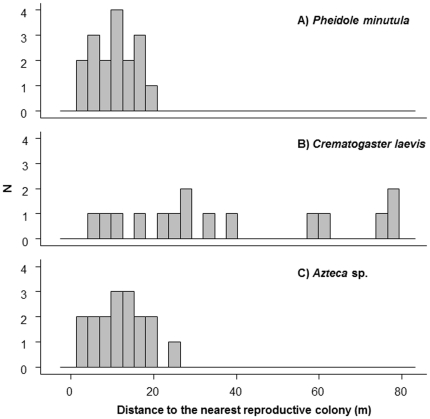
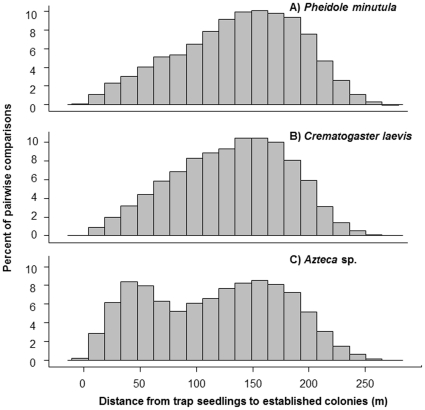
METHODOLOGY/PRINCIPAL FINDINGS: We used empirical data and inverse modeling--a technique developed by plant ecologists to model seed dispersal--to quantify and compare the dispersal kernels of queens from three Amazonian ant species that compete for access to host-plants. We found that the modal colonization distance of queens varied 8-fold, with the generalist ant species (Crematogaster laevis) having a greater modal distance than two specialists (Pheidole minutula, Azteca sp.) that use the same host-plants. However, our results also suggest that queens of Azteca sp. have maximal distances that are four-sixteen times greater than those of its competitors.
CONCLUSIONS/SIGNIFICANCE: We found large differences between ant species in both the modal and maximal distance ant queens disperse to find vacant seedlings used to found new colonies. These differences could result from interspecific differences in queen body size, and hence wing musculature, or because queens differ in their ability to identify potential host plants while in flight. Our results provide support for one of the necessary conditions underlying several of the hypothesized mechanisms promoting coexistence in tropical plant-ants. They also suggest that for some ant species limited dispersal capability could pose a significant barrier to the rescue of populations in isolated forest fragments. Finally, we demonstrate that inverse models parameterized with field data are an excellent means of quantifying the dispersal of ant queens.
蚁后扩散能力是理解蚂蚁生活史进化的核心,对蚂蚁种群和群落动态、遗传多样性的维持以及入侵蚂蚁的传播起着基础性作用。在热带生态系统中,超过 40 个属的蚂蚁物种在专门植物的茎干、空心刺或叶袋中建立殖民地。然而,对于争夺进入同一宿主植物机会的蚁后相对扩散能力,我们知之甚少。
方法/主要发现:我们使用了经验数据和反演模型——一种由植物生态学家开发的用于模拟种子扩散的技术,来量化和比较三种竞争进入宿主植物的亚马逊蚁后扩散的扩散核。我们发现蚁后的模式定植距离变化了 8 倍,一般主义者蚁种(Crematogaster laevis)的模式距离大于两种使用相同宿主植物的专家(Pheidole minutula、Azteca sp.)。然而,我们的结果也表明,Azteca sp.的蚁后最大距离是其竞争对手的四到十六倍。
结论/意义:我们发现,在蚁后寻找新殖民地使用的空闲幼苗的模式和最大扩散距离上,不同蚂蚁物种之间存在很大差异。这些差异可能来自于蚁后体型的种间差异,从而影响翅膀肌肉,或者因为蚁后在飞行中识别潜在宿主植物的能力不同。我们的结果为几个假设的促进热带植物蚂蚁共存的机制所必需的条件之一提供了支持。它们还表明,对于某些蚂蚁物种,有限的扩散能力可能会对孤立森林片段中种群的拯救构成重大障碍。最后,我们证明了用实地数据参数化的反演模型是量化蚁后扩散的极好方法。