Department of Wildlife Ecology & Conservation, University of Florida, Gainesville, Florida, United States of America.
PLoS One. 2012;7(8):e40803. doi: 10.1371/journal.pone.0040803. Epub 2012 Aug 9.
The organization of networks of interacting species, such as plants and animals engaged in mutualisms, strongly influences the ecology and evolution of partner communities. Habitat fragmentation is a globally pervasive form of spatial heterogeneity that could profoundly impact the structure of mutualist networks. This is particularly true for biodiversity-rich tropical ecosystems, where the majority of plant species depend on mutualisms with animals and it is thought that changes in the structure of mutualist networks could lead to cascades of extinctions.
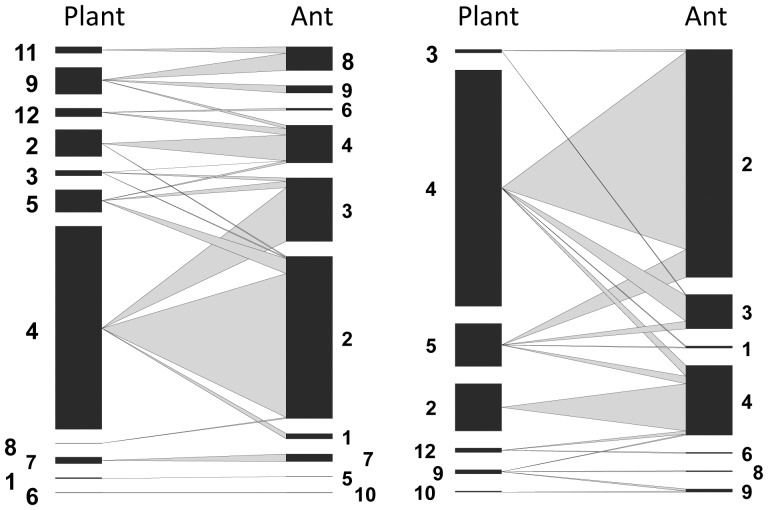
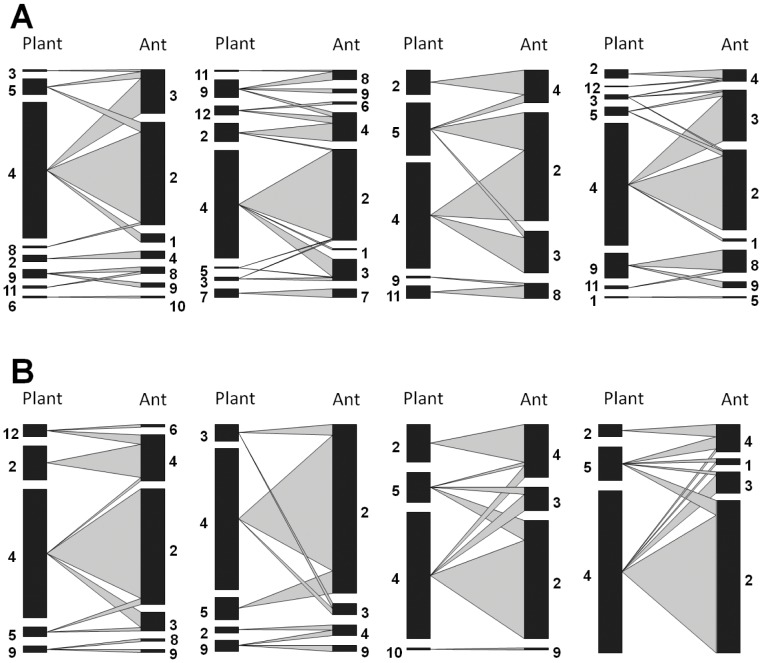
METHODOLOGY/PRINCIPAL FINDINGS: We evaluated effects of fragmentation on mutualistic networks by calculating metrics of network structure for ant-plant networks in continuous Amazonian forests with those in forest fragments. We hypothesized that networks in fragments would have fewer species and higher connectance, but equal nestedness and resilience compared to forest networks. Only one of the nine metrics we compared differed between continuous forest and forest fragments, indicating that networks were resistant to the biotic and abiotic changes that accompany fragmentation. This is partially the result of the loss of only specialist species with one connection that were lost in forest fragments.
CONCLUSIONS/SIGNIFICANCE: We found that the networks of ant-plant mutualists in twenty-five year old fragments are similar to those in continuous forest, suggesting these interactions are resistant to the detrimental changes associated with habitat fragmentation, at least in landscapes that are a mosaic of fragments, regenerating forests, and pastures. However, ant-plant mutualistic networks may have several properties that may promote their persistence in fragmented landscapes. Proactive identification of key mutualist partners may be necessary to focus conservation efforts on the interactions that insure the integrity of network structure and the ecosystems services networks provide.
相互作用的物种网络的组织,如参与互利共生的动植物,强烈影响着伙伴群落的生态学和进化。生境破碎化是一种普遍存在的空间异质性形式,可能会深刻影响互利共生网络的结构。对于生物多样性丰富的热带生态系统来说尤其如此,大多数植物物种都依赖于与动物的互利共生,而且人们认为互利共生网络结构的变化可能会导致一系列物种灭绝。
方法/主要发现:我们通过计算连续亚马逊雨林中的蚂蚁-植物网络和森林片段中的蚂蚁-植物网络的网络结构指标,评估了破碎化对互利共生网络的影响。我们假设片段中的网络物种较少,连接度较高,但嵌套度和弹性与森林网络相等。我们比较的九个指标中只有一个在连续森林和森林片段之间存在差异,这表明网络能够抵抗伴随破碎化而来的生物和非生物变化。这部分是由于具有一个连接的只有一个连接的专门物种的丧失,这些物种在森林片段中消失了。
结论/意义:我们发现,在 25 年的森林片段中,蚂蚁-植物互利共生网络与连续森林中的网络相似,这表明这些相互作用能够抵抗与生境破碎化相关的不利变化,至少在由片段、再生森林和牧场组成的镶嵌景观中是如此。然而,蚂蚁-植物互利共生网络可能具有几种特性,这些特性可能会促进它们在破碎化景观中的生存。主动识别关键的互利伙伴可能是必要的,以便将保护工作集中在确保网络结构完整性和网络提供的生态系统服务的相互作用上。