Department of Invertebrates, Natural History Museum, Bernastrasse 15, Bern, Switzerland.
Syst Biol. 2011 Dec;60(6):813-25. doi: 10.1093/sysbio/syr061. Epub 2011 Aug 9.
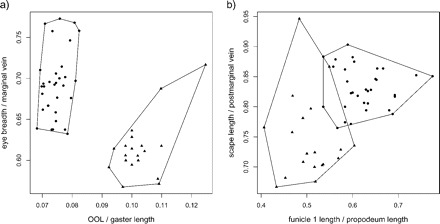
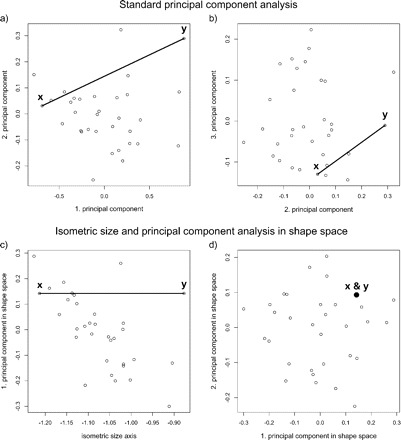
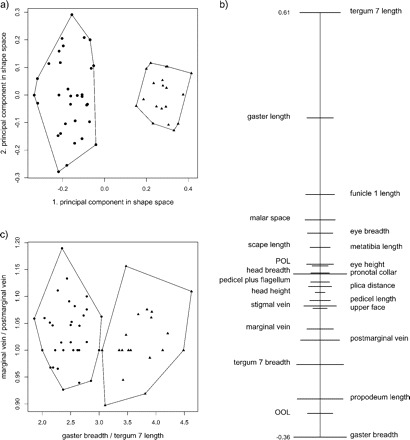
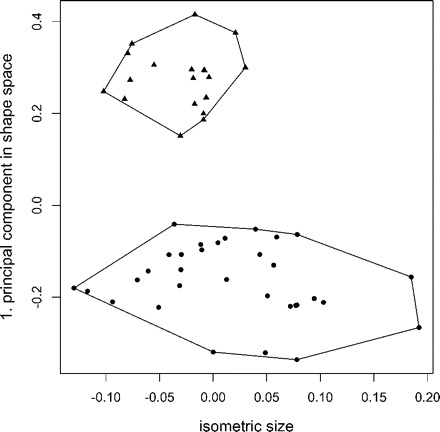
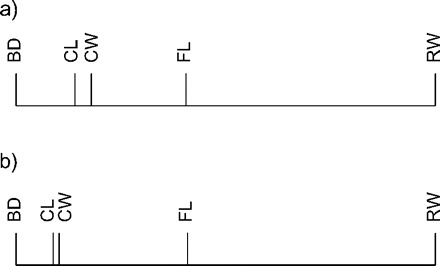
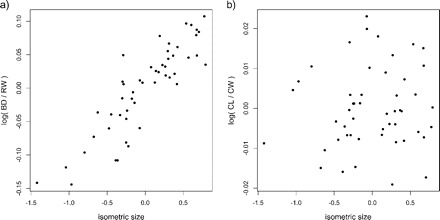
The analysis of ratios of body measurements is deeply ingrained in the taxonomic literature. Whether for plants or animals, certain ratios are commonly indicated in identification keys, diagnoses, and descriptions. They often provide the only means for separation of cryptic species that mostly lack distinguishing qualitative characters. Additionally, they provide an obvious way to study differences in body proportions, as ratios reflect geometric shape differences. However, when it comes to multivariate analysis of body measurements, for instance, with linear discriminant analysis (LDA) or principal component analysis (PCA), interpretation using body ratios is difficult. Both techniques are commonly applied for separating similar taxa or for exploring the structure of variation, respectively, and require standardized raw or log-transformed variables as input. Here, we develop statistical procedures for the analysis of body ratios in a consistent multivariate statistical framework. In particular, we present algorithms adapted to LDA and PCA that allow the interpretation of numerical results in terms of body proportions. We first introduce a method called the "LDA ratio extractor," which reveals the best ratios for separation of two or more groups with the help of discriminant analysis. We also provide measures for deciding how much of the total differences between individuals or groups of individuals is due to size and how much is due to shape. The second method, a graphical tool called the "PCA ratio spectrum," aims at the interpretation of principal components in terms of body ratios. Based on a similar idea, the "allometry ratio spectrum" is developed which can be used for studying the allometric behavior of ratios. Because size can be defined in different ways, we discuss several concepts of size. Central to this discussion is Jolicoeur's multivariate generalization of the allometry equation, a concept that was derived only with a heuristic argument. Here we present a statistical derivation of the allometric size vector using the method of least squares. The application of the above methods is extensively demonstrated using published data sets from parasitic wasps and rock crabs.
体尺比率分析在分类学文献中有着深厚的基础。无论是植物还是动物,某些比率通常在鉴定钥匙、诊断和描述中都有指示。它们通常是区分大多数缺乏明显定性特征的隐种的唯一手段。此外,它们提供了一种研究身体比例差异的明显方法,因为比率反映了几何形状的差异。然而,当涉及到身体测量的多元分析时,例如线性判别分析(LDA)或主成分分析(PCA),使用身体比率进行解释是困难的。这两种技术通常分别用于分离相似的分类群或探索变异结构,并且需要标准化的原始或对数转换变量作为输入。在这里,我们在一致的多元统计框架中开发了用于分析身体比率的统计程序。特别是,我们提出了适用于 LDA 和 PCA 的算法,可以根据身体比例解释数值结果。我们首先介绍了一种称为“LDA 比率提取器”的方法,该方法借助判别分析揭示了分离两个或多个组的最佳比率。我们还提供了衡量个体或个体群体之间的差异有多少归因于大小以及有多少归因于形状的指标。第二种方法是一种称为“PCA 比率光谱”的图形工具,旨在根据身体比率解释主成分。基于类似的想法,开发了“比例谱”,用于研究比率的比例行为。由于可以以不同的方式定义大小,因此我们讨论了几种大小的概念。其中核心的是 Jolicoeur 的多元比方程的推广,这一概念仅基于启发式论证得出。在这里,我们使用最小二乘法的方法提出了一种统计上的比大小向量的推导。上述方法的应用通过发表的寄生蜂和石蟹数据集得到了广泛的证明。