Odum School of Ecology, University of Georgia, Athens, Georgia, United States of America.
PLoS Comput Biol. 2011 Jul;7(7):e1002104. doi: 10.1371/journal.pcbi.1002104. Epub 2011 Jul 28.
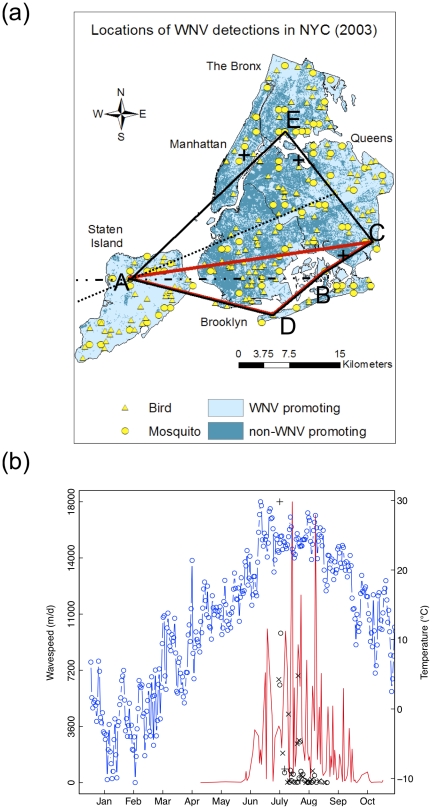
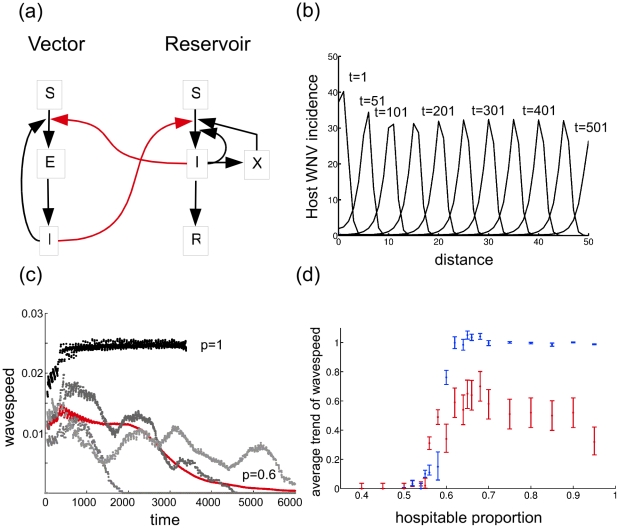
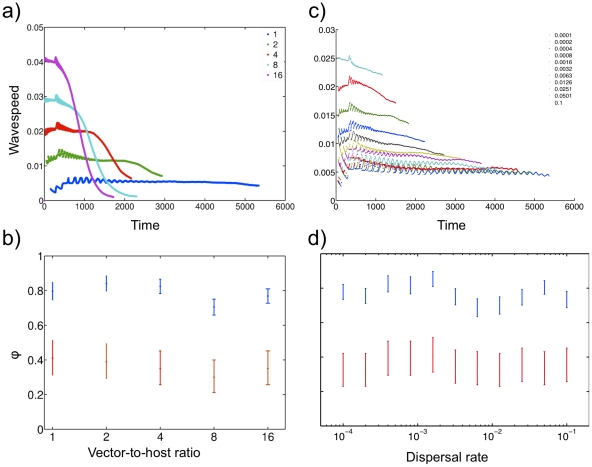
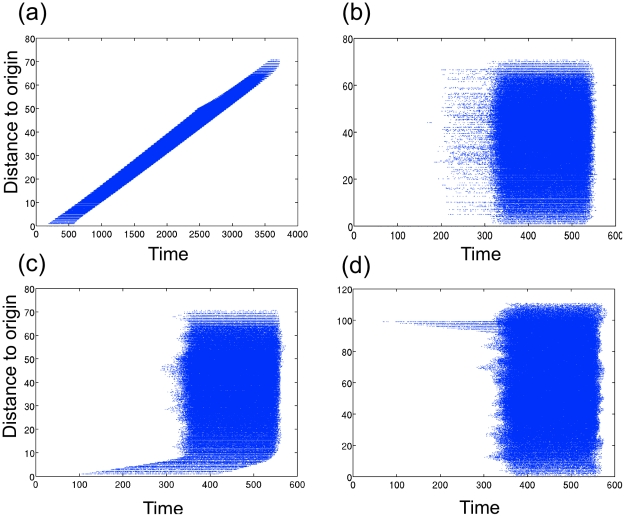
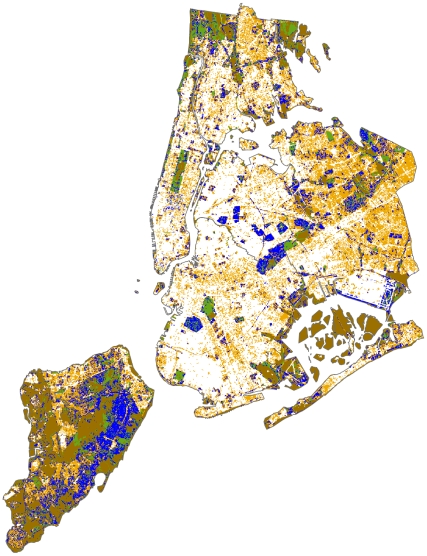
Vector-borne diseases are emerging and re-emerging in urban environments throughout the world, presenting an increasing challenge to human health and a major obstacle to development. Currently, more than half of the global population is concentrated in urban environments, which are highly heterogeneous in the extent, degree, and distribution of environmental modifications. Because the prevalence of vector-borne pathogens is so closely coupled to the ecologies of vector and host species, this heterogeneity has the potential to significantly alter the dynamical systems through which pathogens propagate, and also thereby affect the epidemiological patterns of disease at multiple spatial scales. One such pattern is the speed of spread. Whereas standard models hold that pathogens spread as waves with constant or increasing speed, we hypothesized that heterogeneity in urban environments would cause decelerating travelling waves in incipient epidemics. To test this hypothesis, we analysed data on the spread of West Nile virus (WNV) in New York City (NYC), the 1999 epicentre of the North American pandemic, during annual epizootics from 2000-2008. These data show evidence of deceleration in all years studied, consistent with our hypothesis. To further explain these patterns, we developed a spatial model for vector-borne disease transmission in a heterogeneous environment. An emergent property of this model is that deceleration occurs only in the vicinity of a critical point. Geostatistical analysis suggests that NYC may be on the edge of this criticality. Together, these analyses provide the first evidence for the endogenous generation of decelerating travelling waves in an emerging infectious disease. Since the reported deceleration results from the heterogeneity of the environment through which the pathogen percolates, our findings suggest that targeting control at key sites could efficiently prevent pathogen spread to remote susceptible areas or even halt epidemics.
在全球范围内,城市环境中出现了越来越多的虫媒传染病,对人类健康构成了日益严峻的挑战,也是发展的主要障碍。目前,全球一半以上的人口集中在城市环境中,这些环境在环境改变的程度、范围和分布上存在高度异质性。由于虫媒传染病的流行与媒介和宿主物种的生态密切相关,这种异质性有可能显著改变病原体传播的动力系统,并因此影响多种空间尺度上疾病的流行病学模式。其中一种模式是传播速度。标准模型认为,病原体以恒定或增加的速度传播,但我们假设城市环境中的异质性会导致初发传染病的传播波减速。为了验证这一假设,我们分析了 2000-2008 年期间,在纽约市(NYC)发生的年度动物传染病中,西尼罗河病毒(WNV)传播的数据。这些数据显示,在所有研究年份中都存在减速现象,与我们的假设一致。为了进一步解释这些模式,我们开发了一个用于异质环境中虫媒传染病传播的空间模型。该模型的一个新出现的特性是,只有在临界点附近才会发生减速。地质统计学分析表明,NYC 可能处于这个临界点的边缘。这些分析共同为新兴传染病中内生减速传播波的产生提供了第一个证据。由于报告的减速是由病原体传播的环境异质性引起的,因此我们的研究结果表明,将控制目标集中在关键地点,可以有效地防止病原体传播到偏远的易感地区,甚至可以阻止疫情的发生。