Graduate School of Agricultural Sciences, Kobe University, Kobe, Japan.
PLoS Pathog. 2011 Jul;7(7):e1002147. doi: 10.1371/journal.ppat.1002147. Epub 2011 Jul 28.
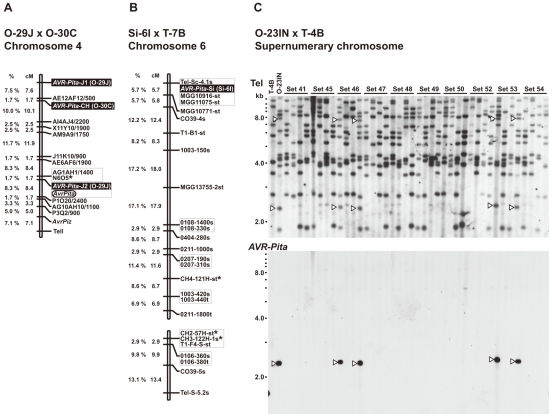
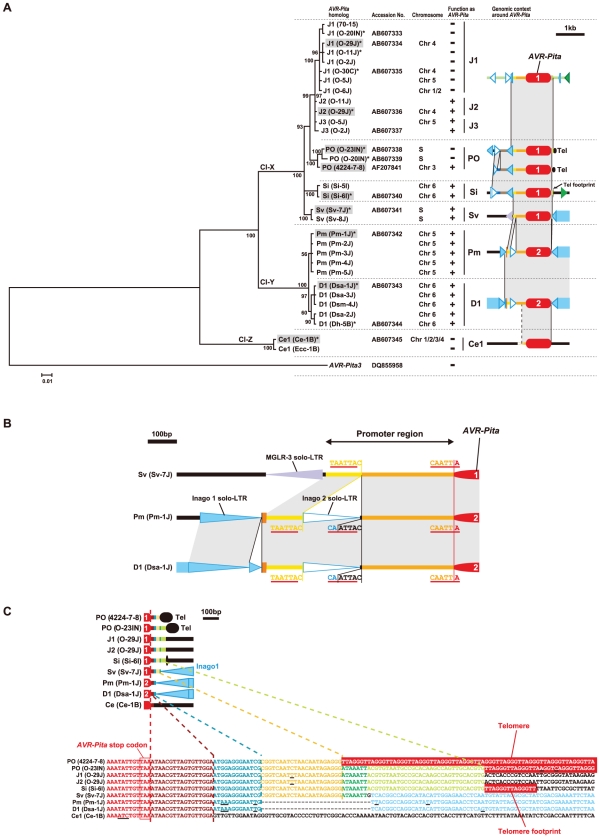
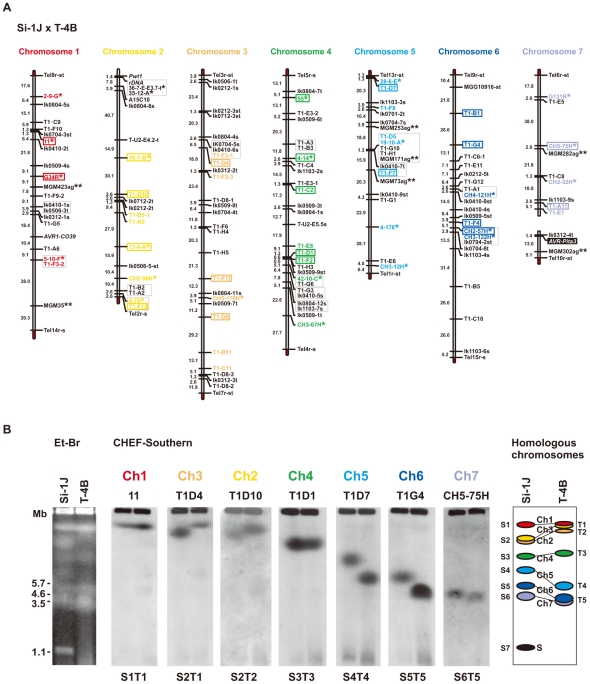
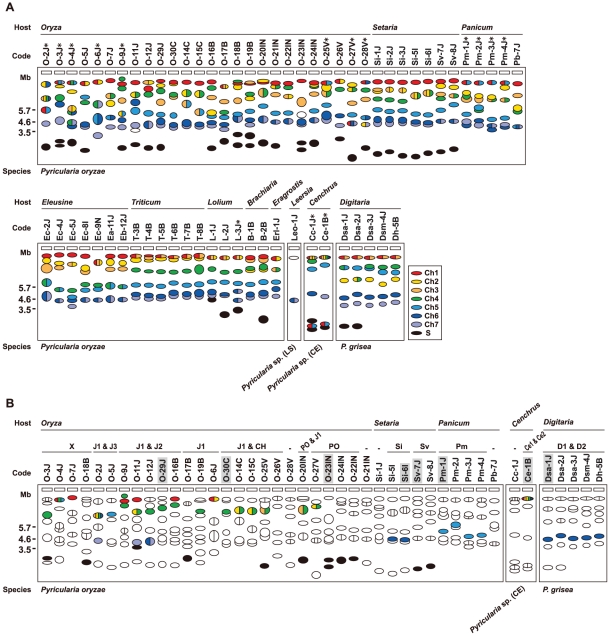
Magnaporthe oryzae is the causal agent of rice blast disease, a devastating problem worldwide. This fungus has caused breakdown of resistance conferred by newly developed commercial cultivars. To address how the rice blast fungus adapts itself to new resistance genes so quickly, we examined chromosomal locations of AVR-Pita, a subtelomeric gene family corresponding to the Pita resistance gene, in various isolates of M. oryzae (including wheat and millet pathogens) and its related species. We found that AVR-Pita (AVR-Pita1 and AVR-Pita2) is highly variable in its genome location, occurring in chromosomes 1, 3, 4, 5, 6, 7, and supernumerary chromosomes, particularly in rice-infecting isolates. When expressed in M. oryzae, most of the AVR-Pita homologs could elicit Pita-mediated resistance, even those from non-rice isolates. AVR-Pita was flanked by a retrotransposon, which presumably contributed to its multiple translocation across the genome. On the other hand, family member AVR-Pita3, which lacks avirulence activity, was stably located on chromosome 7 in a vast majority of isolates. These results suggest that the diversification in genome location of AVR-Pita in the rice isolates is a consequence of recognition by Pita in rice. We propose a model that the multiple translocation of AVR-Pita may be associated with its frequent loss and recovery mediated by its transfer among individuals in asexual populations. This model implies that the high mobility of AVR-Pita is a key mechanism accounting for the rapid adaptation toward Pita. Dynamic adaptation of some fungal plant pathogens may be achieved by deletion and recovery of avirulence genes using a population as a unit of adaptation.
稻瘟病菌是稻瘟病的病原体,是全球范围内的毁灭性问题。该真菌已导致新开发的商业品种所赋予的抗性失效。为了解稻瘟病菌如何如此迅速地适应新的抗性基因,我们检查了位于水稻品种的 Pita 抗性基因对应的端粒基因家族 AVR-Pita 的染色体位置,这些水稻品种包括小麦和谷子的病原体及其相关物种。我们发现,AVR-Pita(AVR-Pita1 和 AVR-Pita2)在基因组位置上高度可变,发生在染色体 1、3、4、5、6、7 和超数染色体上,特别是在感染水稻的分离株中。当在稻瘟病菌中表达时,大多数 AVR-Pita 同源物都能引起 Pita 介导的抗性,即使来自非水稻分离株的同源物也能引起抗性。AVR-Pita 被逆转录转座子所包围,这可能导致其在基因组中多次易位。另一方面,缺乏无毒活性的家族成员 AVR-Pita3 在大多数分离株中稳定位于 7 号染色体上。这些结果表明,稻瘟病菌中 AVR-Pita 的基因组位置多样化是其在水稻中被 Pita 识别的结果。我们提出了一个模型,即 AVR-Pita 在基因组位置的多样化是由其在无性种群个体间的转移介导的频繁丢失和恢复所导致的。该模型表明,AVR-Pita 的多次易位可能与其在个体间的转移有关,这是其频繁丢失和恢复的原因。一些真菌植物病原体的动态适应可能是通过无性种群作为适应单位来删除和恢复无毒基因来实现的。