State Key Laboratory of Plant Genomics and National Center for Plant Gene Research, Institute of Genetics and Developmental Biology, Chinese Academy of Sciences, Beijing, China.
PLoS Genet. 2011 Jul;7(7):e1002196. doi: 10.1371/journal.pgen.1002196. Epub 2011 Jul 28.
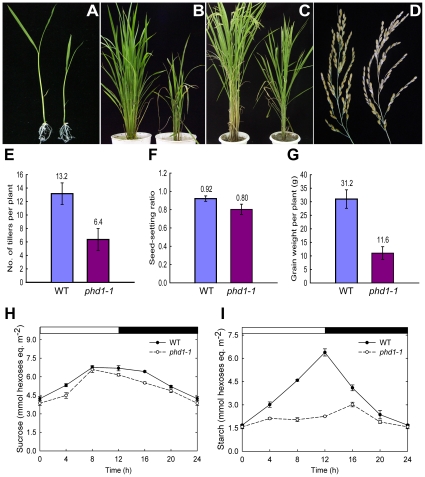
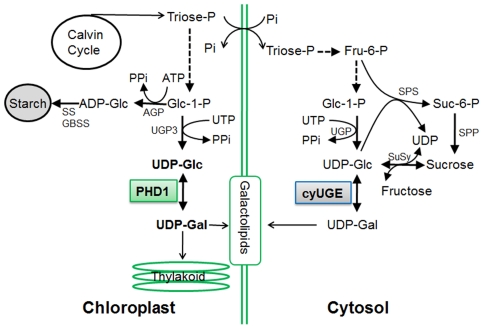
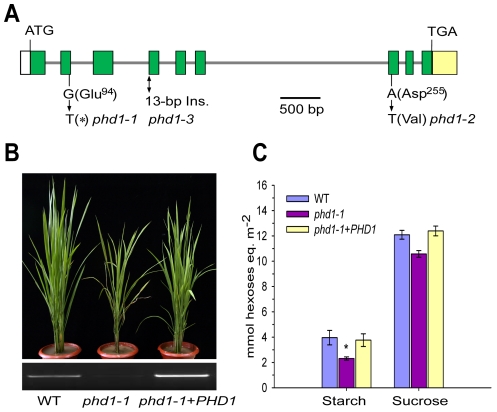
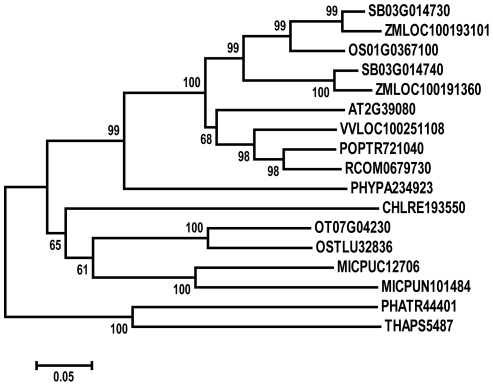
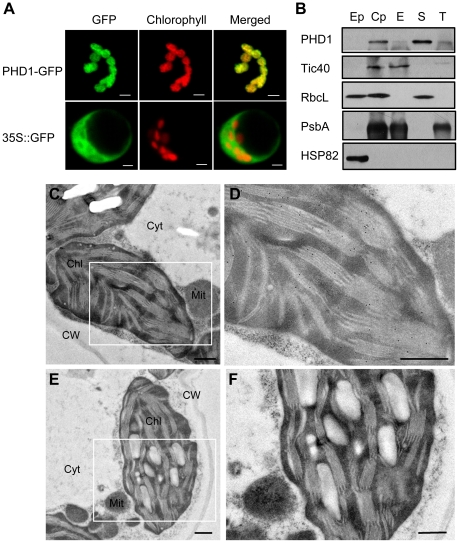
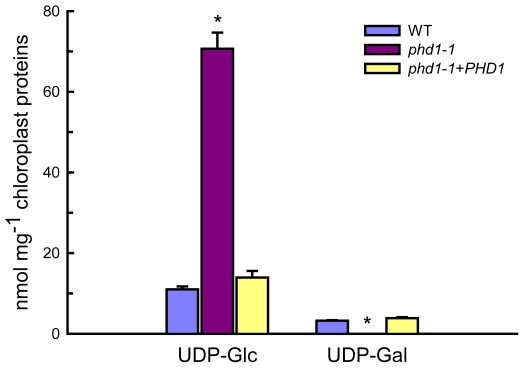
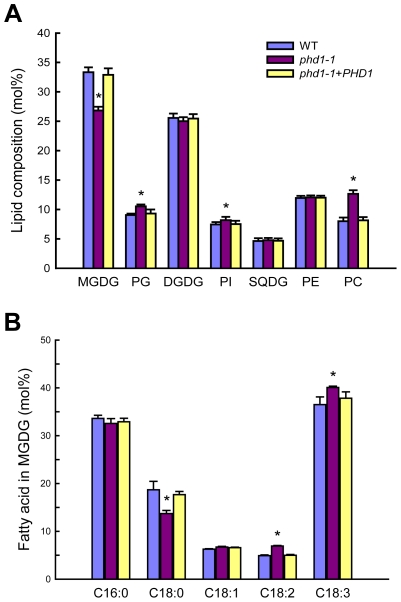
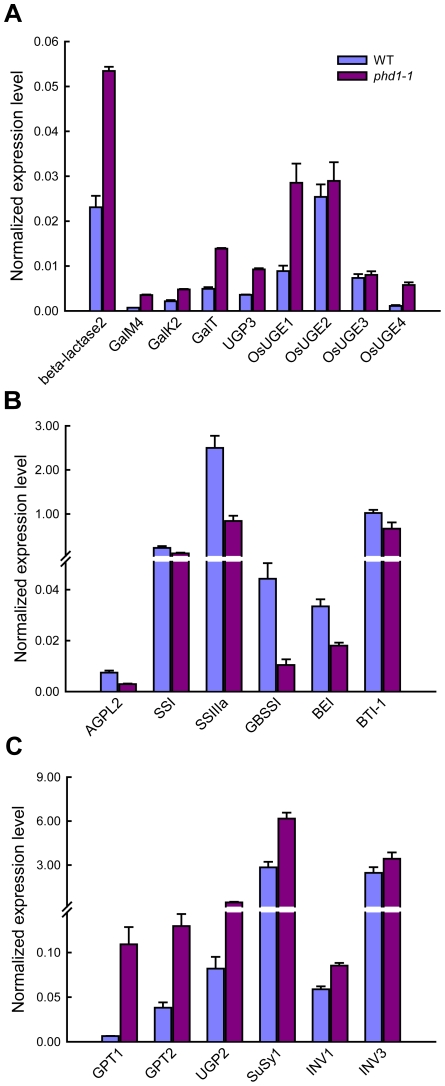
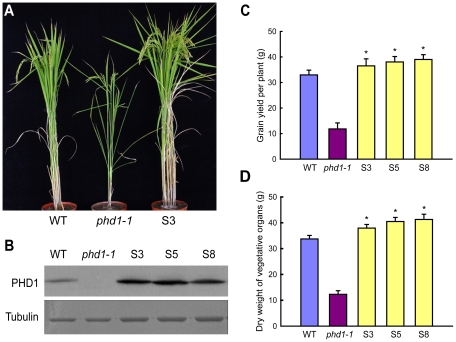
Photosynthesis is the final determinator for crop yield. To gain insight into genes controlling photosynthetic capacity, we selected from our large T-DNA mutant population a rice stunted growth mutant with decreased carbon assimilate and yield production named photoassimilate defective1 (phd1). Molecular and biochemical analyses revealed that PHD1 encodes a novel chloroplast-localized UDP-glucose epimerase (UGE), which is conserved in the plant kingdom. The chloroplast localization of PHD1 was confirmed by immunoblots, immunocytochemistry, and UGE activity in isolated chloroplasts, which was approximately 50% lower in the phd1-1 mutant than in the wild type. In addition, the amounts of UDP-glucose and UDP-galactose substrates in chloroplasts were significantly higher and lower, respectively, indicating that PHD1 was responsible for a major part of UGE activity in plastids. The relative amount of monogalactosyldiacylglycerol (MGDG), a major chloroplast membrane galactolipid, was decreased in the mutant, while the digalactosyldiacylglycerol (DGDG) amount was not significantly altered, suggesting that PHD1 participates mainly in UDP-galactose supply for MGDG biosynthesis in chloroplasts. The phd1 mutant showed decreased chlorophyll content, photosynthetic activity, and altered chloroplast ultrastructure, suggesting that a correct amount of galactoglycerolipids and the ratio of glycolipids versus phospholipids are necessary for proper chloroplast function. Downregulated expression of starch biosynthesis genes and upregulated expression of sucrose cleavage genes might be a result of reduced photosynthetic activity and account for the decreased starch and sucrose levels seen in phd1 leaves. PHD1 overexpression increased photosynthetic efficiency, biomass, and grain production, suggesting that PHD1 plays an important role in supplying sufficient galactolipids to thylakoid membranes for proper chloroplast biogenesis and photosynthetic activity. These findings will be useful for improving crop yields and for bioenergy crop engineering.
光合作用是作物产量的最终决定因素。为了深入了解控制光合作用能力的基因,我们从我们的大型 T-DNA 突变体群体中选择了一个水稻生长矮小突变体,该突变体的碳同化和产量减少,命名为光合缺陷 1(phd1)。分子和生化分析表明,PHD1 编码一种新型的质体定位 UDP-葡萄糖差向异构酶(UGE),在植物界中保守。通过免疫印迹、免疫细胞化学和分离的质体中的 UGE 活性证实了 PHD1 的质体定位,phd1-1 突变体中的 PHD1 定位约比野生型低 50%。此外,质体中 UDP-葡萄糖和 UDP-半乳糖底物的量分别显著增加和降低,表明 PHD1 负责质体中 UGE 活性的主要部分。突变体中主要的叶绿体膜半乳糖脂单半乳糖二酰基甘油(MGDG)的相对量减少,而二半乳糖二酰基甘油(DGDG)的量没有显著改变,表明 PHD1 主要参与 UDP-半乳糖供应用于叶绿体中 MGDG 的生物合成。phd1 突变体表现出叶绿素含量降低、光合作用活性降低和叶绿体超微结构改变,表明正确的半乳糖甘油脂量和糖脂与磷脂的比例对于适当的叶绿体功能是必要的。淀粉生物合成基因的下调表达和蔗糖裂解基因的上调表达可能是光合作用活性降低的结果,并解释了 phd1 叶片中淀粉和蔗糖水平降低的原因。PHD1 的过表达增加了光合作用效率、生物量和谷物产量,表明 PHD1 在为类囊体膜提供足够的半乳糖脂以进行适当的叶绿体发生和光合作用活性方面发挥重要作用。这些发现将有助于提高作物产量和生物能源作物工程。