Institute of Basic Medical Sciences, Chinese Academy of Medical Sciences & Peking Union Medical College, Beijing, People's Republic of China.
PLoS One. 2011;6(7):e22426. doi: 10.1371/journal.pone.0022426. Epub 2011 Jul 28.
The diagnosis of hepatocellular carcinoma (HCC) in the early stage is crucial to the application of curative treatments which are the only hope for increasing the life expectancy of patients. Recently, several large-scale studies have shed light on this problem through analysis of gene expression profiles to identify markers correlated with HCC progression. However, those marker sets shared few genes in common and were poorly validated using independent data. Therefore, we developed a systems biology based classifier by combining the differential gene expression with topological features of human protein interaction networks to enhance the ability of HCC diagnosis.
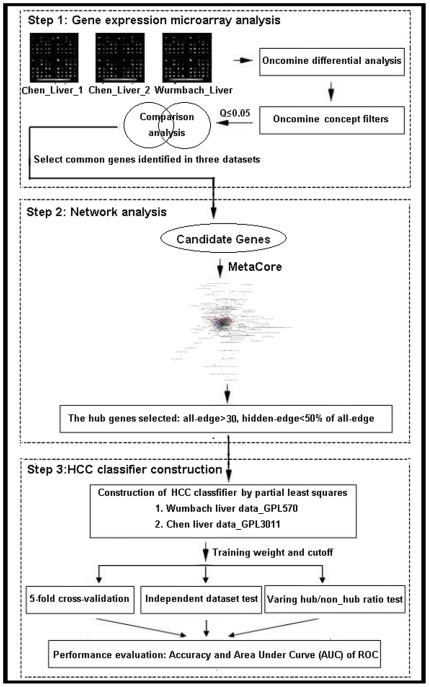
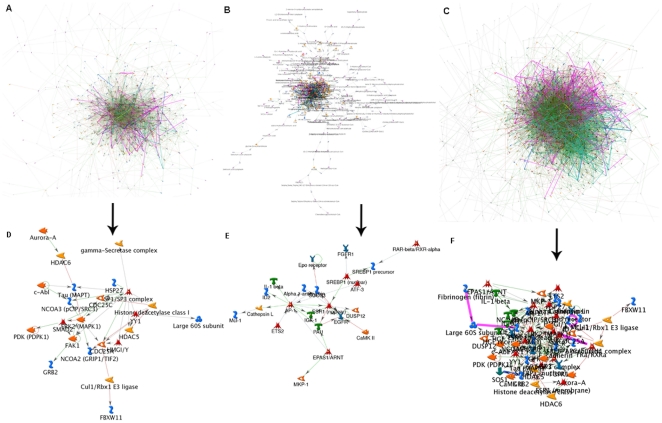
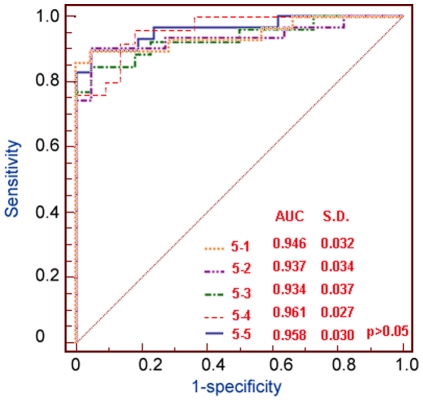
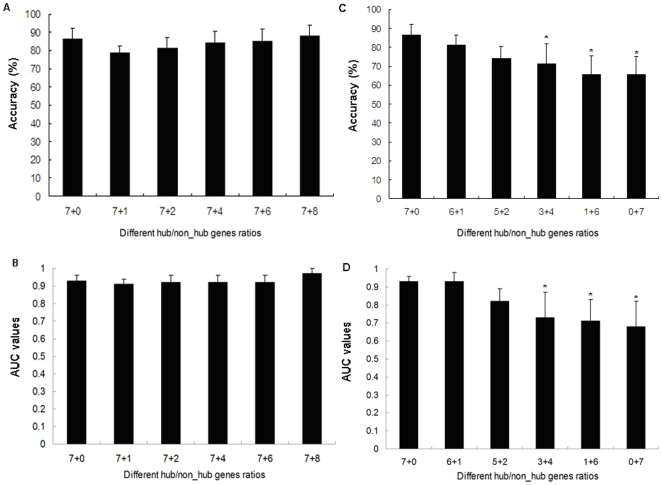
In the Oncomine platform, genes differentially expressed in HCC tissues relative to their corresponding normal tissues were filtered by a corrected Q value cut-off and Concept filters. The identified genes that are common to different microarray datasets were chosen as the candidate markers. Then, their networks were analyzed by GeneGO Meta-Core software and the hub genes were chosen. After that, an HCC diagnostic classifier was constructed by Partial Least Squares modeling based on the microarray gene expression data of the hub genes. Validations of diagnostic performance showed that this classifier had high predictive accuracy (85.88∼92.71%) and area under ROC curve (approximating 1.0), and that the network topological features integrated into this classifier contribute greatly to improving the predictive performance. Furthermore, it has been demonstrated that this modeling strategy is not only applicable to HCC, but also to other cancers.
Our analysis suggests that the systems biology-based classifier that combines the differential gene expression and topological features of human protein interaction network may enhance the diagnostic performance of HCC classifier.
早期诊断肝细胞癌(HCC)对于应用治愈性治疗至关重要,这是提高患者预期寿命的唯一希望。最近,几项大规模的研究通过分析基因表达谱来解决这个问题,以确定与 HCC 进展相关的标志物。然而,这些标志物集很少有共同的基因,并且使用独立数据验证效果不佳。因此,我们通过结合人类蛋白质相互作用网络的差异基因表达和拓扑特征,开发了一种基于系统生物学的分类器,以增强 HCC 诊断的能力。
在 Oncomine 平台上,通过校正 Q 值截止值和概念筛选,筛选出 HCC 组织相对于相应正常组织差异表达的基因。选择不同微阵列数据集共有的基因作为候选标志物。然后,使用 GeneGO Meta-Core 软件分析它们的网络,并选择枢纽基因。之后,基于枢纽基因的微阵列基因表达数据,通过偏最小二乘建模构建 HCC 诊断分类器。验证诊断性能表明,该分类器具有较高的预测准确性(85.88%∼92.71%)和 ROC 曲线下面积(接近 1.0),并且将网络拓扑特征集成到该分类器中对提高预测性能有很大贡献。此外,已经证明这种建模策略不仅适用于 HCC,也适用于其他癌症。
我们的分析表明,将差异基因表达和人类蛋白质相互作用网络的拓扑特征相结合的基于系统生物学的分类器可能会增强 HCC 分类器的诊断性能。