Laboratoire de Neuropsychologie Interventionnelle, Department Études Cognitive, École Normale Supérieure, Paris, France.
PLoS One. 2011;6(7):e22432. doi: 10.1371/journal.pone.0022432. Epub 2011 Jul 28.
The extraordinarily high incidence of grammatical language impairments in developmental disorders suggests that this uniquely human cognitive function is "fragile". Yet our understanding of the neurobiology of grammatical impairments is limited. Furthermore, there is no "gold-standard" to identify grammatical impairments and routine screening is not undertaken. An accurate screening test to identify grammatical abilities would serve the research, health and education communities, further our understanding of developmental disorders, and identify children who need remediation, many of whom are currently un-diagnosed. A potential realistic screening tool that could be widely administered is the Grammar and Phonology Screening (GAPS) test--a 10 minute test that can be administered by professionals and non-professionals alike. Here we provide a further step in evaluating the validity and accuracy (sensitivity and specificity) of the GAPS test in identifying children who have Specific Language Impairment (SLI).
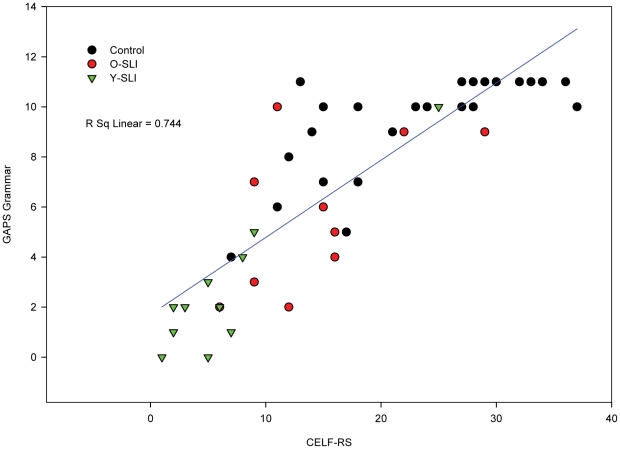
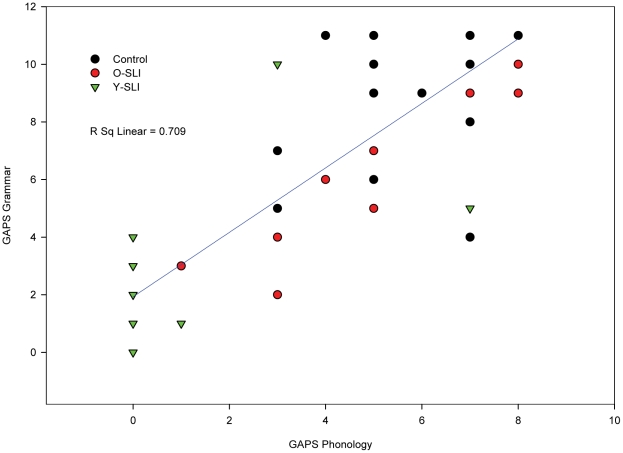
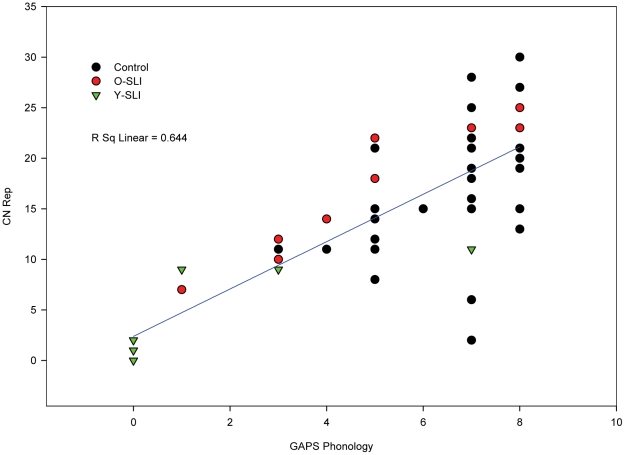
We tested three groups of children; two groups aged 3;6-6:6, a typically developing (n = 30) group, and a group diagnosed with SLI: (n = 11) (Young (Y)-SLI), and a further group aged 6;9-8;11 with SLI (Older (O)-SLI) (n = 10) who were above the test age norms. We employed a battery of language assessments including the GAPS test to assess the children's language abilities. For Y-SLI children, analyses revealed a sensitivity and specificity at the 5(th) and 10(th) percentile of 1.00 and 0.98, respectively, and for O-SLI children at the 10(th) and 15(th) percentile .83 and .90, respectively.
The findings reveal that the GAPS is highly accurate in identifying impaired vs. non-impaired children up to 6;8 years, and has moderate-to-high accuracy up to 9 years. The results indicate that GAPS is a realistic tool for the early identification of grammatical abilities and impairment in young children. A larger investigation is warranted in children with SLI and other developmental disorders.
发育障碍中语法语言损伤的极高发病率表明,这种独特的人类认知功能是“脆弱的”。然而,我们对语法损伤的神经生物学的理解是有限的。此外,没有“金标准”来识别语法损伤,也没有进行常规筛查。一个准确的筛查测试来识别语法能力将服务于研究、健康和教育界,进一步了解发育障碍,并确定需要补救的儿童,其中许多儿童目前未被诊断。一个潜在的现实筛选工具,可以广泛管理是语法和音韵筛查(GAPS)测试-一个 10 分钟的测试,可以由专业人士和非专业人士管理。在这里,我们提供了一个进一步的步骤,以评估 GAPS 测试的有效性和准确性(灵敏度和特异性),以识别有特定语言损伤(SLI)的儿童。
我们测试了三组儿童;两组年龄为 3 岁;6-6:6,一个典型的发展(n=30)组,和一个被诊断为 SLI 的组:(n=11)(年轻(Y)-SLI),以及一个年龄较大的 6 岁;9-8 岁;11 岁的 SLI 组(老年(O)-SLI)(n=10),他们超过了测试年龄标准。我们采用了一系列语言评估,包括 GAPS 测试,以评估儿童的语言能力。对于 Y-SLI 儿童,分析显示,5%和 10%百分位数的灵敏度和特异性分别为 1.00 和 0.98,而对于 O-SLI 儿童,在 10%和 15%百分位数分别为 0.83 和 0.90。
研究结果表明,GAPS 在识别 6 岁至 8 岁受损和非受损儿童方面具有高度准确性,在 9 岁时具有中等至高度准确性。结果表明,GAPS 是一种现实的工具,用于早期识别幼儿的语法能力和损伤。在有 SLI 和其他发育障碍的儿童中,需要进行更大的调查。