Fonteneau Elisabeth, van der Lely Heather K J
UCL Centre for Developmental Language Disorders and Cognitive Neuroscience, University College London, London, United Kingdom.
PLoS One. 2008 Mar 12;3(3):e1832. doi: 10.1371/journal.pone.0001832.
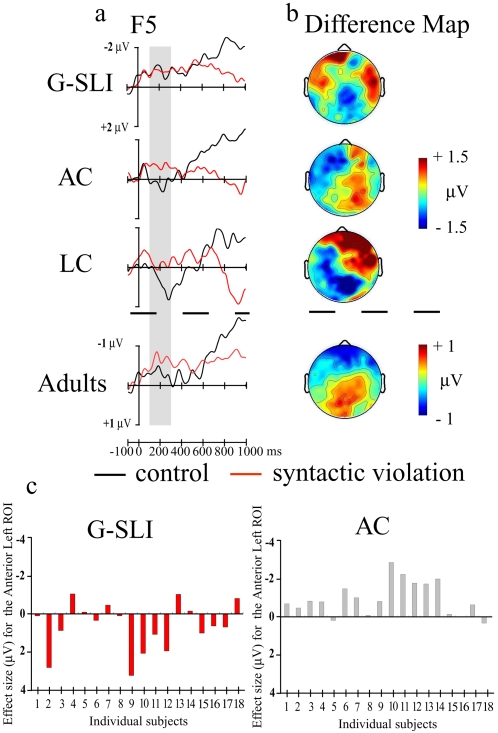
Scientific and public fascination with human language have included intensive scrutiny of language disorders as a new window onto the biological foundations of language and its evolutionary origins. Specific language impairment (SLI), which affects over 7% of children, is one such disorder. SLI has received robust scientific attention, in part because of its recent linkage to a specific gene and loci on chromosomes and in part because of the prevailing question regarding the scope of its language impairment: Does the disorder impact the general ability to segment and process language or a specific ability to compute grammar? Here we provide novel electrophysiological data showing a domain-specific deficit within the grammar of language that has been hitherto undetectable through behavioural data alone.
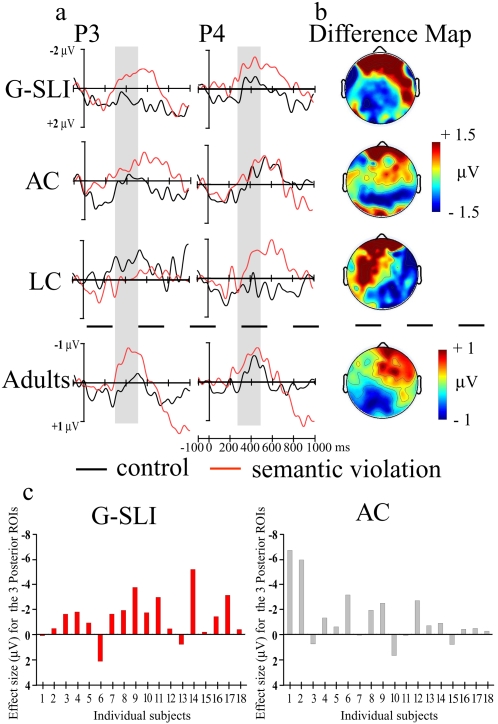
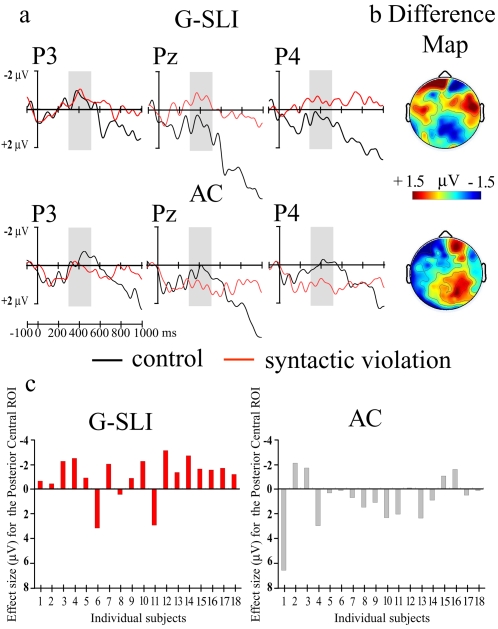
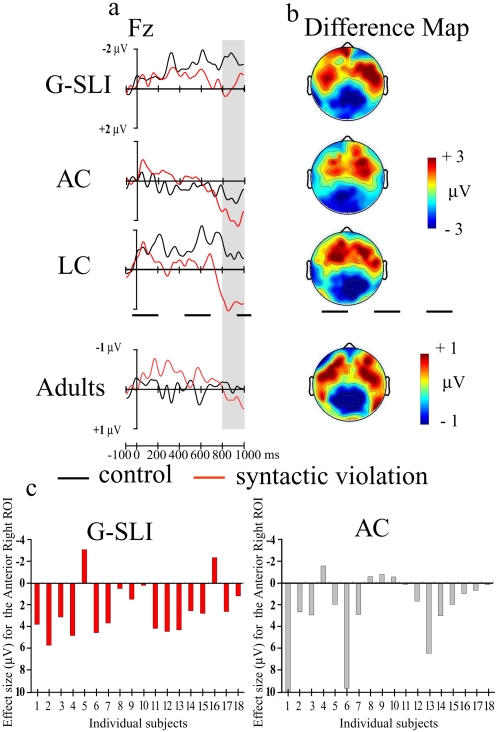
We presented participants with Grammatical(G)-SLI, age-matched controls, and younger child and adult controls, with questions containing syntactic violations and sentences containing semantic violations. Electrophysiological brain responses revealed a selective impairment to only neural circuitry that is specific to grammatical processing in G-SLI. Furthermore, the participants with G-SLI appeared to be partially compensating for their syntactic deficit by using neural circuitry associated with semantic processing and all non-grammar-specific and low-level auditory neural responses were normal.
The findings indicate that grammatical neural circuitry underlying language is a developmentally unique system in the functional architecture of the brain, and this complex higher cognitive system can be selectively impaired. The findings advance fundamental understanding about how cognitive systems develop and all human language is represented and processed in the brain.
科学界和公众对人类语言的着迷包括对语言障碍的深入研究,将其作为了解语言生物学基础及其进化起源的新窗口。特定语言障碍(SLI)影响超过7%的儿童,就是这样一种障碍。SLI受到了广泛的科学关注,部分原因是它最近与染色体上的特定基因和基因座相关联,部分原因是关于其语言障碍范围的普遍问题:这种障碍是影响语言分割和处理的一般能力,还是计算语法的特定能力?在这里,我们提供了新的电生理数据,显示了语言语法中一种特定领域的缺陷,这种缺陷迄今为止仅通过行为数据是无法检测到的。
我们向患有语法型特定语言障碍(G-SLI)的参与者、年龄匹配的对照组、年幼儿童和成人对照组呈现包含句法违规的问题和包含语义违规的句子。脑电生理反应显示,G-SLI患者仅对特定于语法处理的神经回路有选择性损伤。此外,患有G-SLI的参与者似乎通过使用与语义处理相关的神经回路来部分补偿其句法缺陷,并且所有非语法特定的和低级听觉神经反应都是正常的。
研究结果表明,语言背后的语法神经回路在大脑功能结构中是一个发育上独特的系统,并且这个复杂的高级认知系统可能会受到选择性损伤。这些发现推进了我们对认知系统如何发展以及所有人类语言在大脑中如何被表征和处理的基本理解。