Suraj Eye Institute, Nagpur, Maharashtra, India.
PLoS One. 2011;6(7):e22756. doi: 10.1371/journal.pone.0022756. Epub 2011 Aug 4.
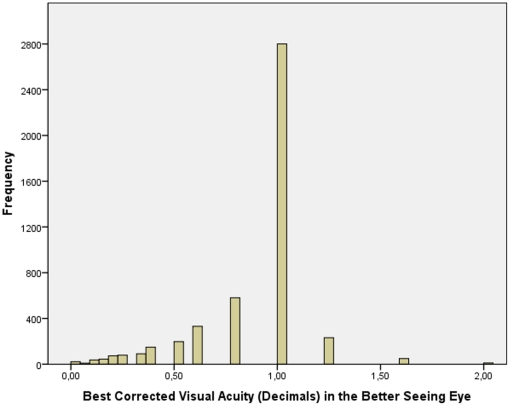
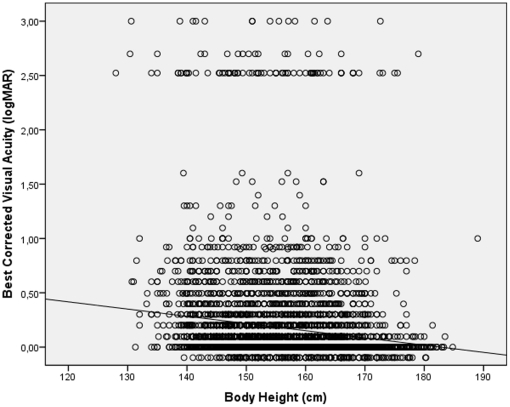
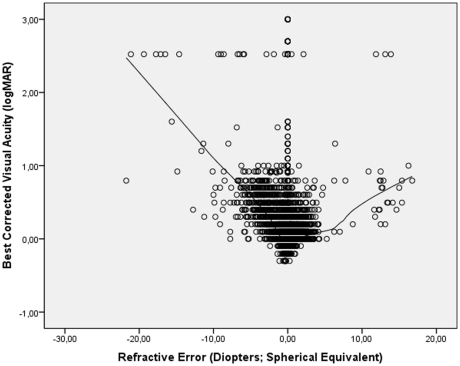
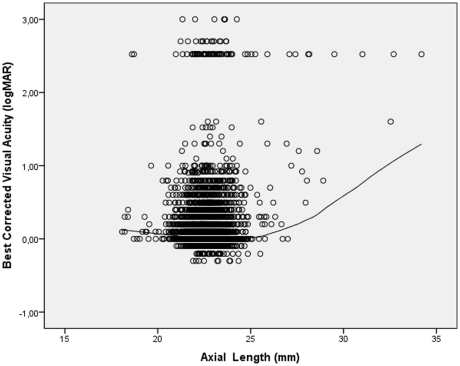
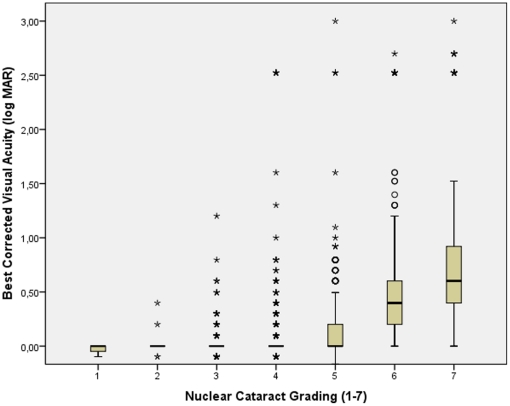
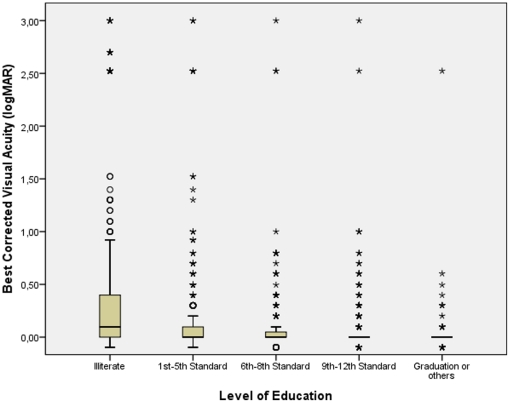
Visual acuity is a major parameter for quality of vision and quality of life. Information on visual acuity and its associated factors in rural societies almost untouched by any industrialization is mostly non-available. It was, therefore, the purpose of our study to determine the distribution of visual acuity and its associated factors in a rural population not marked influenced by modern lifestyle. The population-based Central India Eye and Medical Study included 4711 subjects (aged 30+ years), who underwent a detailed ophthalmologic examination including visual acuity measurement. Visual acuity measurements were available for 4706 subjects with a mean age of 49.5±13.4 years (range: 30-100 years). BCVA decreased significantly (P<0.001) from the moderately hyperopic group (0.08±0.15 logMAR) to the emmetropic group (0.16±0.52 logMAR), the moderately myopic group (0.28±0.33 logMAR), the highly hyperopic group (0.66±0.62 logMAR) and finally the highly myopic group (1.32±0.92 logMAR). In multivariate analysis, BCVA was significantly associated with the systemic parameters of lower age (P<0.001), higher level of education (P<0.001), higher body stature (P<0.001) and higher body mass index (P<0.001), and with the ophthalmic parameters of more hyperopic refractive error (spherical equivalent) (P<0.001), shorter axial length (P<0.001), lower degree of nuclear cataract (P<0.001), and lower intraocular pressure (P = 0.006). The results suggest that in the rural population of Central India, major determinants of visual acuity were socioeconomic background, body stature and body mass index, age, refractive error, cataract and intraocular pressure.
视力是衡量视觉质量和生活质量的主要参数。在几乎没有受到任何工业化影响的农村社会中,有关视力及其相关因素的信息大多尚未涉及。因此,我们的研究目的是确定未受现代生活方式明显影响的农村人口的视力分布及其相关因素。这项基于人群的印度中部眼科和医学研究纳入了 4711 名(年龄 30 岁以上)受试者,他们接受了详细的眼科检查,包括视力测量。有 4706 名受试者的视力测量值可用,平均年龄为 49.5±13.4 岁(范围:30-100 岁)。BCVA 从中度远视组(0.08±0.15 logMAR)显著下降到正视组(0.16±0.52 logMAR)、中度近视组(0.28±0.33 logMAR)、高度远视组(0.66±0.62 logMAR),最后是高度近视组(1.32±0.92 logMAR)。多变量分析显示,BCVA 与年龄较低(P<0.001)、受教育程度较高(P<0.001)、身高较高(P<0.001)和身体质量指数较高(P<0.001)等全身参数以及远视屈光不正(等效球镜)(P<0.001)、眼轴较短(P<0.001)、核性白内障程度较低(P<0.001)和眼压较低(P=0.006)等眼科参数显著相关。结果表明,在印度中部农村人口中,视力的主要决定因素是社会经济背景、身高和身体质量指数、年龄、屈光不正、白内障和眼压。