Center for Advanced Research in Sleep Medicine, Hôpital du Sacré-Cœur de Montréal, Montréal, Québec, Canada.
PLoS One. 2011;6(8):e22679. doi: 10.1371/journal.pone.0022679. Epub 2011 Aug 4.
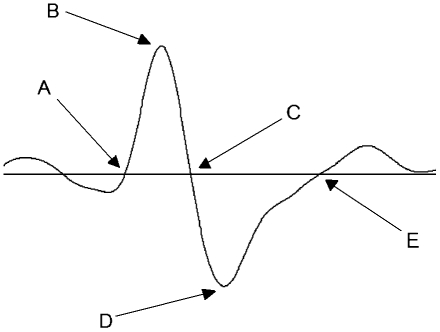
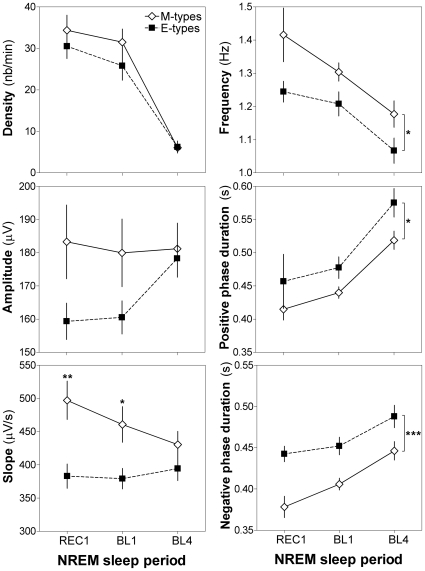
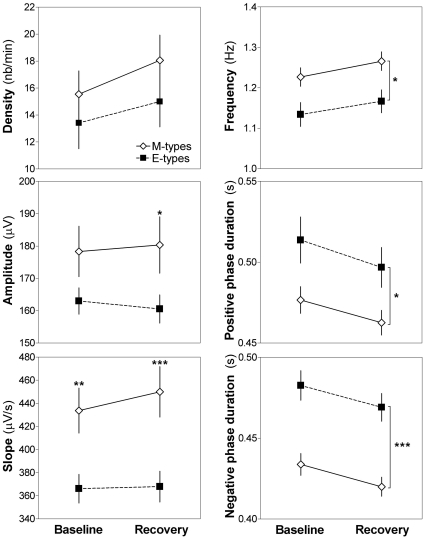
Brain recovery after prolonged wakefulness is characterized by increased density, amplitude and slope of slow waves (SW, <4 Hz) during non-rapid eye movement (NREM) sleep. These SW comprise a negative phase, during which cortical neurons are mostly silent, and a positive phase, in which most neurons fire intensively. Previous work showed, using EEG spectral analysis as an index of cortical synchrony, that Morning-types (M-types) present faster dynamics of sleep pressure than Evening-types (E-types). We thus hypothesized that single SW properties will also show larger changes in M-types than in E-types in response to increased sleep pressure. SW density (number per minute) and characteristics (amplitude, slope between negative and positive peaks, frequency and duration of negative and positive phases) were compared between chronotypes for a baseline sleep episode (BL) and for recovery sleep (REC) after two nights of sleep fragmentation. While SW density did not differ between chronotypes, M-types showed higher SW amplitude and steeper slope than E-types, especially during REC. SW properties were also averaged for 3 NREM sleep periods selected for their decreasing level of sleep pressure (first cycle of REC [REC1], first cycle of BL [BL1] and fourth cycle of BL [BL4]). Slope was significantly steeper in M-types than in E-types in REC1 and BL1. SW frequency was consistently higher and duration of positive and negative phases constantly shorter in M-types than in E-types. Our data reveal that specific properties of cortical synchrony during sleep differ between M-types and E-types, although chronotypes show a similar capacity to generate SW. These differences may involve 1) stable trait characteristics independent of sleep pressure (i.e., frequency and durations) likely linked to the length of silent and burst-firing phases of individual neurons, and 2) specific responses to increased sleep pressure (i.e., slope and amplitude) expected to depend on the synchrony between neurons.
长时间觉醒后大脑的恢复表现为非快速眼动(NREM)睡眠期间慢波(SW,<4 Hz)的密度、幅度和斜率增加。这些 SW 包括一个负相,在此期间皮质神经元大多处于静息状态,一个正相,在此期间大多数神经元强烈放电。以前的工作使用 EEG 频谱分析作为皮质同步性的指标表明,早起型(M 型)比晚起型(E 型)具有更快的睡眠压力动力学。因此,我们假设在增加睡眠压力的情况下,SW 的单一特性在 M 型中的变化也会大于 E 型。在基线睡眠(BL)和两晚睡眠碎片化后的恢复睡眠(REC)期间,比较了两种睡眠类型的 SW 密度(每分钟数量)和特征(幅度、负峰和正峰之间的斜率、频率和持续时间)。虽然两种睡眠类型的 SW 密度没有差异,但 M 型的 SW 幅度和斜率比 E 型更高,尤其是在 REC 期间。还为三个 NREM 睡眠期计算了 SW 特性的平均值,这些睡眠期是根据其睡眠压力的降低水平选择的(REC 的第一个周期[REC1]、BL 的第一个周期[BL1]和 BL 的第四个周期[BL4])。在 REC1 和 BL1 中,M 型的斜率明显比 E 型更陡。在 M 型中,SW 频率始终高于 E 型,正相和负相的持续时间始终比 E 型更短。我们的数据表明,尽管两种睡眠类型都具有产生 SW 的相似能力,但在睡眠期间皮质同步性的特定特性在 M 型和 E 型之间存在差异。这些差异可能涉及 1)独立于睡眠压力的稳定特质(即频率和持续时间),可能与单个神经元的静息和爆发放电阶段的长度有关,以及 2)对增加睡眠压力的特定反应(即斜率和幅度),预计取决于神经元之间的同步性。