Lazar Alpar S, Lazar Zsolt I, Dijk Derk-Jan
Surrey Sleep Research Centre, Faculty of Health and Medical Sciences, University of Surrey, Guildford, UK; John van Geest Centre for Brain Repair, Department of Clinical Neurosciences, University of Cambridge, Cambridge, UK.
Department of Physics, Babes-Bolyai University, Cluj-Napoca, Romania.
Neuroimage. 2015 Aug 1;116:123-34. doi: 10.1016/j.neuroimage.2015.05.012. Epub 2015 May 12.
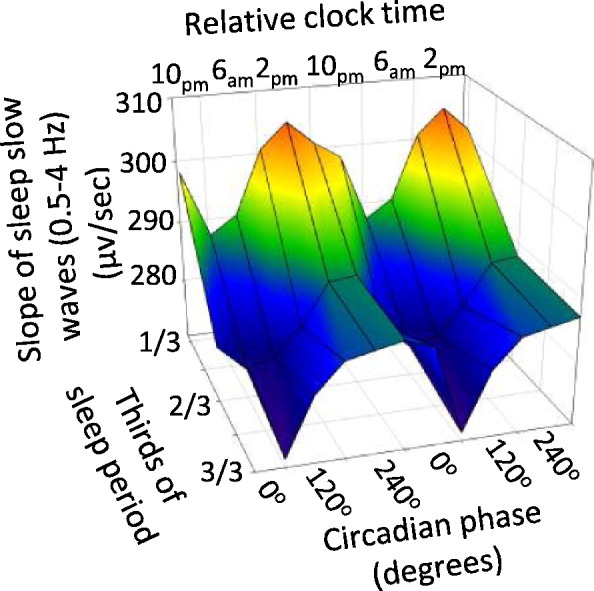
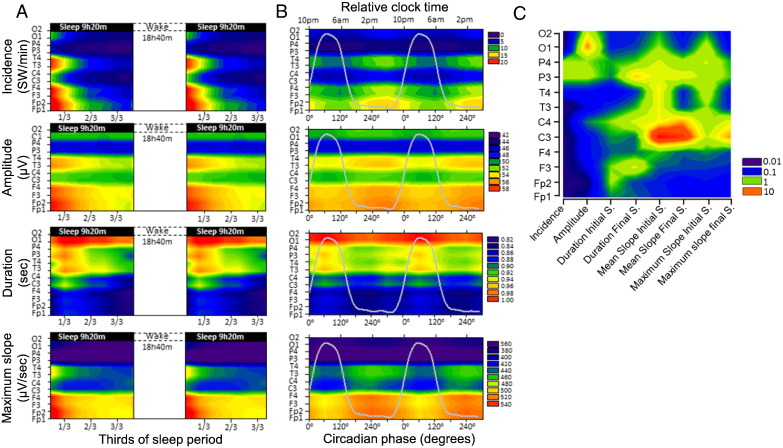
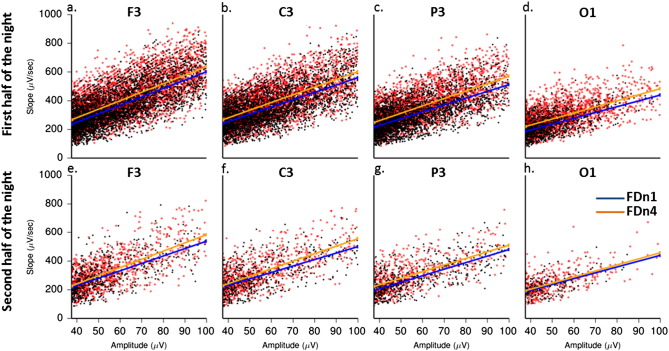
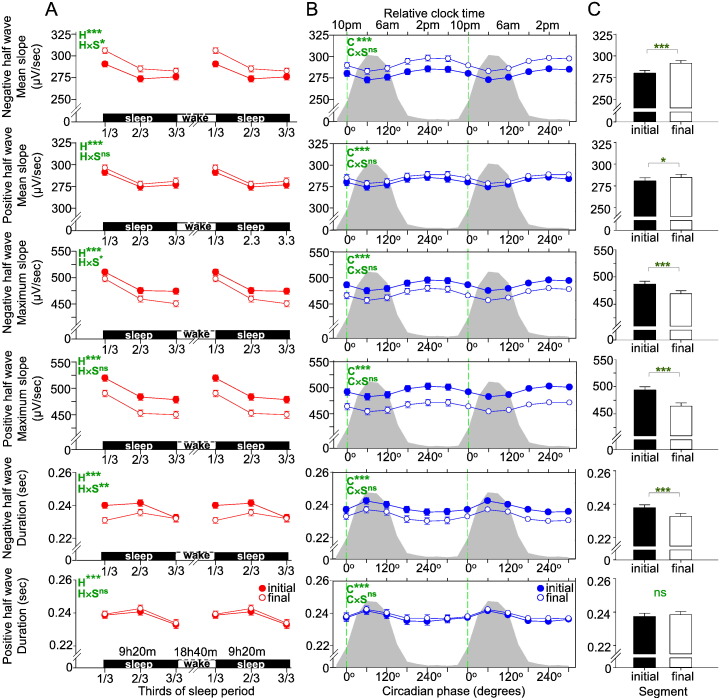
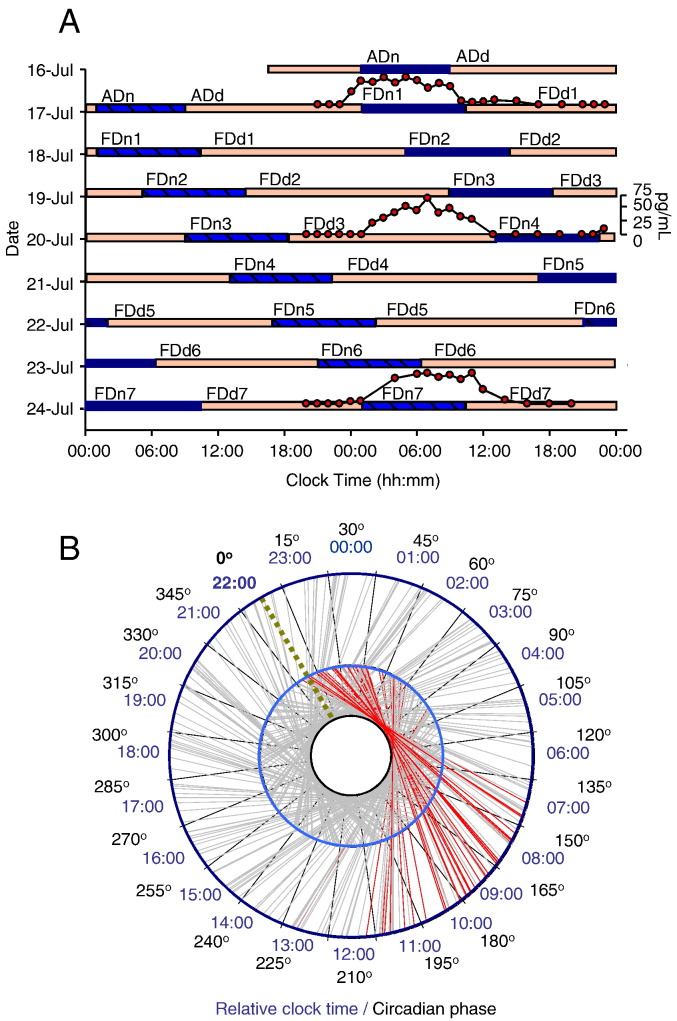
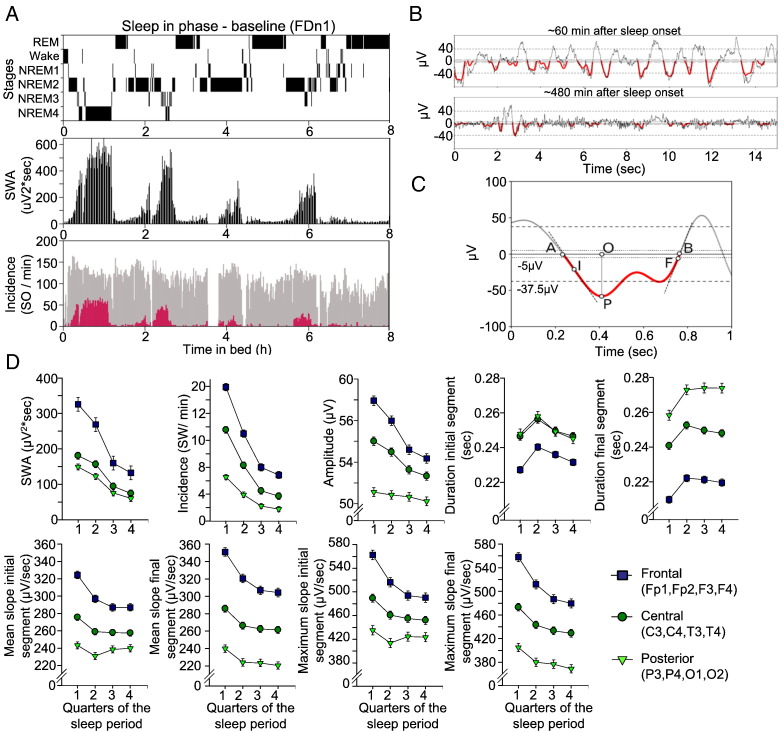
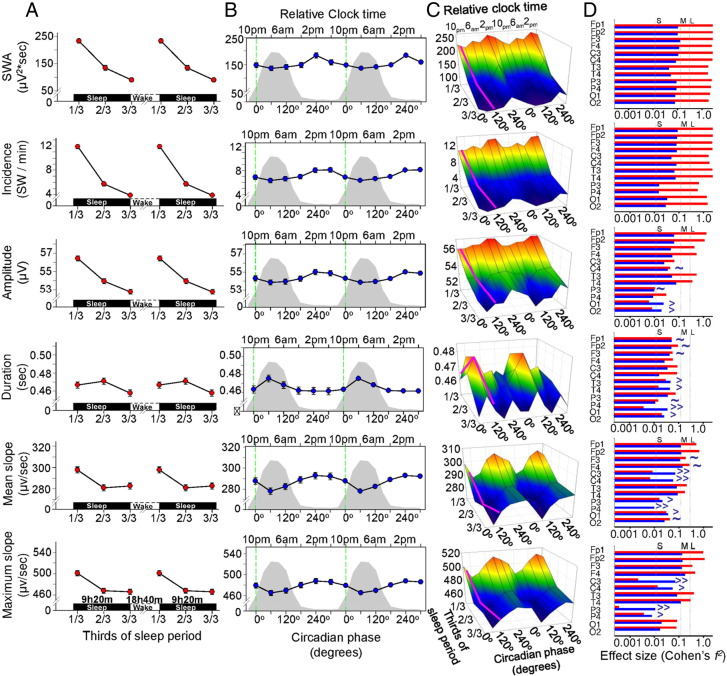
Slow waves (SWs, 0.5-4Hz) in field potentials during sleep reflect synchronized alternations between bursts of action potentials and periods of membrane hyperpolarization of cortical neurons. SWs decline during sleep and this is thought to be related to a reduction of synaptic strength in cortical networks and to be central to sleep's role in maintaining brain function. A central assumption in current concepts of sleep function is that SWs during sleep, and associated recovery processes, are independent of circadian rhythmicity. We tested this hypothesis by quantifying all SWs from 12 EEG derivations in 34 participants in whom 231 sleep periods were scheduled across the circadian cycle in a 10-day forced-desynchrony protocol which allowed estimation of the separate circadian and sleep-dependent modulation of SWs. Circadian rhythmicity significantly modulated the incidence, amplitude, frequency and the slope of the SWs such that the peaks of the circadian rhythms in these slow-wave parameters were located during the biological day. Topographical analyses demonstrated that the sleep-dependent modulation of SW characteristics was most prominent in frontal brain areas whereas the circadian effect was similar to or greater than the sleep-dependent modulation over the central and posterior brain regions. The data demonstrate that circadian rhythmicity directly modulates characteristics of SWs thought to be related to synaptic plasticity and that this modulation depends on topography. These findings have implications for the understanding of local sleep regulation and conditions such as ageing, depression, and neurodegeneration which are associated with changes in SWs, neural plasticity and circadian rhythmicity.
睡眠期间场电位中的慢波(SWs,0.5 - 4Hz)反映了动作电位爆发与皮层神经元膜超极化期之间的同步交替。慢波在睡眠期间会减少,这被认为与皮层网络中突触强度的降低有关,并且是睡眠在维持脑功能中所起作用的核心。当前睡眠功能概念的一个核心假设是,睡眠期间的慢波以及相关的恢复过程独立于昼夜节律。我们通过对34名参与者12个脑电图导联中的所有慢波进行量化来检验这一假设,在一项为期10天的强制去同步方案中,在昼夜周期内安排了231个睡眠时段,从而能够估计慢波的昼夜节律和睡眠依赖性调制的各自情况。昼夜节律显著调节了慢波的发生率、幅度、频率和斜率,使得这些慢波参数的昼夜节律峰值出现在生物白天。地形分析表明,慢波特征的睡眠依赖性调制在额叶脑区最为显著,而昼夜节律效应在中央和后脑区域与睡眠依赖性调制相似或更大。数据表明,昼夜节律直接调节被认为与突触可塑性相关的慢波特征,并且这种调节取决于地形。这些发现对于理解局部睡眠调节以及与慢波、神经可塑性和昼夜节律变化相关的衰老、抑郁和神经退行性变等情况具有重要意义。