Dallas Cochlear Implant Program, Callier Advanced Hearing Research Center, University of Texas at Dallas, Dallas, Texas 75235, USA.
Ear Hear. 2011 Feb;32(1 Suppl):39S-48S. doi: 10.1097/AUD.0b013e3181fa41dc.
The purpose of this study is to identify factors predictive of successful English language outcomes in adolescents who received a cochlear implant (CI) between 2 and 5 yrs of age.
All 112 participants had been part of a previous study examining English language outcomes at the age of 8 and 9 yrs with CIs. The participants were given a battery of language and verbal reasoning tests in their preferred communication mode along with measures of working memory (digit span) and verbal rehearsal speed (sentence repetition duration). The degree to which students' language performance was enhanced when sign was added to spoken language was estimated at both test sessions. Multiple linear regression analyses were used to document factors contributing to overall language outcomes.
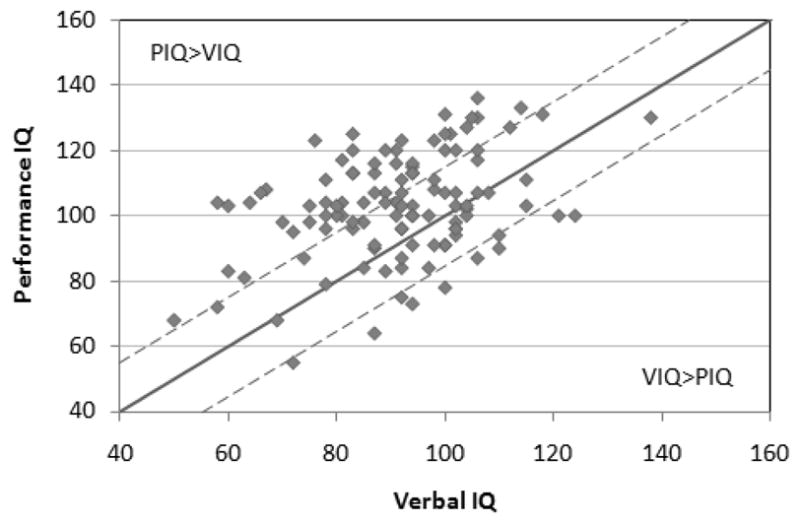
A substantial proportion of the adolescents obtained test scores within or above 1SD compared with hearing age-mates in the tests' normative samples: 71% on a verbal intelligence test, 68% on a measure of language content, 71% on receptive vocabulary, and 74% on expressive vocabulary. Improvement in verbal intelligence scores over an 8-yr interval exceeded expectation based on age-mates in the test's normative sample. Better English language outcomes were associated with shorter duration of deafness before cochlear implantation, higher nonverbal intelligence, higher family socioeconomic status, longer digit spans, and faster verbal rehearsal speed as measured by sentence repetition rate. Students whose current receptive vocabulary scores were not enhanced by the addition of signs also exhibited higher English language scores than those without sign enhancement; however, sign enhancement demonstrated in the elementary school years was not predictive of later high-school language skills.
Results of this study support the provision of CIs to children at the youngest age possible. In addition, it highlights the substantial role that cognition plays in later language outcomes. Although the students' use of sign to enhance language skills during the elementary years does not appear to have a negative impact on later language skills, students who continue to rely on sign to improve their vocabulary comprehension into high school typically exhibit poorer English language outcomes than students whose spoken language comprehension parallels or exceeds their comprehension of speech + sign. Overall, the language results obtained from these teenagers with more than 10 yrs of CI experience reflect substantial improvement over the verbal skills exhibited by adolescents with similar levels of hearing loss before the advent of CIs. These optimistic results were observed in teenagers who were among the first in the United States and Canada to receive a CI. We anticipate that the use of improved technology that is being initiated at even younger ages should lead to age-appropriate language levels in an even larger proportion of children with CIs.
本研究旨在确定在 2 至 5 岁之间接受人工耳蜗植入的青少年在英语语言方面取得成功的预测因素。
所有 112 名参与者均参与了先前一项研究,该研究在 8 岁和 9 岁时使用人工耳蜗检查了英语语言的结果。研究人员在参与者首选的交流模式下,对他们进行了一系列语言和言语推理测试,以及工作记忆(数字跨度)和言语复述速度(句子重复时长)的测试。在这两个测试阶段,均评估了将手语添加到口语中对学生语言表现的增强程度。使用多元线性回归分析来记录对整体语言结果有贡献的因素。
相当一部分青少年在测试中的得分与听力年龄匹配的正常样本相比处于或高于 1SD:71%的人在言语智力测试中,68%的人在语言内容测试中,71%的人在接受性词汇中,74%的人在表达性词汇中。言语智力得分在 8 年的间隔内的提高超过了测试正常样本中同龄人的预期。更好的英语语言结果与人工耳蜗植入前耳聋时间较短、非言语智力较高、家庭社会经济地位较高、数字跨度较长和言语复述速度较快(以句子重复率衡量)有关。当前接受性词汇得分未因添加手语而提高的学生的英语语言得分也高于没有手语增强的学生;然而,在小学阶段展示的手语增强并不能预测以后的高中语言技能。
本研究结果支持为最小年龄的儿童提供人工耳蜗。此外,它强调了认知在以后的语言结果中所起的重要作用。尽管学生在小学阶段使用手语来增强语言技能,但这似乎不会对以后的语言技能产生负面影响,但是那些继续依赖手语来提高词汇理解能力的学生,其语言成绩通常不如那些口语理解与言语+手语理解相当或超过的学生。总的来说,这些接受人工耳蜗超过 10 年的青少年的语言结果反映了与人工耳蜗问世前听力损失相似的青少年相比,他们的言语技能有了实质性的提高。这些乐观的结果出现在美国和加拿大最早接受人工耳蜗的青少年中。我们预计,在更小的年龄开始使用改进的技术将导致更大比例的接受人工耳蜗的儿童达到适当年龄的语言水平。
