Ling Carolina H Y, de Craen Anton J M, Slagboom P Eline, Westendorp Rudi G J, Maier Andrea B
Department of Gerontology and Geriatrics, Leiden University Medical Center, Albinusdreef 2, 2333 ZA, Leiden, The Netherlands.
Age (Dordr). 2012 Oct;34(5):1261-8. doi: 10.1007/s11357-011-9295-4. Epub 2011 Aug 11.
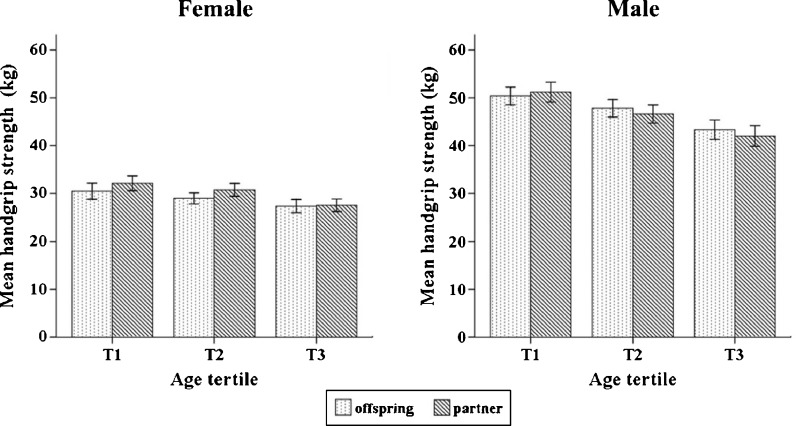
Low handgrip strength has been linked with premature mortality in diverse samples of middle-aged and elderly subjects. The value of handgrip strength as marker of "exceptional" human longevity has not been previously explored. We postulated that the genetic influence on extreme survival might also be involved in the muscular strength determination pathway. Therefore, the objective of this study was to assess the muscle strength in a sample of middle-aged adults who are genetically enriched for exceptional survival and comparing them to a control group. We included 336 offspring of the nonagenarian from the Leiden Longevity Study who were enriched for heritable exceptional longevity, and 336 of their partners were used as controls. The Leiden Longevity study was a prospective follow up study of long-living siblings pairs together with their offspring and their partners. Handgrip strength was used as a proxy for overall muscle strength. No significant difference in handgrip strength was seen between the offspring of the nonagenarian and their partners after adjustment for potential confounders including body compositions, sum score of comorbidities, medication use, smoking and alcohol history. The main determinants of midlife handgrip strength were age, gender, total body percentage fat and relative appendicular lean mass. Although midlife handgrip strength has previously been shown to be an important prognostic indicator of survival, it is not a marker of exceptional familial longevity in middle-aged adults. This finding suggests that genetic component of susceptibility to extreme survival is likely to be separate from that of muscular strength.
握力低下与中老年人群不同样本中的过早死亡有关。握力作为“超长”人类寿命标志物的价值此前尚未得到探讨。我们推测,对极端生存的遗传影响可能也参与了肌肉力量的决定途径。因此,本研究的目的是评估一组具有超长生存遗传倾向的中年成年人的肌肉力量,并将他们与对照组进行比较。我们纳入了来自莱顿长寿研究的336名百岁老人的后代,他们具有可遗传的超长寿命,另外336名他们的伴侣作为对照。莱顿长寿研究是一项对长寿兄弟姐妹及其后代和伴侣进行的前瞻性随访研究。握力被用作整体肌肉力量的代表指标。在对包括身体组成、合并症总分、用药情况、吸烟和饮酒史等潜在混杂因素进行调整后,百岁老人的后代与其伴侣之间的握力没有显著差异。中年握力的主要决定因素是年龄、性别、全身脂肪百分比和相对四肢瘦体重。尽管中年握力此前已被证明是生存的重要预后指标,但它并不是中年成年人家族超长寿命的标志物。这一发现表明,对极端生存易感性的遗传成分可能与肌肉力量的遗传成分是分开的。