Rantanen Taina, Masaki Kamal, He Qimei, Ross G Webster, Willcox Bradley J, White Lon
Gerontology Research Center, Department of Health Sciences, University of Jyvaskylä, Finland.
Age (Dordr). 2012 Jun;34(3):563-70. doi: 10.1007/s11357-011-9256-y. Epub 2011 May 4.
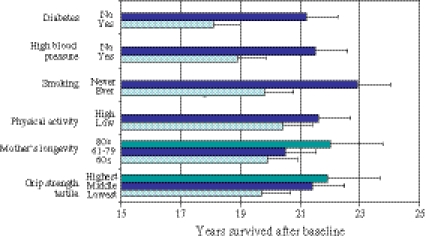
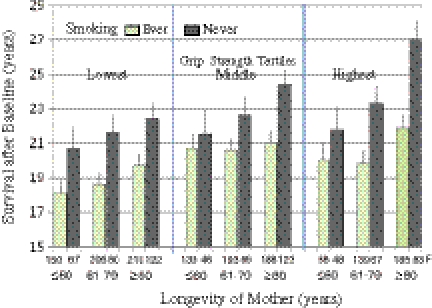
We studied prospectively the midlife handgrip strength, living habits, and parents' longevity as predictors of length of life up to becoming a centenarian. The participants were 2,239 men from the Honolulu Heart Program/Honolulu-Asia Aging Study who were born before the end of June 1909 and who took part in baseline physical assessment in 1965-1968, when they were 56-68 years old. Deaths were followed until the end of June 2009 for 44 years with complete ascertainment. Longevity was categorized as centenarian (≥100 years, n = 47), nonagenarian (90-99 years, n = 545), octogenarian (80-89 years, n = 847), and ≤79 years (n = 801, reference). The average survival after baseline was 20.8 years (SD = 9.62). Compared with people who died at the age of ≤79 years, centenarians belonged 2.5 times (odds ratio (OR) = 2.52, 95% confidence interval (CI) = 1.23-5.10) more often to the highest third of grip strength in midlife, were never smokers (OR = 5.75 95% CI = 3.06-10.80), had participated in physical activity outside work (OR = 1.13 per daily hour, 95% CI = 1.02-1.25), and had a long-lived mother (≥80 vs. ≤60 years, OR = 2.3, 95% CI = 1.06-5.01). Associations for nonagenarians and octogenarians were parallel, but weaker. Multivariate modeling showed that mother's longevity and offspring's grip strength operated through the same or overlapping pathway to longevity. High midlife grip strength and long-lived mother may indicate resilience to aging, which, combined with healthy lifestyle, increases the probability of extreme longevity.
我们前瞻性地研究了中年握力、生活习惯和父母的长寿情况,以此作为活到百岁老人的寿命预测指标。研究对象为来自檀香山心脏项目/檀香山亚洲老龄化研究的2239名男性,他们出生于1909年6月底之前,并于1965 - 1968年参加了基线身体评估,当时他们的年龄在56 - 68岁之间。对死亡情况进行了44年的跟踪,直至2009年6月底,确保数据完整。长寿被分为百岁老人(≥100岁,n = 47)、九旬老人(90 - 99岁,n = 545)、八旬老人(80 - 89岁,n = 847)和≤79岁(n = 801,参照组)。基线后的平均存活时间为20.8年(标准差 = 9.62)。与在≤79岁时死亡的人相比,百岁老人在中年握力最高的三分之一人群中所占比例高2.5倍(优势比(OR) = 2.52,95%置信区间(CI) = 1.23 - 5.10),从不吸烟(OR = 5.75,95% CI = 3.06 - 10.80),曾参加工作以外的体育活动(每增加一小时的OR = 1.13,95% CI = 1.02 - 1.25),并且母亲长寿(≥80岁与≤60岁相比,OR = 2.3,95% CI = 1.06 - 5.01)。九旬老人和八旬老人的关联情况与之相似,但较弱。多变量模型显示,母亲的长寿和后代的握力通过相同或重叠的途径影响长寿。中年时的高握力和母亲的长寿可能表明对衰老具有抵抗力,再加上健康的生活方式,会增加活到极高年龄的概率。