Orthopaedic and Trauma Department, Tzanio General Hospital of Piraeus, Zanni and Afendouli 1, GR-185 36, Piraeus, Greece.
J Orthop Surg Res. 2011 Aug 11;6:41. doi: 10.1186/1749-799X-6-41.
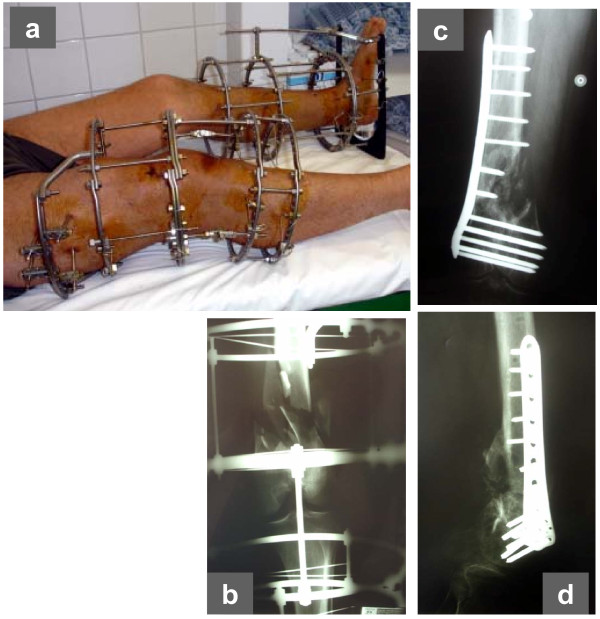
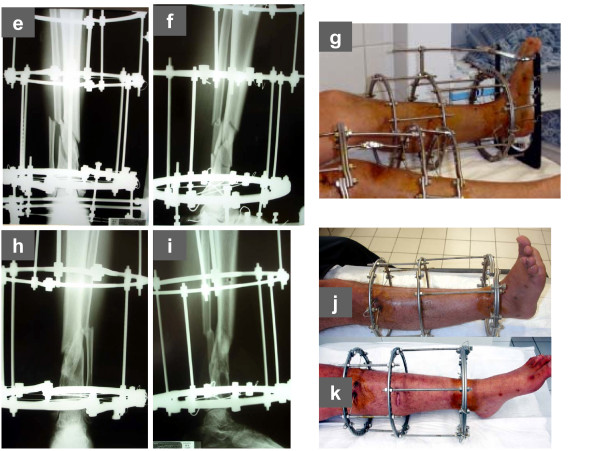
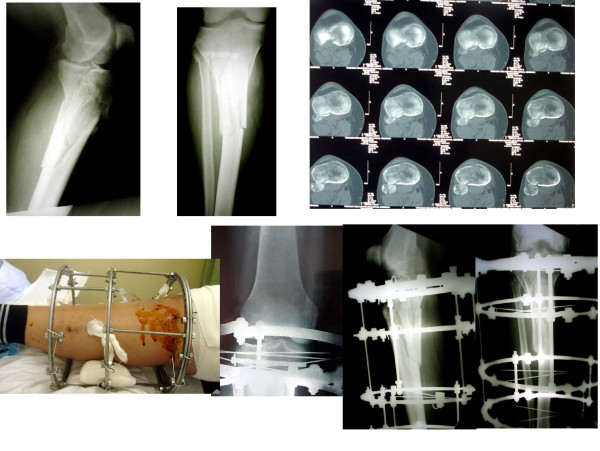
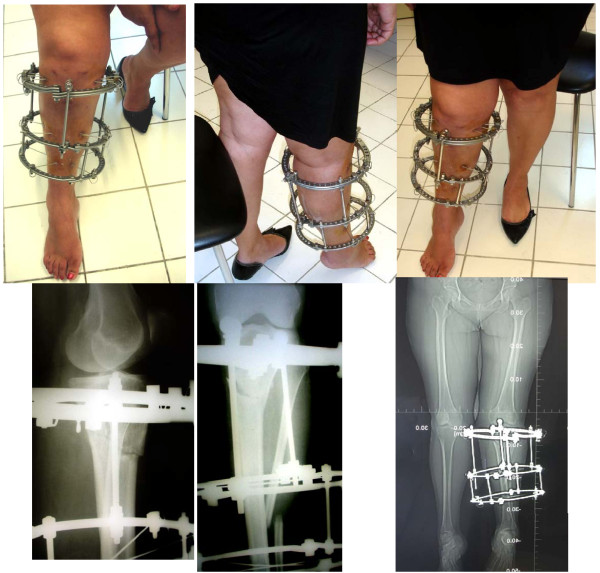
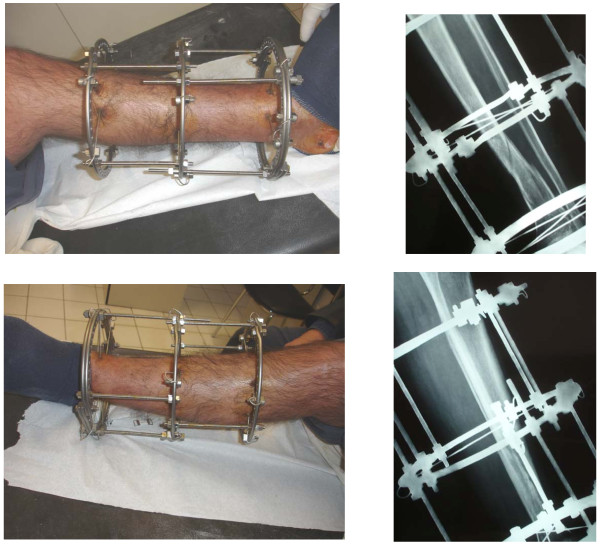
In peri- or intra-articular fractures of the tibia or femur, the presence of short metaphyseal bone fragments may make the application of an Ilizarov external fixator (IEF) challenging. In such cases, it may be necessary to bridge the adjacent joint in order to ensure stable fixation. The twin-ring (TR) module of circular external fixation is proposed as an alternative method that avoids joint bridging, without compromising stability of fixation. The aim of this study is to present the experimental tests performed to compare the biomechanical characteristics of the single- and TR IEF modules. The clinical application of the TR module in select patients is also presented and the merits of this technique are discussed.
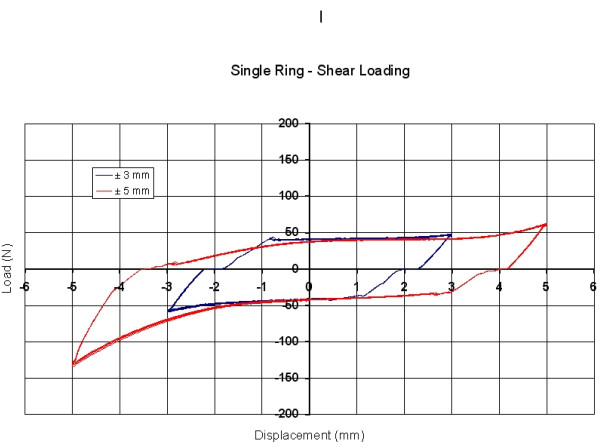
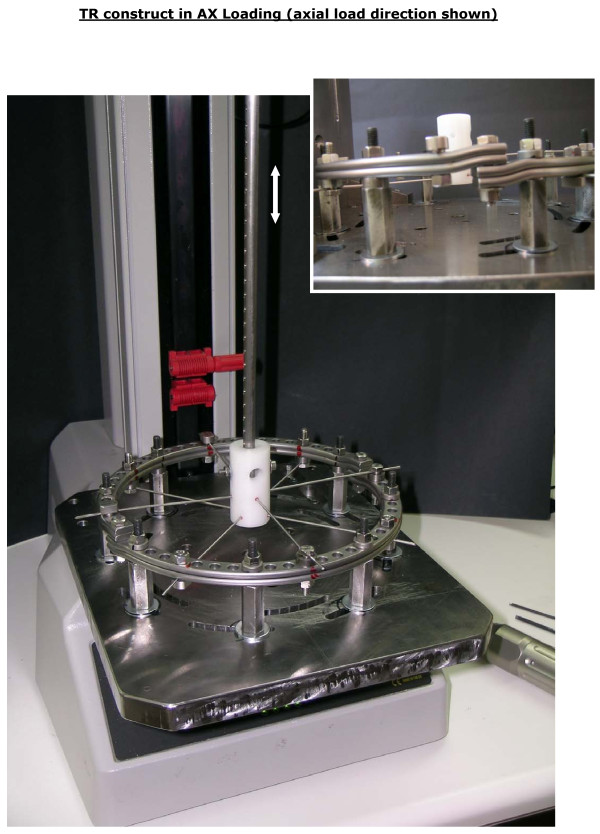
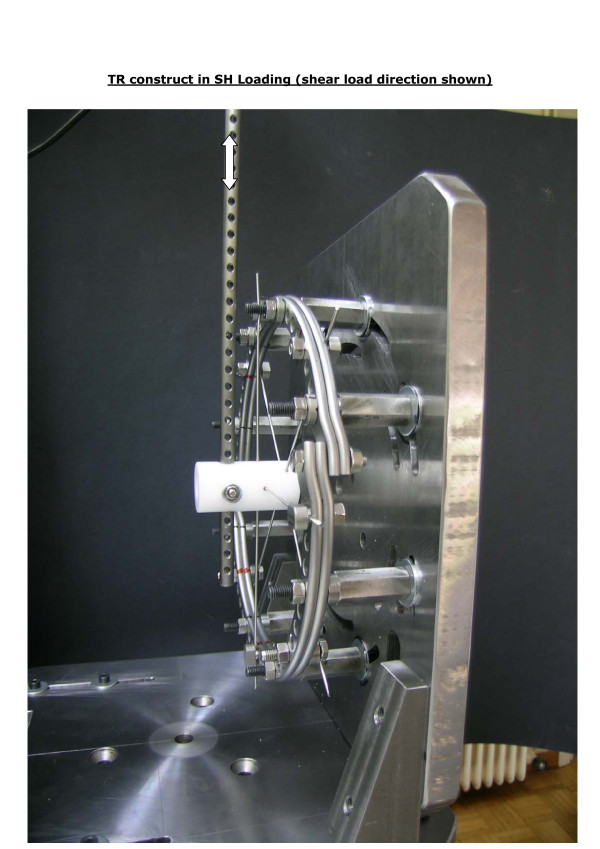
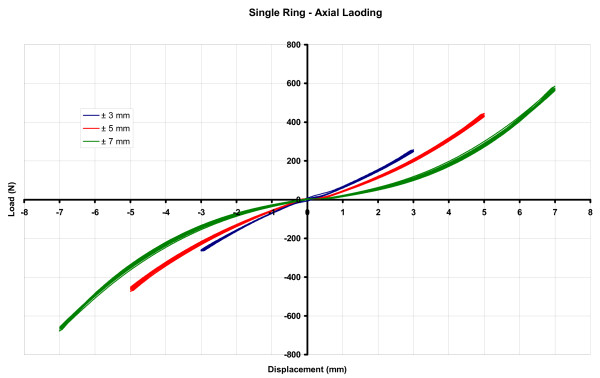
In this experimental study, the passive stiffness and stability of the single-ring (SR) and twin-ring (TR) IEF modules were tested under axial and shear loading conditions. In each module, two perpendicular wires on the upper surface and another two wires on the lower surface of the rings were used for fixation of the rings on plastic acetal cylinders simulating long bones.
In axial loading, the main outcome measure was stiffness and the SR module proved stiffer than the TR. In shear loading, the main outcome measure was stability, the TR module proving more stable than the SR.
The TR configuration, being stiffer in shear loading, may make joint bridging unnecessary when an IEF is applied. If it is still required, TR frames allow for an earlier discontinuation of bridging; either case is in favour of a successful final outcome.
The application of the TR module has led to satisfactory clinical outcomes and should be considered as an alternative in select trauma patients treated with an IEF. Biomechanically, the TR module possesses features which enhance fracture healing and at the same time obviate the need for bridging adjacent joints, thereby significantly reducing patient morbidity.
在胫骨或股骨的关节周围或关节内骨折中,短干骺端骨碎片的存在可能使伊利扎洛夫外固定器(IEF)的应用具有挑战性。在这种情况下,可能有必要桥接相邻的关节,以确保固定的稳定性。提出环形外固定的双环(TR)模块作为一种替代方法,避免关节桥接,同时不影响固定的稳定性。本研究旨在介绍为比较单环和 TR IEF 模块的生物力学特性而进行的实验测试。还介绍了 TR 模块在选择患者中的临床应用,并讨论了该技术的优点。
在这项实验研究中,在轴向和剪切加载条件下测试了单环(SR)和双环(TR)IEF 模块的被动刚度和稳定性。在每个模块中,在上表面的两条垂直线和环的下表面的另外两条线用于将环固定在模拟长骨的塑料缩醛圆柱体上。
在轴向加载中,主要的测量指标是刚度,SR 模块比 TR 模块更硬。在剪切加载中,主要的测量指标是稳定性,TR 模块比 SR 模块更稳定。
TR 结构在剪切加载中更硬,当应用 IEF 时可能使关节桥接变得不必要。如果仍然需要,TR 框架允许更早地停止桥接;无论哪种情况都有利于获得成功的最终结果。
TR 模块的应用带来了令人满意的临床结果,并且应该被认为是在使用 IEF 治疗的选择创伤患者中的一种替代方法。从生物力学的角度来看,TR 模块具有增强骨折愈合的特性,同时避免了桥接相邻关节的需要,从而显著降低了患者的发病率。