Department of Mathematics, Institute of Applied Pedagogy, University of Burundi, Burundi.
Malar J. 2011 Aug 11;10:234. doi: 10.1186/1475-2875-10-234.
Malaria is a major public health issue in Burundi in terms of both morbidity and mortality, with around 2.5 million clinical cases and more than 15,000 deaths each year. It is still the single main cause of mortality in pregnant women and children below five years of age. Because of the severe health and economic burden of malaria, there is still a growing need for methods that will help to understand the influencing factors. Several studies/researches have been done on the subject yielding different results as which factors are most responsible for the increase in malaria transmission. This paper considers the modelling of the dependence of malaria cases on spatial determinants and climatic covariates including rainfall, temperature and humidity in Burundi.
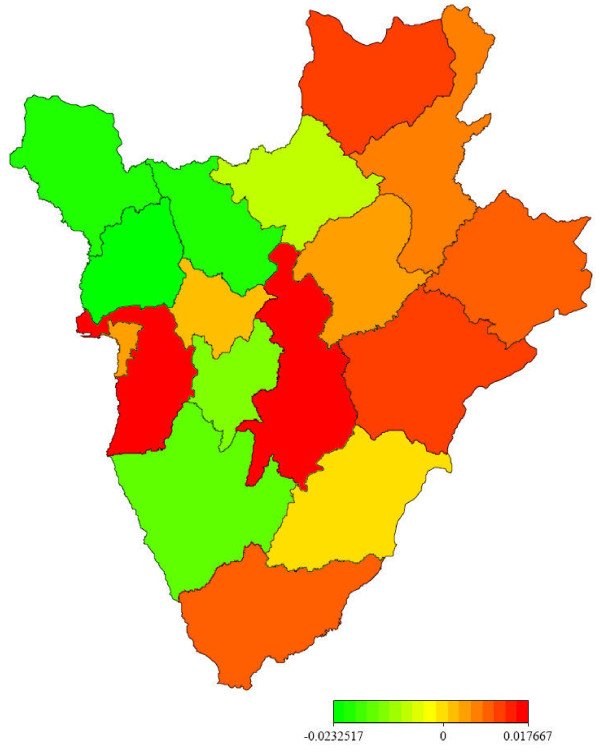
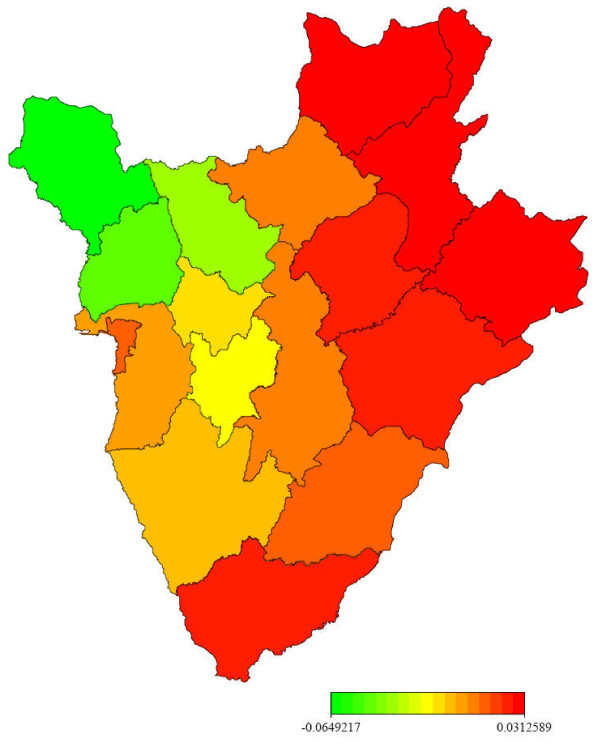
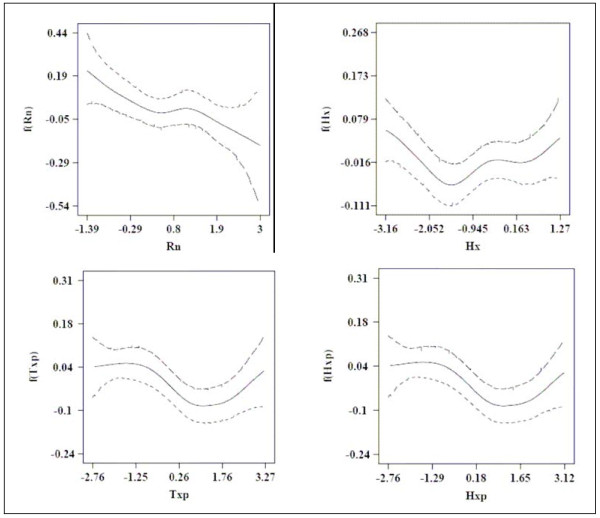
The analysis carried out in this work exploits real monthly data collected in the area of Burundi over 12 years (1996-2007). Semi-parametric regression models are used. The spatial analysis is based on a geo-additive model using provinces as the geographic units of study. The spatial effect is split into structured (correlated) and unstructured (uncorrelated) components. Inference is fully Bayesian and uses Markov chain Monte Carlo techniques. The effects of the continuous covariates are modelled by cubic p-splines with 20 equidistant knots and second order random walk penalty. For the spatially correlated effect, Markov random field prior is chosen. The spatially uncorrelated effects are assumed to be i.i.d. Gaussian. The effects of climatic covariates and the effects of other spatial determinants are estimated simultaneously in a unified regression framework.
The results obtained from the proposed model suggest that although malaria incidence in a given month is strongly positively associated with the minimum temperature of the previous months, regional patterns of malaria that are related to factors other than climatic variables have been identified, without being able to explain them.
In this paper, semiparametric models are used to model the effects of both climatic covariates and spatial effects on malaria distribution in Burundi. The results obtained from the proposed models suggest a strong positive association between malaria incidence in a given month and the minimum temperature of the previous month. From the spatial effects, important spatial patterns of malaria that are related to factors other than climatic variables are identified. Potential explanations (factors) could be related to socio-economic conditions, food shortage, limited access to health care service, precarious housing, promiscuity, poor hygienic conditions, limited access to drinking water, land use (rice paddies for example), displacement of the population (due to armed conflicts).
布隆迪的疟疾在发病率和死亡率方面都是一个重大的公共卫生问题,每年有 250 万例临床病例和超过 15000 人死亡。它仍然是孕妇和五岁以下儿童死亡的单一主要原因。由于疟疾对健康和经济的严重负担,仍然需要不断寻求帮助理解影响因素的方法。已经有几项关于这一主题的研究/调查,得出的结果不尽相同,因为哪些因素是导致疟疾传播增加的最主要原因。本文考虑了在布隆迪建模疟疾病例对空间决定因素和气候协变量(包括降雨量、温度和湿度)的依赖性。
本工作中的分析利用了在布隆迪地区收集的 12 年(1996-2007 年)的真实月度数据。采用半参数回归模型。空间分析基于使用省份作为研究地理单位的地理附加模型。空间效应分为结构化(相关)和非结构化(不相关)两部分。推理是完全贝叶斯的,并使用马尔可夫链蒙特卡罗技术。连续协变量的效应通过具有 20 个等距节点和二阶随机游走惩罚的立方 p-样条来建模。对于空间相关效应,选择马尔可夫随机场先验。空间不相关效应被假设为独立同分布的高斯。在统一的回归框架中同时估计气候协变量和其他空间决定因素的效应。
从提出的模型中得到的结果表明,尽管在给定月份的疟疾发病率与前几个月的最低温度呈强烈正相关,但已经确定了与气候变量以外的其他因素相关的疟疾区域模式,而无法解释这些模式。
在本文中,使用半参数模型来对布隆迪疟疾分布的气候协变量和空间效应的影响进行建模。从提出的模型中得到的结果表明,在给定月份的疟疾发病率与前一个月的最低温度之间存在强烈的正相关关系。从空间效应来看,确定了与气候变量以外的其他因素有关的重要疟疾空间模式。潜在的解释因素(因素)可能与社会经济条件、粮食短缺、获得医疗服务的机会有限、住房不稳定、滥交、卫生条件差、饮用水获取受限、土地利用(例如稻田)、人口流离失所(由于武装冲突)有关。