Ranjbar Mansour, Shoghli Alireza, Kolifarhood Goodarz, Tabatabaei Seyed Mehdi, Amlashi Morteza, Mohammadi Mahdi
Center for Vectors and Vector-Borne Diseases, Department of Biology, Mahidol University, Bangkok, Thailand.
Independent Malaria Consultant, Member of Surveillance, Monitoring and Evaluation Technical Expert Group, Global Malaria Programme, WHO, Geneva, Switzerland.
Malar J. 2016 Mar 2;15:138. doi: 10.1186/s12936-016-1192-y.
Malaria re-introduction is a challenge in elimination settings. To prevent re-introduction, receptivity, vulnerability, and health system capacity of foci should be monitored using appropriate tools. This study aimed to design an applicable model to monitor predicting factors of re-introduction of malaria in highly prone areas.
This exploratory, descriptive study was conducted in a pre-elimination setting with a high-risk of malaria transmission re-introduction. By using nominal group technique and literature review, a list of predicting indicators for malaria re-introduction and outbreak was defined. Accordingly, a checklist was developed and completed in the field for foci affected by re-introduction and for cleared-up foci as a control group, for a period of 12 weeks before re-introduction and for the same period in the previous year. Using field data and analytic hierarchical process (AHP), each variable and its sub-categories were weighted, and by calculating geometric means for each sub-category, score of corresponding cells of interaction matrices, lower and upper threshold of different risks strata, including low and mild risk of re-introduction and moderate and high risk of malaria outbreaks, were determined. The developed predictive model was calibrated through resampling with different sets of explanatory variables using R software. Sensitivity and specificity of the model were calculated based on new samples.
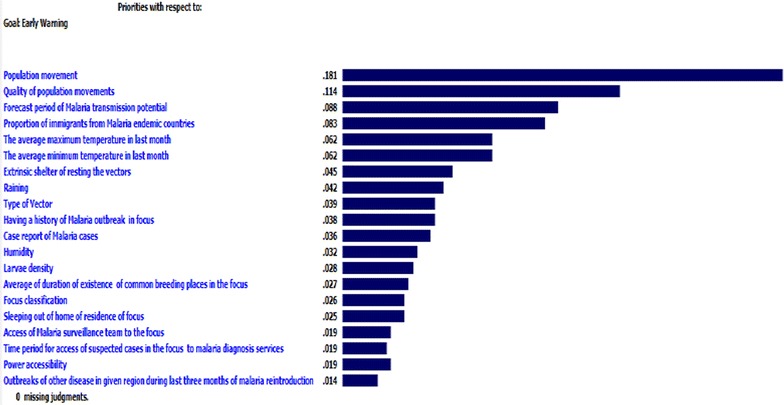
Twenty explanatory predictive variables of malaria re-introduction were identified and a predictive model was developed. Unpermitted immigrants from endemic neighbouring countries were determined as a pivotal factor (AHP score: 0.181). Moreover, quality of population movement (0.114), following malaria transmission season (0.088), average daily minimum temperature in the previous 8 weeks (0.062), an outdoor resting shelter for vectors (0.045), and rainfall (0.042) were determined. Positive and negative predictive values of the model were 81.8 and 100 %, respectively.
This study introduced a new, simple, yet reliable model to forecast malaria re-introduction and outbreaks eight weeks in advance in pre-elimination and elimination settings. The model incorporates comprehensive deterministic factors that can easily be measured in the field, thereby facilitating preventive measures.
在疟疾消除地区,疟疾重新传入是一项挑战。为防止重新传入,应使用适当工具监测疫源地的易感性、脆弱性和卫生系统能力。本研究旨在设计一个适用模型,以监测疟疾高发病地区疟疾重新传入的预测因素。
本探索性描述性研究在一个存在疟疾传播重新传入高风险的疟疾预消除地区开展。通过使用名义组技术和文献综述,确定了疟疾重新传入和暴发的预测指标清单。据此,制定了一份检查表,并在实地对受重新传入影响的疫源地以及作为对照组的已清除疫源地进行填写,记录重新传入前12周以及上一年同期的数据。利用实地数据和层次分析法(AHP),对每个变量及其子类别进行加权,并通过计算每个子类别的几何平均数、交互矩阵相应单元格的得分、不同风险分层(包括低和轻度重新传入风险以及中度和高度疟疾暴发风险)的下限和上限。使用R软件通过对不同解释变量集进行重采样来校准所开发的预测模型。根据新样本计算模型的敏感性和特异性。
确定了20个疟疾重新传入的解释性预测变量,并开发了一个预测模型。来自疟疾流行邻国的非法移民被确定为关键因素(AHP得分:0.181)。此外,还确定了人口流动质量(0.114)、疟疾传播季节之后(0.088)、前8周的日平均最低气温(0.062)、媒介的户外栖息场所(0.045)和降雨量(0.042)。该模型的阳性预测值和阴性预测值分别为81.8%和100%。
本研究引入了一种新的、简单但可靠的模型,可在疟疾预消除和消除地区提前8周预测疟疾的重新传入和暴发。该模型纳入了可在实地轻松测量的综合确定性因素,从而便于采取预防措施。