• 文献检索
  • 文档翻译
  • 深度研究
  • 学术资讯
  • Suppr Zotero 插件Zotero 插件
  • 邀请有礼
  • 套餐&价格
  • 历史记录
应用&插件
Suppr Zotero 插件Zotero 插件浏览器插件Mac 客户端Windows 客户端微信小程序
定价
高级版会员购买积分包购买API积分包
服务
文献检索文档翻译深度研究API 文档MCP 服务
关于我们
关于 Suppr公司介绍联系我们用户协议隐私条款
关注我们

Suppr 超能文献

核心技术专利:CN118964589B侵权必究
粤ICP备2023148730 号-1Suppr @ 2026

文献检索

告别复杂PubMed语法,用中文像聊天一样搜索,搜遍4000万医学文献。AI智能推荐,让科研检索更轻松。

立即免费搜索

文件翻译

保留排版,准确专业,支持PDF/Word/PPT等文件格式,支持 12+语言互译。

免费翻译文档

深度研究

AI帮你快速写综述,25分钟生成高质量综述,智能提取关键信息,辅助科研写作。

立即免费体验

蚊媒传染病模型中的空间连通性:方法和假设的系统评价。

Spatial connectivity in mosquito-borne disease models: a systematic review of methods and assumptions.

机构信息

Centre for Mathematical Modelling of Infectious Diseases, London School of Hygiene & Tropical Medicine, London, UK.

Centre on Climate Change and Planetary Health, London School of Hygiene & Tropical Medicine, London, UK.

出版信息

J R Soc Interface. 2021 May;18(178):20210096. doi: 10.1098/rsif.2021.0096. Epub 2021 May 26.

DOI:10.1098/rsif.2021.0096
PMID:34034534
原文链接:https://pmc.ncbi.nlm.nih.gov/articles/PMC8150046/
Abstract

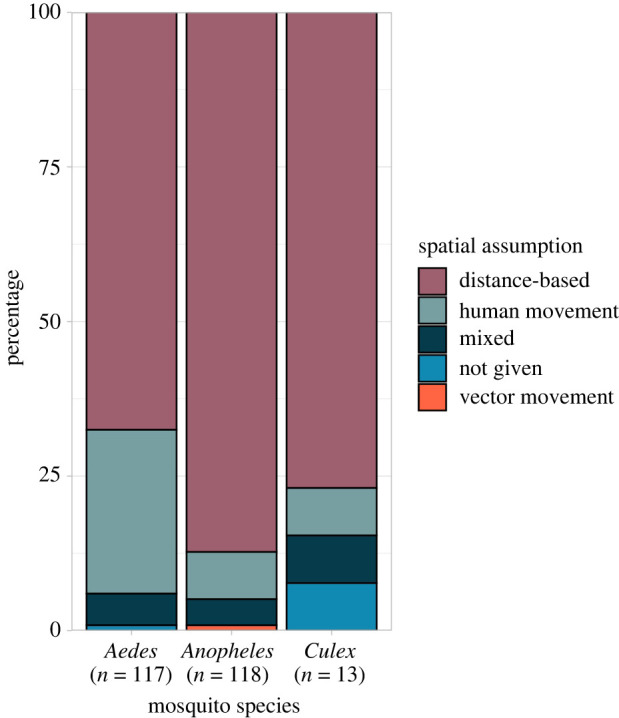
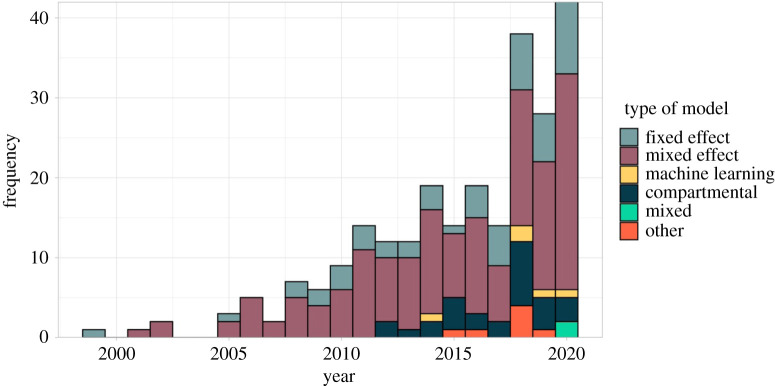
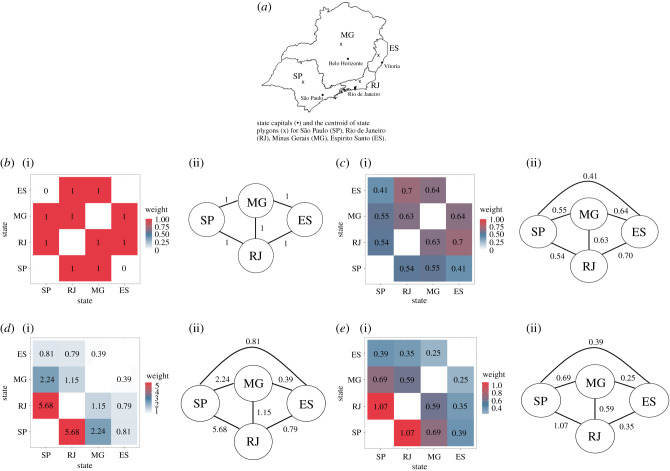
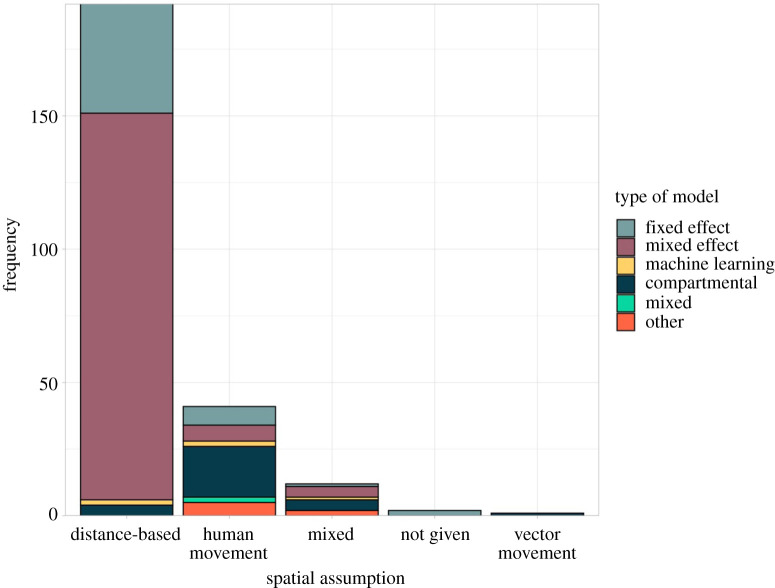
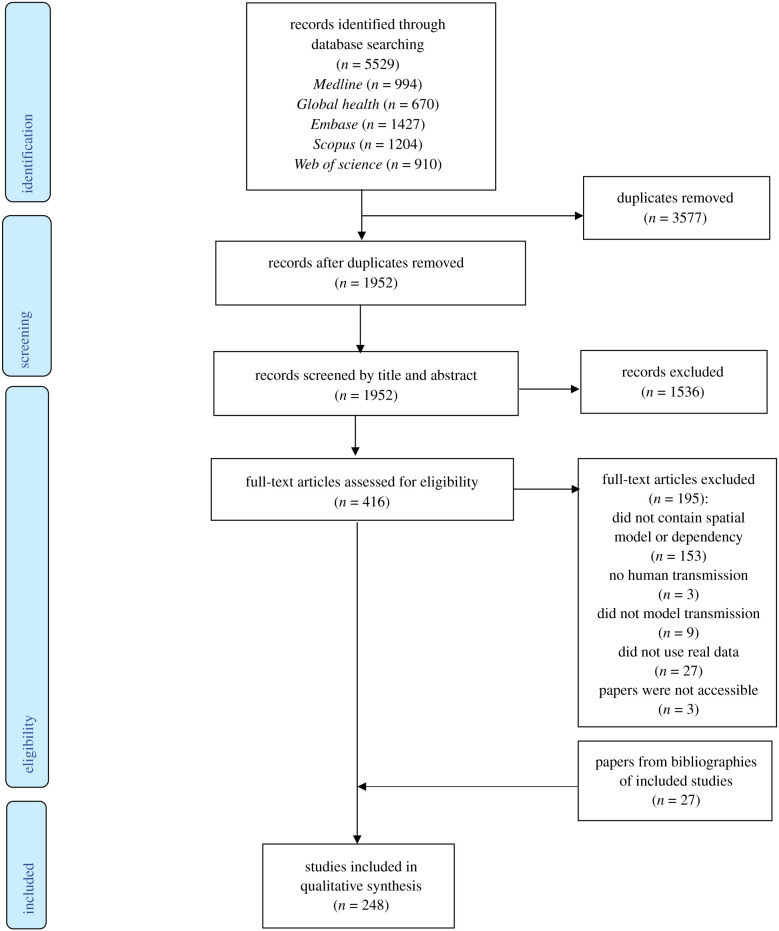
Spatial connectivity plays an important role in mosquito-borne disease transmission. Connectivity can arise for many reasons, including shared environments, vector ecology and human movement. This systematic review synthesizes the spatial methods used to model mosquito-borne diseases, their spatial connectivity assumptions and the data used to inform spatial model components. We identified 248 papers eligible for inclusion. Most used statistical models (84.2%), although mechanistic are increasingly used. We identified 17 spatial models which used one of four methods (spatial covariates, local regression, random effects/fields and movement matrices). Over 80% of studies assumed that connectivity was distance-based despite this approach ignoring distant connections and potentially oversimplifying the process of transmission. Studies were more likely to assume connectivity was driven by human movement if the disease was transmitted by an mosquito. Connectivity arising from human movement was more commonly assumed in studies using a mechanistic model, likely influenced by a lack of statistical models able to account for these connections. Although models have been increasing in complexity, it is important to select the most appropriate, parsimonious model available based on the research question, disease transmission process, the spatial scale and availability of data, and the way spatial connectivity is assumed to occur.

摘要

空间连通性在蚊媒疾病传播中起着重要作用。连通性可能有多种原因,包括共享环境、媒介生态学和人类活动。本系统综述综合了用于模拟蚊媒疾病的空间方法、其空间连通性假设以及用于告知空间模型组成部分的数据。我们确定了 248 篇符合纳入标准的论文。大多数使用了统计模型(84.2%),尽管机制模型的使用也在逐渐增加。我们确定了 17 个空间模型,这些模型使用了以下四种方法之一(空间协变量、局部回归、随机效应/场和运动矩阵)。尽管这种方法忽略了远距离连接,并可能使传播过程过于简化,但超过 80%的研究假设连通性是基于距离的。如果疾病是由蚊子传播的,那么研究更有可能假设连通性是由人类活动驱动的。在使用机制模型的研究中,更有可能假设连通性是由人类活动引起的,这可能是由于缺乏能够解释这些连接的统计模型的影响。尽管模型的复杂性不断增加,但根据研究问题、疾病传播过程、空间尺度和数据可用性以及假设空间连通性发生的方式,选择最合适、最简约的可用模型非常重要。
https://cdn.ncbi.nlm.nih.gov/pmc/blobs/bc99/8150046/2ad248f68477/rsif20210096f05.jpg
https://cdn.ncbi.nlm.nih.gov/pmc/blobs/bc99/8150046/d82f2ba2da99/rsif20210096f01.jpg
https://cdn.ncbi.nlm.nih.gov/pmc/blobs/bc99/8150046/c7af750cba84/rsif20210096f02.jpg
https://cdn.ncbi.nlm.nih.gov/pmc/blobs/bc99/8150046/b3807cc49823/rsif20210096f03.jpg
https://cdn.ncbi.nlm.nih.gov/pmc/blobs/bc99/8150046/c3f7bb1ec95b/rsif20210096f04.jpg
https://cdn.ncbi.nlm.nih.gov/pmc/blobs/bc99/8150046/2ad248f68477/rsif20210096f05.jpg
https://cdn.ncbi.nlm.nih.gov/pmc/blobs/bc99/8150046/d82f2ba2da99/rsif20210096f01.jpg
https://cdn.ncbi.nlm.nih.gov/pmc/blobs/bc99/8150046/c7af750cba84/rsif20210096f02.jpg
https://cdn.ncbi.nlm.nih.gov/pmc/blobs/bc99/8150046/b3807cc49823/rsif20210096f03.jpg
https://cdn.ncbi.nlm.nih.gov/pmc/blobs/bc99/8150046/c3f7bb1ec95b/rsif20210096f04.jpg
https://cdn.ncbi.nlm.nih.gov/pmc/blobs/bc99/8150046/2ad248f68477/rsif20210096f05.jpg

相似文献

1
Spatial connectivity in mosquito-borne disease models: a systematic review of methods and assumptions.蚊媒传染病模型中的空间连通性:方法和假设的系统评价。
J R Soc Interface. 2021 May;18(178):20210096. doi: 10.1098/rsif.2021.0096. Epub 2021 May 26.
2
The spatial and temporal scales of local dengue virus transmission in natural settings: a retrospective analysis.自然环境中局部登革热病毒传播的时空尺度:回顾性分析。
Parasit Vectors. 2018 Feb 2;11(1):79. doi: 10.1186/s13071-018-2662-6.
3
The 'lifecycle' of human beings: a call to explore vector-borne diseases from an ecosystem perspective.人类的“生命周期”:呼吁从生态系统角度探索虫媒传染病。
Infect Dis Poverty. 2020 Apr 16;9(1):37. doi: 10.1186/s40249-020-00653-y.
4
The role of human movement in the transmission of vector-borne pathogens.人类活动在媒介传播病原体中的作用。
PLoS Negl Trop Dis. 2009 Jul 21;3(7):e481. doi: 10.1371/journal.pntd.0000481.
5
Efficacy of a spatial repellent for control of -borne virus transmission: A cluster-randomized trial in Iquitos, Peru.空间驱避剂控制 - 传播病毒的效果:秘鲁伊基托斯的一项集群随机试验。
Proc Natl Acad Sci U S A. 2022 Jun 28;119(26):e2118283119. doi: 10.1073/pnas.2118283119. Epub 2022 Jun 23.
6
Climate-driven mosquito-borne viral suitability index: measuring risk transmission of dengue, chikungunya and Zika in Mexico.气候驱动的蚊媒病毒适宜性指数:评估登革热、基孔肯雅热和寨卡病毒在墨西哥的传播风险。
Int J Health Geogr. 2022 Oct 27;21(1):15. doi: 10.1186/s12942-022-00317-0.
7
WebGIS-Based Real-Time Surveillance and Response System for Vector-Borne Infectious Diseases.基于 WebGIS 的虫媒传染病实时监测与响应系统。
Int J Environ Res Public Health. 2023 Feb 20;20(4):3740. doi: 10.3390/ijerph20043740.
8
Mosquito-borne transmission in urban landscapes: the missing link between vector abundance and human density.城市景观中的蚊媒传播:媒介丰度与人群密度之间缺失的环节。
Proc Biol Sci. 2018 Aug 15;285(1884):20180826. doi: 10.1098/rspb.2018.0826.
9
Role of vector phenotypic plasticity in disease transmission as illustrated by the spread of dengue virus by Aedes albopictus.媒介表型可塑性在疾病传播中的作用——以白纹伊蚊传播登革病毒为例。
Nat Commun. 2024 Sep 7;15(1):7823. doi: 10.1038/s41467-024-52144-5.
10
Utility of mosquito surveillance data for spatial prioritization of vector control against dengue viruses in three Brazilian cities.巴西三个城市蚊虫监测数据在登革病毒病媒控制空间优先排序中的效用
Parasit Vectors. 2015 Feb 15;8:98. doi: 10.1186/s13071-015-0659-y.

引用本文的文献

1
The overlapping global distribution of dengue, chikungunya, Zika and yellow fever.登革热、基孔肯雅热、寨卡病毒病和黄热病在全球的分布重叠。
Nat Commun. 2025 Apr 10;16(1):3418. doi: 10.1038/s41467-025-58609-5.
2
Exploring Dengue Dynamics: A Multi-Scale Analysis of Spatio-Temporal Trends in Ibagué, Colombia.探索登革热动态:哥伦比亚伊瓦格多尺度时空趋势分析。
Viruses. 2024 Jun 3;16(6):906. doi: 10.3390/v16060906.
3
Modeling the Regional Distribution of International Travelers in Spain to Estimate Imported Cases of Dengue and Malaria: Statistical Inference and Validation Study.

本文引用的文献

1
A spatial-temporal study of dengue in Peninsular Malaysia for the year 2017 in two different space-time model.2017年马来西亚半岛登革热在两种不同时空模型下的时空研究。
J Appl Stat. 2019 Jul 31;47(4):739-756. doi: 10.1080/02664763.2019.1648391. eCollection 2020.
2
Spatiotemporal distribution and socioeconomic disparities of dengue, chikungunya and Zika in two Latin American cities from 2007 to 2017.2007 年至 2017 年拉丁美洲两个城市登革热、基孔肯雅热和寨卡病毒的时空分布及社会经济差异。
Trop Med Int Health. 2021 Mar;26(3):301-315. doi: 10.1111/tmi.13530. Epub 2020 Dec 13.
3
Measuring the contribution of human mobility to malaria persistence.
建模西班牙国际旅行者的区域分布以估计登革热和疟疾的输入病例:统计推断和验证研究。
JMIR Public Health Surveill. 2024 May 27;10:e51191. doi: 10.2196/51191.
4
A systematic review of the data, methods and environmental covariates used to map Aedes-borne arbovirus transmission risk.一项系统回顾数据、方法和环境协变量用于绘制伊蚊传播虫媒病毒风险的地图。
BMC Infect Dis. 2023 Oct 20;23(1):708. doi: 10.1186/s12879-023-08717-8.
5
Implementing landscape genetics in molecular epidemiology to determine drivers of vector-borne disease: A malaria case study.在分子流行病学中实施景观遗传学以确定虫媒病的驱动因素:疟疾案例研究。
Mol Ecol. 2023 Apr;32(8):1848-1859. doi: 10.1111/mec.16846. Epub 2023 Feb 1.
6
Host movement, transmission hot spots, and vector-borne disease dynamics on spatial networks.空间网络上的宿主移动、传播热点与媒介传播疾病动态
Infect Dis Model. 2022 Nov 4;7(4):742-760. doi: 10.1016/j.idm.2022.10.006. eCollection 2022 Dec.
7
A Systematic Review on Modeling Methods and Influential Factors for Mapping Dengue-Related Risk in Urban Settings.基于城市环境的登革热相关风险制图模型方法及影响因素的系统评价
Int J Environ Res Public Health. 2022 Nov 18;19(22):15265. doi: 10.3390/ijerph192215265.
8
A Bayesian modelling framework to quantify multiple sources of spatial variation for disease mapping.一种用于量化疾病制图中多种空间变异来源的贝叶斯建模框架。
J R Soc Interface. 2022 Sep;19(194):20220440. doi: 10.1098/rsif.2022.0440. Epub 2022 Sep 21.
9
Spatio-temporal dynamics of dengue-related deaths and associated factors.登革热相关死亡的时空动态及其相关因素。
Rev Inst Med Trop Sao Paulo. 2022 Apr 4;64:e30. doi: 10.1590/S1678-9946202264030. eCollection 2022.
10
The impact of climate suitability, urbanisation, and connectivity on the expansion of dengue in 21st century Brazil.气候适宜性、城市化和连通性对 21 世纪巴西登革热传播的影响。
PLoS Negl Trop Dis. 2021 Dec 9;15(12):e0009773. doi: 10.1371/journal.pntd.0009773. eCollection 2021 Dec.
衡量人类流动对疟疾持续存在的贡献。
Malar J. 2020 Nov 11;19(1):404. doi: 10.1186/s12936-020-03474-4.
4
Spatiotemporal modeling of dengue fever risk in Puerto Rico.波多黎各登革热风险的时空建模。
Spat Spatiotemporal Epidemiol. 2020 Nov;35:100375. doi: 10.1016/j.sste.2020.100375. Epub 2020 Aug 27.
5
Influence of socio-economic, demographic and climate factors on the regional distribution of dengue in the United States and Mexico.社会经济、人口和气候因素对美国和墨西哥登革热区域分布的影响。
Int J Health Geogr. 2020 Nov 2;19(1):44. doi: 10.1186/s12942-020-00241-1.
6
Predicting dengue outbreaks at neighbourhood level using human mobility in urban areas.利用城市地区的人口流动预测社区层面的登革热疫情。
J R Soc Interface. 2020 Oct;17(171):20200691. doi: 10.1098/rsif.2020.0691. Epub 2020 Oct 28.
7
Malaria Transmission and Spillover across the Peru-Ecuador Border: A Spatiotemporal Analysis.疟疾在秘鲁-厄瓜多尔边境的传播和溢出:时空分析。
Int J Environ Res Public Health. 2020 Oct 13;17(20):7434. doi: 10.3390/ijerph17207434.
8
Climate variability, socio-ecological factors and dengue transmission in tropical Queensland, Australia: A Bayesian spatial analysis.澳大利亚昆士兰州热带地区气候多变性、社会生态因素与登革热传播:贝叶斯空间分析。
Environ Res. 2021 Apr;195:110285. doi: 10.1016/j.envres.2020.110285. Epub 2020 Oct 4.
9
Evaluating the Effects of Climate and Environmental Factors on Under-5 Children Malaria Spatial Distribution Using Generalized Additive Models (GAMs).使用广义相加模型(GAMs)评估气候和环境因素对5岁以下儿童疟疾空间分布的影响。
J Epidemiol Glob Health. 2020 Dec;10(4):304-314. doi: 10.2991/jegh.k.200814.001. Epub 2020 Aug 21.
10
Exploring local and global regression models to estimate the spatial variability of Zika and Chikungunya cases in Recife, Brazil.探讨局部和全局回归模型,以估计巴西累西腓寨卡和基孔肯雅热病例的空间变异性。
Rev Soc Bras Med Trop. 2020 Sep 25;53:e20200027. doi: 10.1590/0037-8682-0027-2020. eCollection 2020.