Northwest Labs, Department of Molecular and Cellular Biology, Harvard University, Cambridge, MA 02138, USA.
Mol Cell. 2011 Sep 2;43(5):738-50. doi: 10.1016/j.molcel.2011.07.020. Epub 2011 Aug 11.
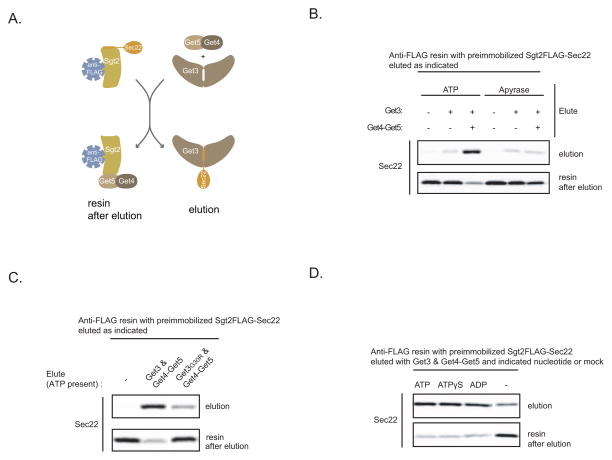
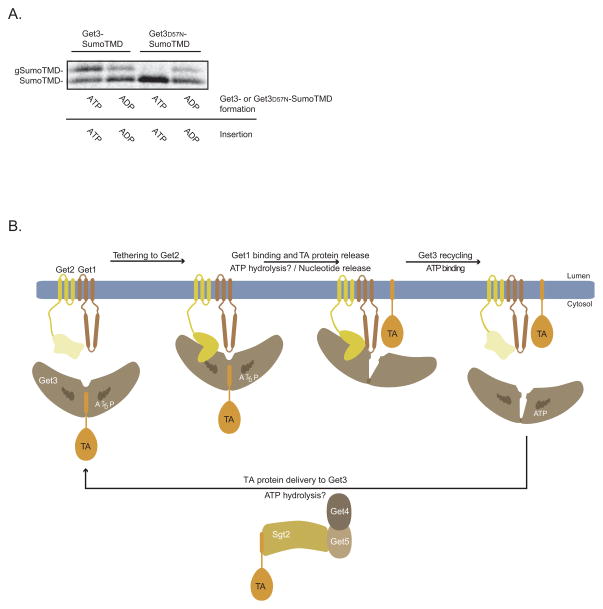
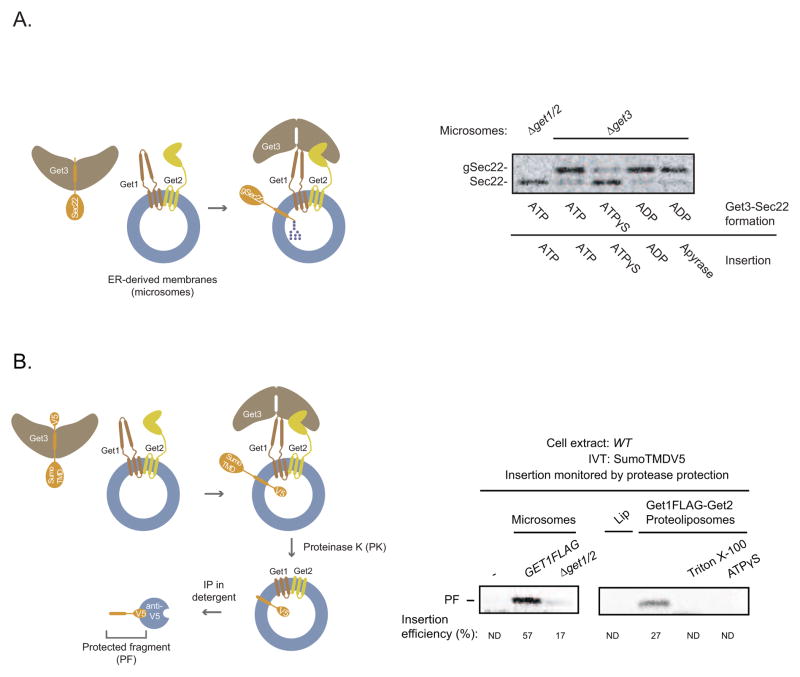
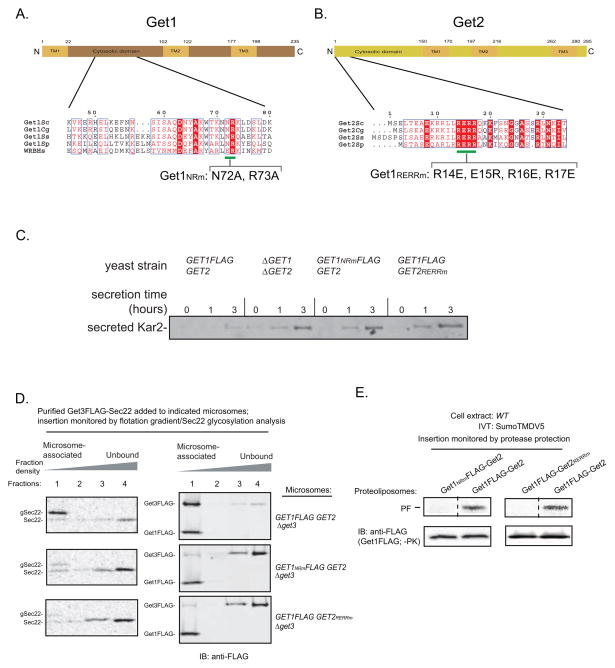
Tail-anchored (TA) proteins access the secretory pathway via posttranslational insertion of their C-terminal transmembrane domain into the endoplasmic reticulum (ER). Get3 is an ATPase that delivers TA proteins to the ER by interacting with the Get1-Get2 transmembrane complex, but how Get3's nucleotide cycle drives TA protein insertion remains unclear. Here, we establish that nucleotide binding to Get3 promotes Get3-TA protein complex formation by recruiting Get3 to a chaperone that hands over TA proteins to Get3. Biochemical reconstitution and mutagenesis reveal that the Get1-Get2 complex comprises the minimal TA protein insertion machinery with functionally critical cytosolic regions. By engineering a soluble heterodimer of Get1-Get2 cytosolic domains, we uncover the mechanism of TA protein release from Get3: Get2 tethers Get3-TA protein complexes into proximity with the ATPase-dependent, substrate-releasing activity of Get1. Lastly, we show that ATP enhances Get3 dissociation from the membrane, thus freeing Get1-Get2 for new rounds of substrate insertion.
尾部锚定(TA)蛋白通过其 C 末端跨膜结构域的翻译后插入内质网(ER)进入分泌途径。Get3 是一种 ATP 酶,通过与 Get1-Get2 跨膜复合物相互作用将 TA 蛋白递送至 ER,但 Get3 的核苷酸循环如何驱动 TA 蛋白插入仍不清楚。在这里,我们确定核苷酸结合 Get3 通过将 Get3 募集到将 TA 蛋白递交给 Get3 的伴侣蛋白来促进 Get3-TA 蛋白复合物的形成。生化重建和突变分析揭示了 Get1-Get2 复合物包含具有功能关键细胞质区域的最小 TA 蛋白插入机制。通过工程化 Get1-Get2 细胞质结构域的可溶性异二聚体,我们揭示了 TA 蛋白从 Get3 释放的机制:Get2 将 Get3-TA 蛋白复合物系留到 Get1 的 ATP 依赖性、底物释放活性附近。最后,我们表明 ATP 增强了 Get3 从膜上的解离,从而使 Get1-Get2 能够进行新的一轮底物插入。