Department of Cell Biology, University of Alabama at Birmingham, Birmingham, Alabama, United States of America.
PLoS One. 2009 Nov 30;4(11):e8061. doi: 10.1371/journal.pone.0008061.
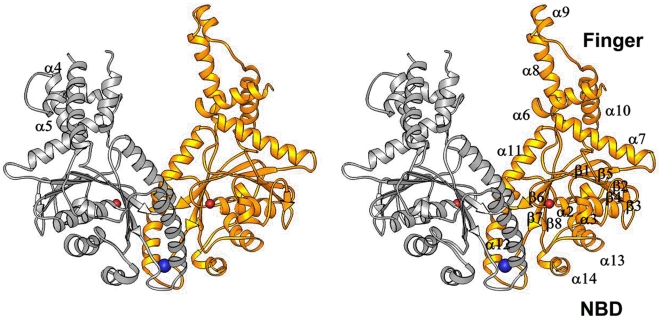
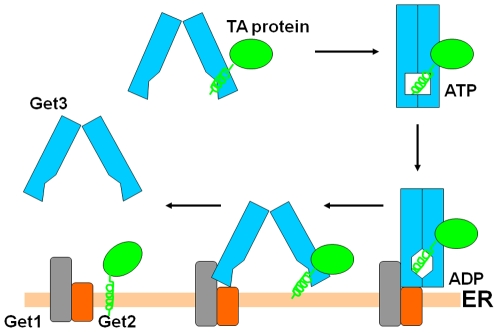
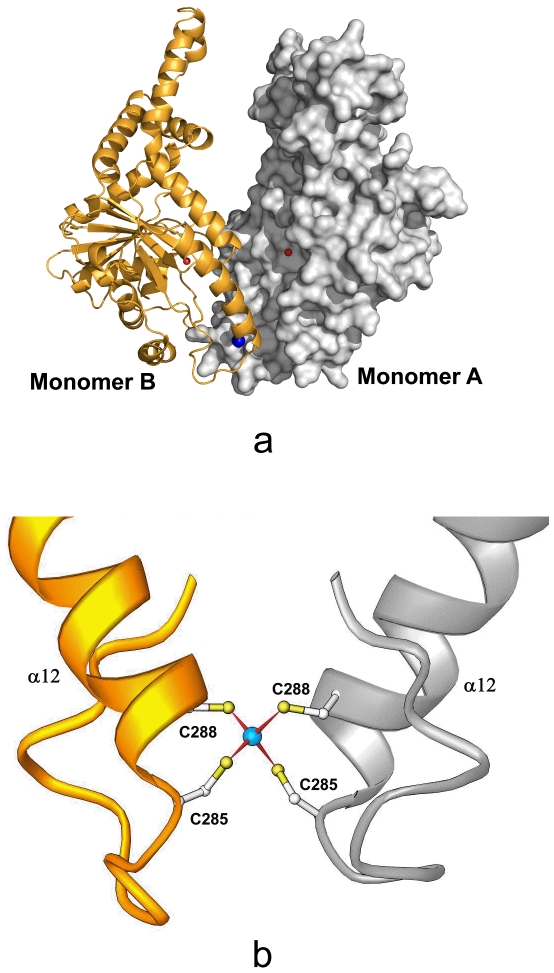
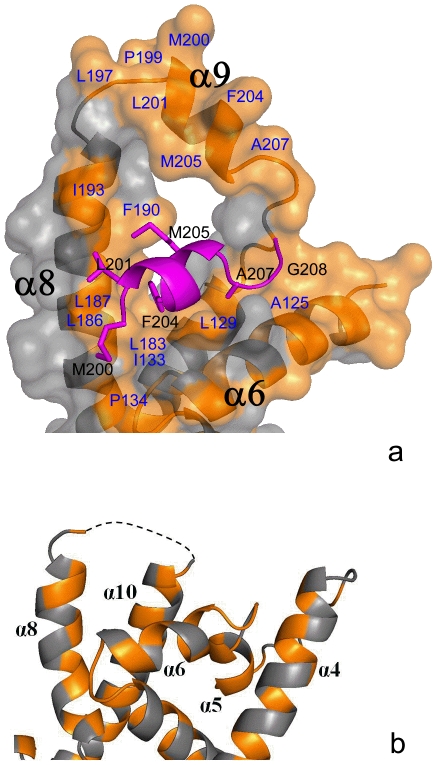
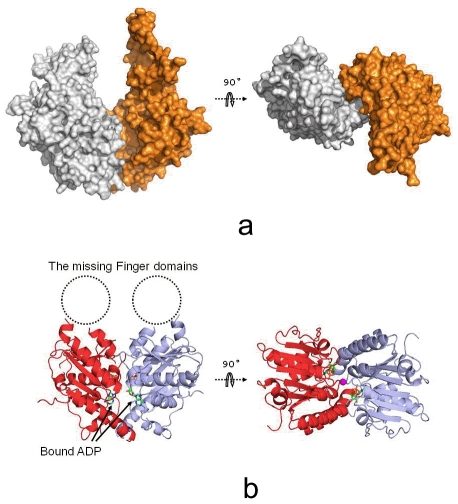
Tail-anchored (TA) proteins represent a unique class of membrane proteins that contain a single C-terminal transmembrane helix. The post-translational insertion of the yeast TA proteins into the ER membrane requires the Golgi ER trafficking (GET) complex which contains Get1, Get2 and Get3. Get3 is an ATPase that recognizes and binds the C-terminal transmembrane domain (TMD) of the TA proteins. We have determined the crystal structures of Get3 from two yeast species, S. cerevisiae and D. hansenii, respectively. These high resolution crystal structures show that Get3 contains a nucleotide-binding domain and a "finger" domain for binding the TA protein TMD. A large hydrophobic groove on the finger domain of S. cerevisiae Get3 structure might represent the binding site for TMD of TA proteins. A hydrophobic helix from a symmetry-related Get3 molecule sits in the TMD-binding groove and mimics the TA binding scenario. Interestingly, the crystal structures of the Get3 dimers from S. cerevisiae and D. hansenii exhibit distinct conformations. The S. cerevisiae Get3 dimer structure does not contain nucleotides and maintains an "open" conformation, while the D. hansenii Get3 dimer structure binds ADP and stays in a "closed" conformation. We propose that the conformational changes to switch the Get3 between the open and closed conformations may facilitate the membrane insertions for TA proteins.
尾部锚定(TA)蛋白是一类独特的膜蛋白,它们只含有一个 C 端跨膜螺旋。酵母 TA 蛋白的翻译后插入内质网(ER)膜需要高尔基体 ER 运输(GET)复合物,该复合物包含 Get1、Get2 和 Get3。Get3 是一种 ATP 酶,可识别和结合 TA 蛋白的 C 端跨膜结构域(TMD)。我们分别确定了来自两种酵母物种,酿酒酵母和汉逊德巴利酵母的 Get3 的晶体结构。这些高分辨率晶体结构显示,Get3 包含一个核苷酸结合结构域和一个用于结合 TA 蛋白 TMD 的“手指”结构域。酿酒酵母 Get3 结构的手指结构域上的一个大疏水性凹槽可能代表 TA 蛋白 TMD 的结合位点。来自对称相关 Get3 分子的疏水性螺旋位于 TMD 结合凹槽中,并模拟 TA 结合情况。有趣的是,来自酿酒酵母和汉逊德巴利酵母的 Get3 二聚体的晶体结构表现出不同的构象。酿酒酵母 Get3 二聚体结构不含核苷酸并保持“开放”构象,而汉逊德巴利酵母 Get3 二聚体结构结合 ADP 并保持“关闭”构象。我们提出,Get3 在开放和关闭构象之间的构象变化可能有助于 TA 蛋白的膜插入。