Department of Psychiatry, Harvard Medical School, Boston MA.
Indian J Psychiatry. 2010 Jan;52(Suppl 1):S153-8. doi: 10.4103/0019-5545.69228.
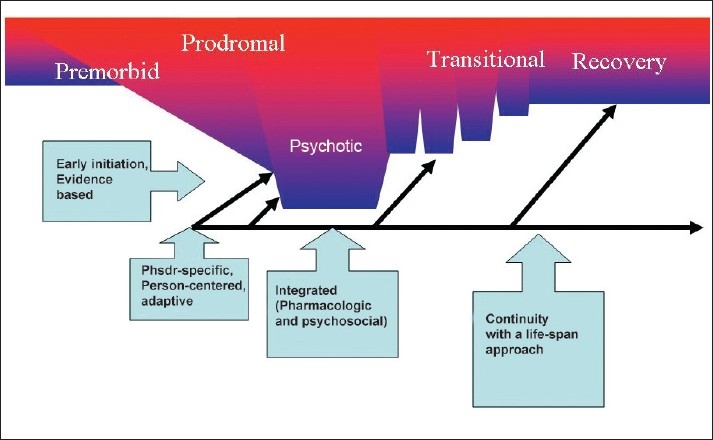
Over the last two decades, there has been an increasing interest in the concept of early intervention (EI) in psychotic disorders, notably schizophrenia. Several lines of research underlie this emerging paradigm shift: (a) an increasingly well-established association between the duration of prolonged untreated illness and poor outcome; (b) evidence of progressive neurobiological changes in the early course of schizophrenia both in the pre-psychotic and psychotic phases, as evidenced by brain imaging studies in schizophrenia; and (c) emerging data, albeit preliminary, suggesting the efficacy and effectiveness of EI programs in improving the outcome in these patients. Mental health service systems across the globe, including Asian countries, have been incorporating specialized early intervention programs. However, literature on EI in the Indian setting is relatively sparse. In this article, we will review the rationale and approaches to EI and the application of these approaches to the Indian context, in light of the available literature. We also examine the constraints in the implementation of EI. Controlled data are needed to evaluate EI and the roadblocks to them, in order to implement EI in the resource-strapped mental health service settings in India.
在过去的二十年中,人们对精神病性障碍(尤其是精神分裂症)的早期干预(EI)概念越来越感兴趣。以下是支持这一新兴范式转变的几个研究方向:(a)长期未经治疗的疾病持续时间与不良结果之间的关联日益得到证实;(b)精神分裂症早期阶段,包括精神病前和精神病阶段,脑影像学研究均证实存在进行性神经生物学变化的证据;(c)虽然初步但有越来越多的数据表明,EI 计划可改善这些患者的结局。全球(包括亚洲国家)的精神卫生服务系统一直在纳入专门的早期干预计划。然而,印度有关 EI 的文献相对较少。在本文中,我们将根据现有文献,综述 EI 的原理和方法及其在印度背景下的应用。我们还检查了实施 EI 所面临的限制。需要对照数据来评估 EI 及其实施障碍,以便在资源有限的印度精神卫生服务环境中实施 EI。