MRC-Cognition and Brain Sciences Unit, 15 Chaucer Road, Cambridge CB2 7EF, UK.
Brain. 2011 Sep;134(Pt 9):2513-22. doi: 10.1093/brain/awr196. Epub 2011 Aug 11.
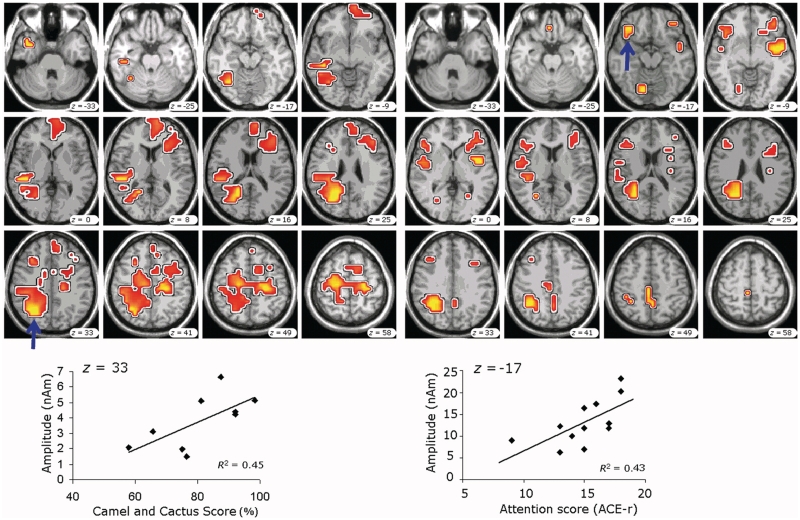
Behavioural variant frontotemporal dementia is a neurodegenerative disorder with dysfunction and atrophy of the frontal lobes leading to changes in personality, behaviour, empathy, social conduct and insight, with relative preservation of language and memory. As novel treatments begin to emerge, biomarkers of frontotemporal dementia will become increasingly important, including functionally relevant neuroimaging indices of the neurophysiological basis of cognition. We used magnetoencephalography to examine behavioural variant frontotemporal dementia using a semantic decision task that elicits both frontal and temporal activity in healthy people. Twelve patients with behavioural variant frontotemporal dementia (age 50-75) and 16 matched controls made categorical semantic judgements about 400 pictures during continuous magnetoencephalography. Distributed source analysis was used to compare patients and controls. The patients had normal early responses to picture confrontation, indicating intact visual processing. However, a predominantly posterior set of regions including temporoparietal cortex showed reduced source activity 250-310 ms after stimulus onset, in proportion to behavioural measures of semantic association. In contrast, a left frontoparietal network showed reduced source activity at 550-650 ms, proportional to patients' deficits in attention and orientation. This late deficit probably reflects impairment in the neural substrate of goal-oriented decision making. The results demonstrate behaviourally relevant neural correlates of semantic processing and decision making in behavioural variant frontotemporal dementia, and show for the first time that magnetoencephalography can be used to study cognitive systems in the context of frontotemporal dementia.
行为变异额颞叶痴呆是一种神经退行性疾病,额叶功能障碍和萎缩导致人格、行为、同理心、社交行为和洞察力改变,语言和记忆相对保留。随着新的治疗方法开始出现,额颞叶痴呆的生物标志物将变得越来越重要,包括认知神经生理学基础的功能相关神经影像学指标。我们使用脑磁图(MEG),通过一项引发健康人额叶和颞叶活动的语义决策任务,来检查行为变异额颞叶痴呆。12 名行为变异额颞叶痴呆患者(年龄 50-75 岁)和 16 名匹配的对照者在连续 MEG 期间对 400 张图片进行分类语义判断。分布式源分析用于比较患者和对照组。患者对图片的对抗有正常的早期反应,表明视觉处理完整。然而,一组主要位于颞顶叶皮层的后部区域,在刺激后 250-310 毫秒显示出源活动减少,与语义联想的行为测量成正比。相比之下,左额顶叶网络在 550-650 毫秒显示出源活动减少,与患者的注意力和定向缺陷成正比。这种晚期缺陷可能反映了目标导向决策的神经基础受损。研究结果表明,行为变异额颞叶痴呆患者的语义处理和决策存在行为相关的神经相关性,并首次表明脑磁图可用于额颞叶痴呆背景下的认知系统研究。