Max Planck Institute of Biochemistry, 82152 Martinsried, Germany.
J Exp Med. 2011 Aug 29;208(9):1749-56. doi: 10.1084/jem.20110578. Epub 2011 Aug 15.
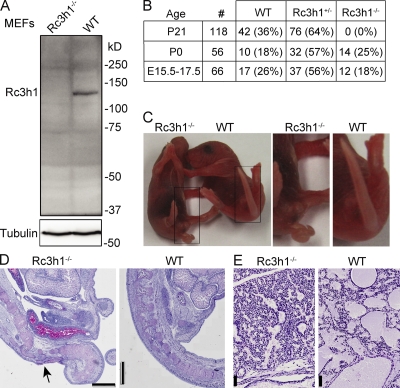
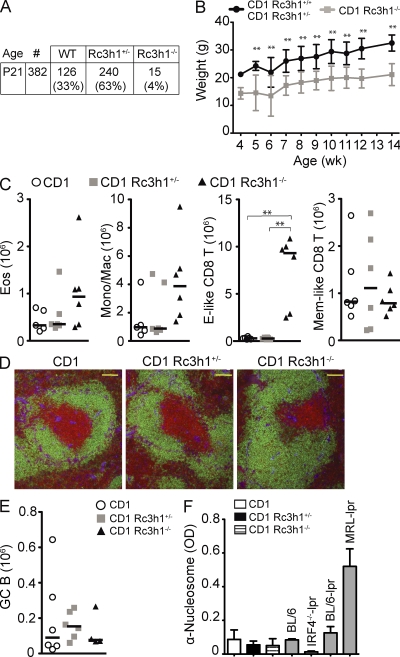
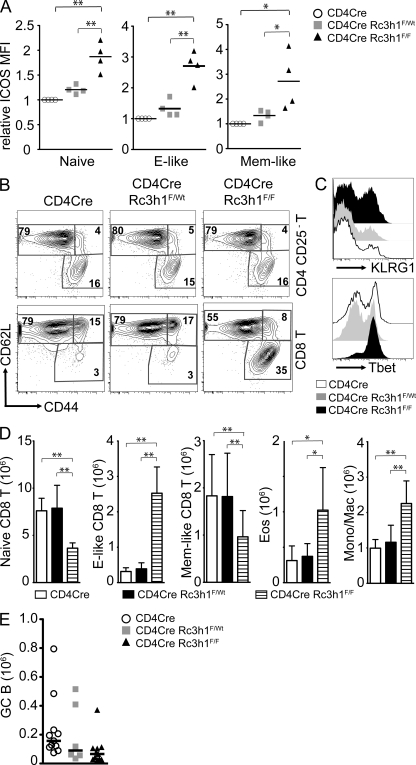
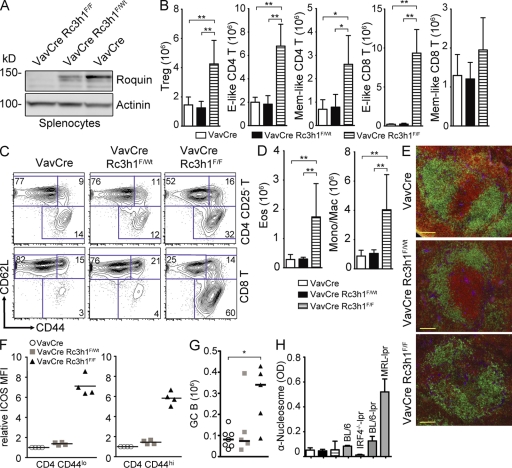
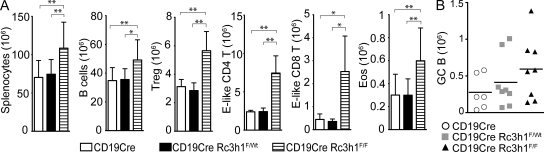
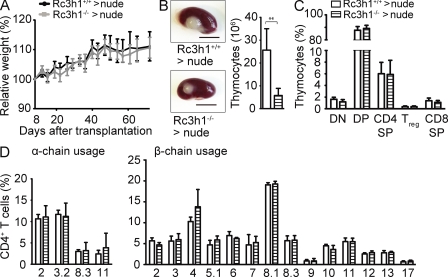
The substitution of one amino acid in the Roquin protein by the sanroque mutation induces a dramatic autoimmune syndrome in mice. This is believed to occur through ectopic expression of inducible T cell co-stimulator (ICOS) and unrestrained differentiation of follicular T helper cells, which induce spontaneous germinal center reactions to self-antigens. In this study, we demonstrate that tissue-specific ablation of Roquin in T or B cells, in the entire hematopoietic system, or in epithelial cells of transplanted thymi did not cause autoimmunity. Loss of Roquin induced elevated expression of ICOS through T cell-intrinsic and -extrinsic mechanisms, which itself was not sufficient to break self-tolerance. Instead, ablation of Roquin in the hematopoietic system caused defined changes in immune homeostasis, including the expansion of macrophages, eosinophils, and T cell subsets, most dramatically CD8 effector-like T cells, through cell-autonomous and nonautonomous mechanisms. Germline Roquin deficiency led to perinatal lethality, which was partially rescued on the genetic background of an outbred strain. However, not even complete absence of Roquin resulted in overt self-reactivity, suggesting that the sanroque mutation induces autoimmunity through an as yet unknown mechanism.
Roquin 蛋白中的一个氨基酸被 sanroque 突变取代,会在小鼠中引发严重的自身免疫综合征。据信,这是通过诱导性 T 细胞共刺激因子(ICOS)的异位表达和滤泡辅助性 T 细胞的不受控制分化引起的,这种分化会诱导自身抗原的自发生发中心反应。在这项研究中,我们证明 T 细胞或 B 细胞、整个造血系统或移植胸腺上皮细胞中 Roquin 的组织特异性缺失不会引起自身免疫。Roquin 的缺失通过 T 细胞内在和外在机制诱导了 ICOS 的高表达,但这本身不足以打破自身耐受。相反,造血系统中 Roquin 的缺失导致免疫稳态的明确改变,包括通过细胞自主和非自主机制,巨噬细胞、嗜酸性粒细胞和 T 细胞亚群的扩张,尤其是 CD8 效应样 T 细胞。生殖系 Roquin 缺失导致围产期致死,在外来品系的遗传背景下部分得到挽救。然而,即使完全缺乏 Roquin 也不会导致明显的自身反应,这表明 sanroque 突变通过未知的机制引起自身免疫。