Department of Pharmacology and Physiology, New Jersey Medical School, University of Medicine and Dentistry of New Jersey, Newark, USA.
J Gen Physiol. 2011 Sep;138(3):321-39. doi: 10.1085/jgp.201110634. Epub 2011 Aug 15.
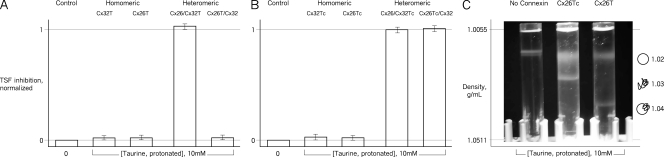
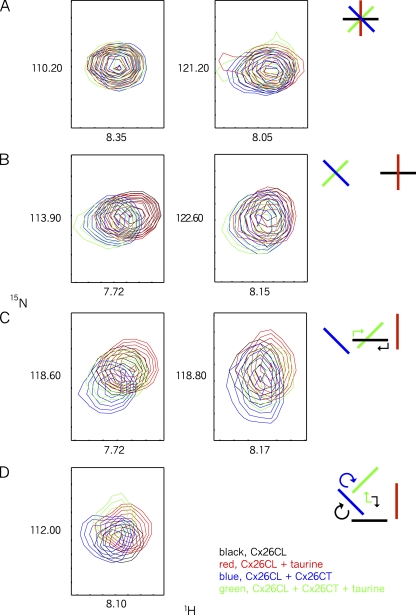
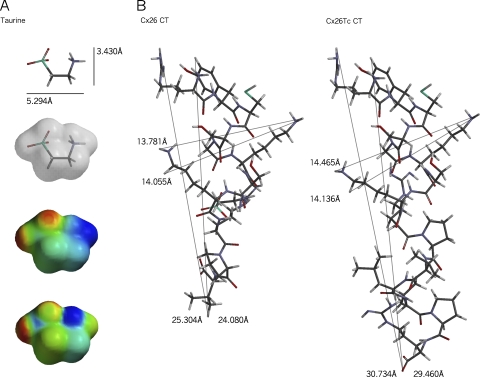
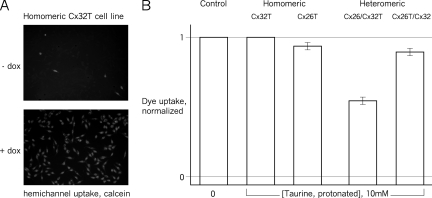
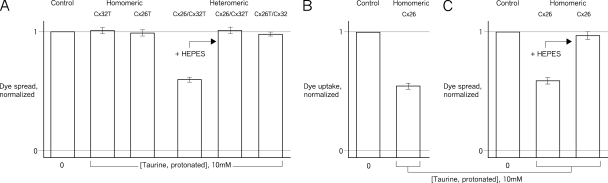
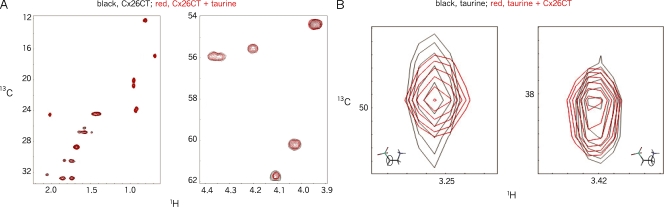
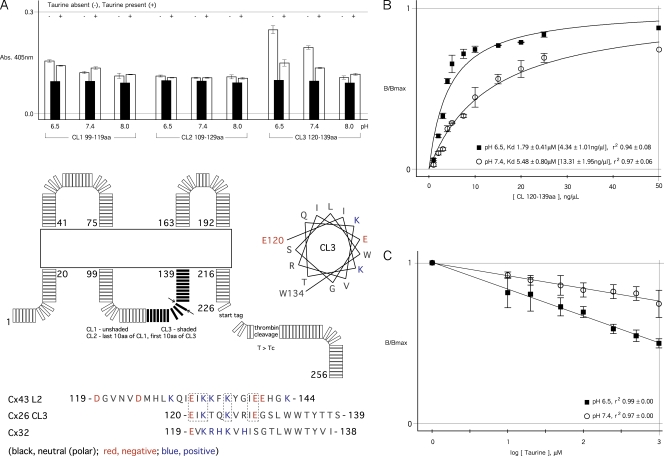
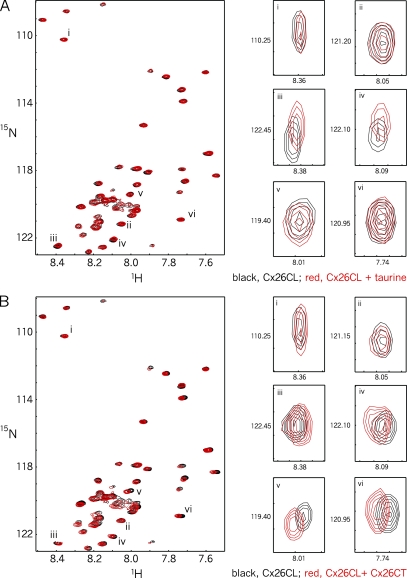
The mechanisms of action of endogenous modulatory ligands of connexin channels are largely unknown. Previous work showed that protonated aminosulfonates (AS), notably taurine, directly and reversibly inhibit homomeric and heteromeric channels that contain Cx26, a widely distributed connexin, but not homomeric Cx32 channels. The present study investigated the molecular mechanisms of connexin channel modulation by taurine, using hemichannels and junctional channels composed of Cx26 (homomeric) and Cx26/Cx32 (heteromeric). The addition of a 28-amino acid "tag" to the carboxyl-terminal domain (CT) of Cx26 (Cx26(T)) eliminated taurine sensitivity of homomeric and heteromeric hemichannels in cells and liposomes. Cleavage of all but four residues of the tag (Cx26(Tc)) resulted in taurine-induced pore narrowing in homomeric hemichannels, and restored taurine inhibition of heteromeric hemichannels (Cx26(Tc)/Cx32). Taurine actions on junctional channels were fully consistent with those on hemichannels. Taurine-induced inhibition of Cx26/Cx32(T) and nontagged Cx26 junctional channels was blocked by extracellular HEPES, a blocker of the taurine transporter, confirming that the taurine-sensitive site of Cx26 is cytoplasmic. Nuclear magnetic resonance of peptides corresponding to Cx26 cytoplasmic domains showed that taurine binds to the cytoplasmic loop (CL) and not the CT, and that the CT and CL directly interact. ELISA showed that taurine disrupts a pH-dependent interaction between the CT and the CT-proximal half of the CL. These studies reveal that AS disrupt a pH-driven cytoplasmic interdomain interaction in Cx26-containing channels, causing closure, and that the Cx26CT has a modulatory role in Cx26 function.
内源性连接蛋白通道调节配体的作用机制在很大程度上尚不清楚。以前的工作表明,质子化的氨基磺酸盐(AS),特别是牛磺酸,可直接和可逆地抑制包含广泛分布的连接蛋白 Cx26 的同型和异型通道,但不抑制同型 Cx32 通道。本研究使用由 Cx26(同型)和 Cx26/Cx32(异型)组成的半通道和连接通道,研究了牛磺酸对连接蛋白通道调制的分子机制。在细胞和脂质体中,在 Cx26 的羧基末端结构域(CT)上添加 28 个氨基酸“标签”(Cx26(T))消除了同型和异型半通道对牛磺酸的敏感性。除去标签的除四个残基之外的所有残基(Cx26(Tc))导致同型半通道中牛磺酸诱导的孔变窄,并恢复了异型半通道(Cx26(Tc)/Cx32)中牛磺酸的抑制作用。牛磺酸对连接通道的作用与对半通道的作用完全一致。牛磺酸对 Cx26/Cx32(T)和非标记的 Cx26 连接通道的抑制作用被细胞外 HEPES 阻断,HEPES 是牛磺酸转运体的阻断剂,这证实了 Cx26 的牛磺酸敏感部位位于细胞质中。对应于 Cx26 细胞质结构域的肽的核磁共振显示,牛磺酸结合到细胞质环(CL)而不是 CT,并且 CT 和 CL 直接相互作用。ELISA 显示,牛磺酸破坏了 CT 和 CL 近端半区之间 pH 依赖性相互作用。这些研究表明,AS 破坏了包含 Cx26 的通道中细胞质域间 pH 驱动的相互作用,导致通道关闭,并且 Cx26CT 在 Cx26 功能中具有调节作用。