Department of Psychiatry, SMG-SNU Boramae Medical Center, Seoul, Korea.
Psychiatry Investig. 2011 Jun;8(2):155-60. doi: 10.4306/pi.2011.8.2.155. Epub 2011 Apr 25.
Smoking related cues may elicit smoking urges and psychophysiological responses in subjects with nicotine dependence. This study aimed to investigate the effect of repeated virtual cue exposure therapy using the surround-screen based projection wall system on the psychophysiological responses in nicotine dependence.
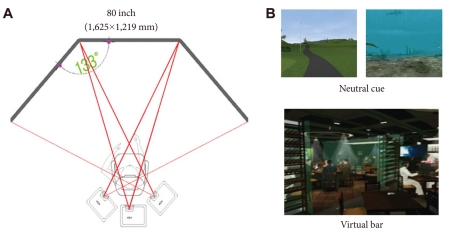
The authors developed 3-dimensional neutral and smoking-related environments using virtual reality (VR) technology. Smoking-related environment was a virtual bar, which comprised both object-related and social situation cues. Ten subjects with nicotine dependence participated in 4-week (one session per week) virtual cue exposure therapy. Psychophysiological responses [electromyography (EMG), skin conductance (SC), and heart rate] and subjective nicotine craving were acquired during each session.
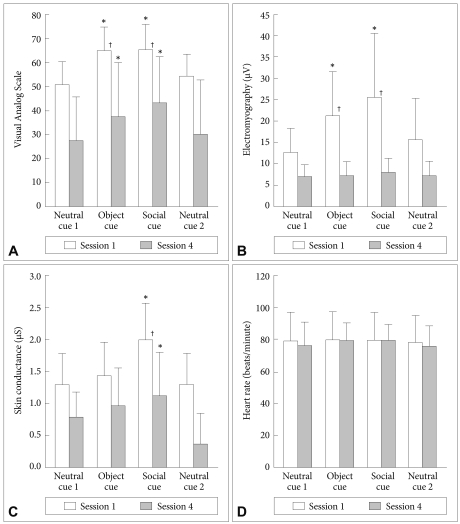
VR nicotine cue elicited greater psychophysiological responses and subjective craving for smoking than did neutral cue, and exposure to social situation cues showed greater psychophysiological responses in SC and EMG than did object-related cues. This responsiveness decreased during the course of repeated therapy.
The present study found that both psychophysiological responses and subjective nicotine craving were greater to nicotine cue exposure via projection wall VR system than to neutral cues and that enhanced cue reactivity decreased gradually over the course of repeated exposure therapy. These results suggest that VR cue exposure therapy combined with psychophysiological response monitoring may be an alternative treatment modality for smoking cessation, although the current findings are preliminary.
与吸烟相关的线索可能会诱发尼古丁依赖者的吸烟欲望和心理生理反应。本研究旨在探讨使用基于环绕屏幕的投影墙系统进行重复虚拟线索暴露治疗对尼古丁依赖者心理生理反应的影响。
作者使用虚拟现实(VR)技术开发了 3 维中性和与吸烟相关的环境。与吸烟相关的环境是一个虚拟酒吧,其中包括与物体相关的和社会情境线索。10 名尼古丁依赖者参加了为期 4 周(每周 1 次)的虚拟线索暴露治疗。在每次治疗过程中,都获得了心理生理反应(肌电图(EMG)、皮肤电导(SC)和心率)和主观吸烟渴望的测量数据。
VR 尼古丁线索引起的心理生理反应和吸烟渴望比中性线索更大,而与社会情境线索相比,物体相关线索引起的 SC 和 EMG 心理生理反应更大。这种反应性在重复治疗过程中逐渐降低。
本研究发现,与中性线索相比,通过投影墙 VR 系统进行尼古丁线索暴露治疗会引起更大的心理生理反应和主观吸烟渴望,并且随着重复暴露治疗的进行,增强的线索反应性逐渐降低。这些结果表明,VR 线索暴露治疗结合心理生理反应监测可能是一种替代的戒烟治疗方式,尽管目前的研究结果还只是初步的。