Department of Addictive Behavior and Addiction Medicine, Central Institute of Mental Health (CIMH), Medical Faculty Mannheim, Heidelberg University, Mannheim, Germany.
Center for Innovative Psychiatric and Psychotherapeutic Research, Central Institute of Mental Health (CIMH), Medical Faculty Mannheim, Heidelberg University, Mannheim, Germany.
Transl Psychiatry. 2021 Dec 6;11(1):617. doi: 10.1038/s41398-021-01739-3.
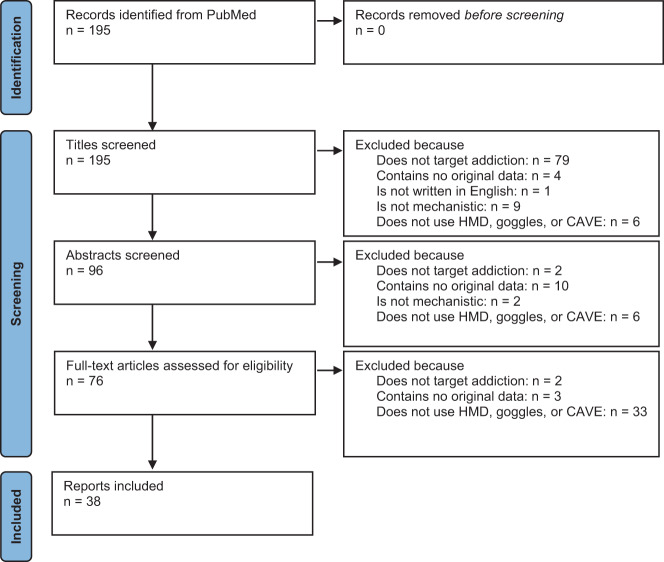
Due to its high ecological validity, virtual reality (VR) technology has emerged as a powerful tool for mental health research. Despite the wide use of VR simulations in research on mental illnesses, the study of addictive processes through the use of VR environments is still at its dawn. In a systematic literature search, we identified 38 reports of research projects using highly immersive head-mounted displays, goggles, or CAVE technologies to provide insight into treatment mechanisms of addictive behaviors. So far, VR research has mainly addressed the roles of craving, psychophysiology, affective states, cognition, and brain activity in addiction. The computer-generated VR environments offer very realistic, dynamic, interactive, and complex real-life simulations requesting active participation. They create a high sense of immersion in users by combining stereoscopic three-dimensional visual, auditory, olfactory, and tactile perceptions, tracking systems responding to user movements, and social interactions. VR is an emerging tool to study how proximal multi-sensorial cues, contextual environmental cues, as well as their interaction (complex cues) modulate addictive behaviors. VR allows for experimental designs under highly standardized, strictly controlled, predictable, and repeatable conditions. Moreover, VR simulations can be personalized. They are currently refined for psychotherapeutic interventions. Embodiment, eye-tracking, and neurobiological factors represent novel future directions. The progress of VR applications has bred auspicious ways to advance the understanding of treatment mechanisms underlying addictions, which researchers have only recently begun to exploit. VR methods promise to yield significant achievements to the addiction field. These are necessary to develop more efficacious and efficient preventive and therapeutic strategies.
由于其高度的生态有效性,虚拟现实 (VR) 技术已成为心理健康研究的有力工具。尽管 VR 模拟在精神疾病研究中得到了广泛应用,但通过使用 VR 环境研究成瘾过程仍处于起步阶段。在系统文献检索中,我们确定了 38 项使用高度沉浸式头戴式显示器、护目镜或 CAVE 技术的研究项目报告,以深入了解成瘾行为的治疗机制。到目前为止,VR 研究主要涉及渴望、心理生理学、情感状态、认知和大脑活动在成瘾中的作用。计算机生成的 VR 环境提供了非常逼真、动态、互动和复杂的现实生活模拟,需要积极参与。它们通过结合立体三维视觉、听觉、嗅觉和触觉感知、跟踪系统响应用户运动以及社交互动,为用户创造高度沉浸感。VR 是一种新兴的工具,可用于研究近端多感官线索、情境环境线索以及它们的相互作用(复杂线索)如何调节成瘾行为。VR 允许在高度标准化、严格控制、可预测和可重复的条件下进行实验设计。此外,VR 模拟可以个性化。它们目前正在为心理治疗干预进行优化。体现、眼动追踪和神经生物学因素代表了新的未来方向。VR 应用的进展为深入了解成瘾的治疗机制带来了有利的途径,研究人员最近才开始利用这些途径。VR 方法有望为成瘾领域带来重大成就。这对于开发更有效和高效的预防和治疗策略是必要的。