Department of Anatomy and the CMBN, University of Oslo, Oslo, Norway.
PLoS One. 2011;6(8):e22960. doi: 10.1371/journal.pone.0022960. Epub 2011 Aug 11.
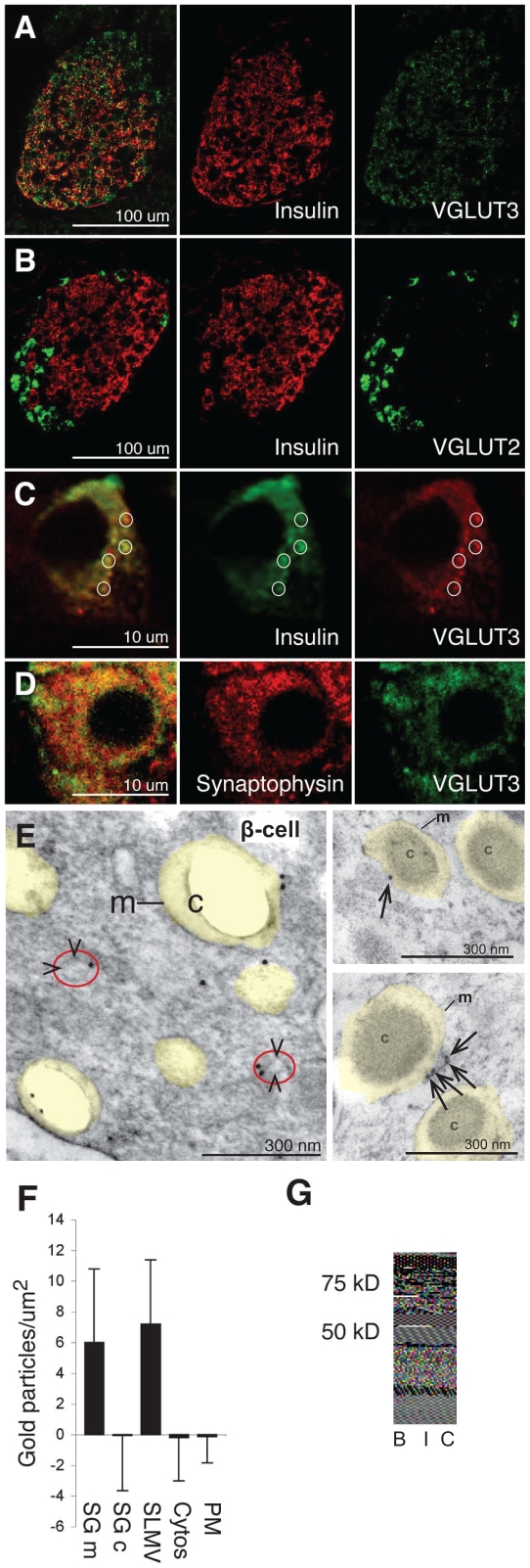
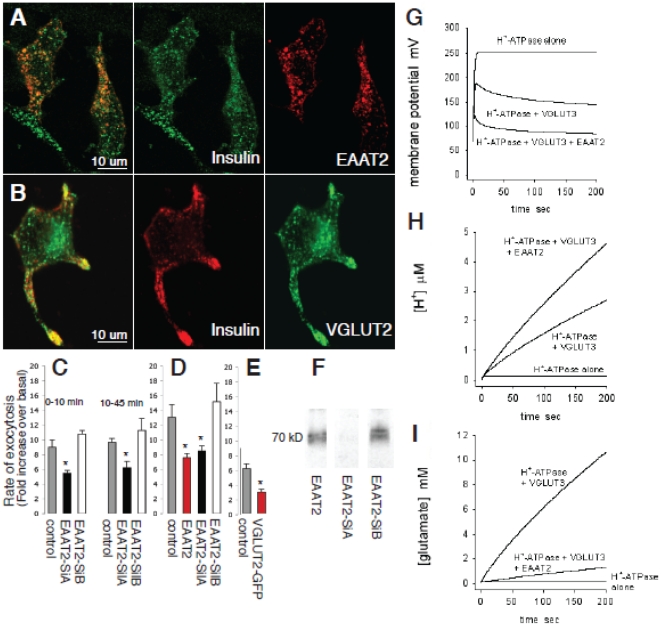
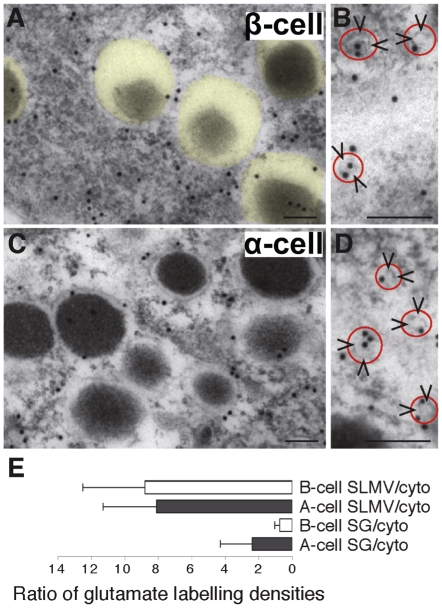
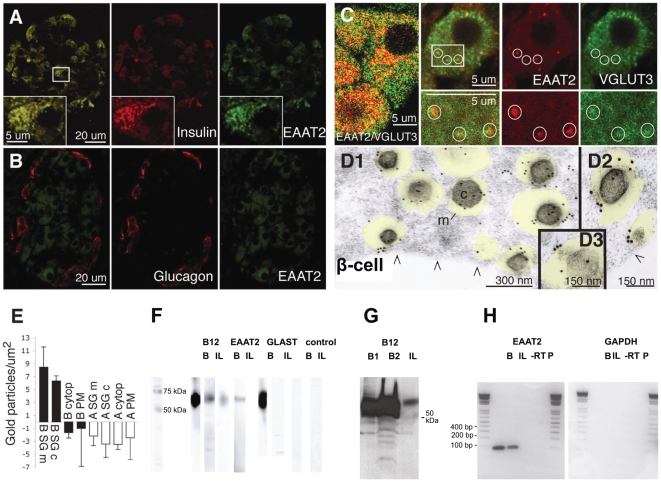
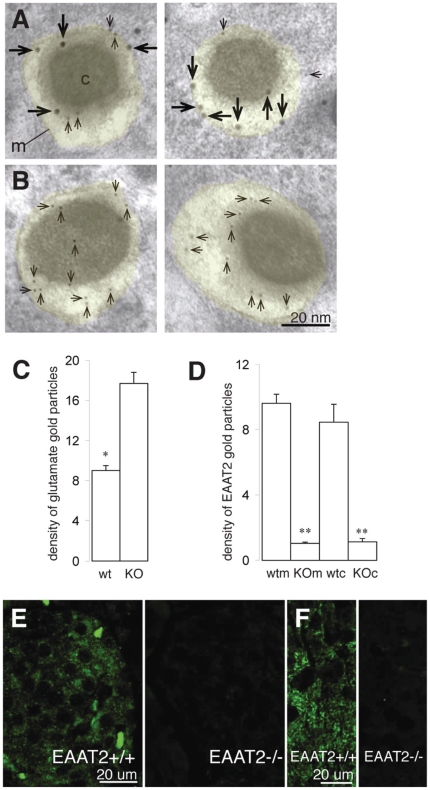
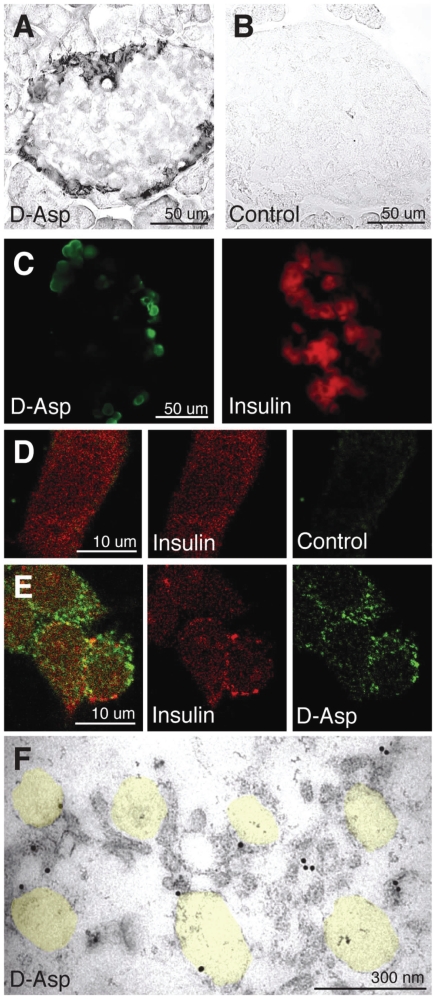
In the brain, glutamate is an extracellular transmitter that mediates cell-to-cell communication. Prior to synaptic release it is pumped into vesicles by vesicular glutamate transporters (VGLUTs). To inactivate glutamate receptor responses after release, glutamate is taken up into glial cells or neurons by excitatory amino acid transporters (EAATs). In the pancreatic islets of Langerhans, glutamate is proposed to act as an intracellular messenger, regulating insulin secretion from β-cells, but the mechanisms involved are unknown. By immunogold cytochemistry we show that insulin containing secretory granules express VGLUT3. Despite the fact that they have a VGLUT, the levels of glutamate in these granules are low, indicating the presence of a protein that can transport glutamate out of the granules. Surprisingly, in β-cells the glutamate transporter EAAT2 is located, not in the plasma membrane as it is in brain cells, but exclusively in insulin-containing secretory granules, together with VGLUT3. In EAAT2 knock out mice, the content of glutamate in secretory granules is higher than in wild type mice. These data imply a glutamate cycle in which glutamate is carried into the granules by VGLUT3 and carried out by EAAT2. Perturbing this cycle by knocking down EAAT2 expression with a small interfering RNA, or by over-expressing EAAT2 or a VGLUT in insulin granules, significantly reduced the rate of granule exocytosis. Simulations of granule energetics suggest that VGLUT3 and EAAT2 may regulate the pH and membrane potential of the granules and thereby regulate insulin secretion. These data suggest that insulin secretion from β-cells is modulated by the flux of glutamate through the secretory granules.
在大脑中,谷氨酸是一种细胞外递质,介导细胞间通讯。在突触前释放之前,它被囊泡谷氨酸转运体(VGLUTs)泵入囊泡。为了在释放后使谷氨酸受体反应失活,谷氨酸被兴奋性氨基酸转运体(EAATs)摄取到神经胶质细胞或神经元中。在胰岛中,谷氨酸被认为作为细胞内信使,调节β细胞的胰岛素分泌,但涉及的机制尚不清楚。通过免疫金细胞化学,我们发现含有胰岛素的分泌颗粒表达 VGLUT3。尽管它们具有 VGLUT,但这些颗粒中的谷氨酸水平较低,表明存在一种可以将谷氨酸从颗粒中转运出来的蛋白质。令人惊讶的是,在β细胞中,谷氨酸转运体 EAAT2 位于胰岛素含有分泌颗粒内,而不是像在脑细胞中那样位于质膜上,与 VGLUT3 一起。在 EAAT2 敲除小鼠中,分泌颗粒中的谷氨酸含量高于野生型小鼠。这些数据表明存在谷氨酸循环,其中谷氨酸由 VGLUT3 带入颗粒,由 EAAT2 带出。通过用小干扰 RNA 敲低 EAAT2 表达、过表达 EAAT2 或 VGLUT 进入胰岛素颗粒来扰乱这个循环,显著降低了颗粒胞吐的速率。颗粒能量学的模拟表明,VGLUT3 和 EAAT2 可能调节颗粒的 pH 值和膜电位,从而调节胰岛素分泌。这些数据表明,β细胞的胰岛素分泌受到通过分泌颗粒的谷氨酸通量的调节。