Center for Disease Control and Prevention of Guangdong Province, Guangzhou, People's Republic of China.
PLoS One. 2011;6(8):e23034. doi: 10.1371/journal.pone.0023034. Epub 2011 Aug 10.
Relying on surveillance of clinical cases limits the ability to understand the full impact and severity of an epidemic, which urges a deep insight into the serological evidence of infection and transmission feature of pandemic H1N1 2009 (pH1N1) virus in Guangdong province.
In this cross-sectional serological survey, serum samples were collected by multi-stage stratified random sampling in Jan 2010. Antibody titers were measured by hemagglutination inhibition (HI) assay. Age-specific and region-specific prevalence were calculated based on the results of HI assay (positive, HI titer≥1:40).
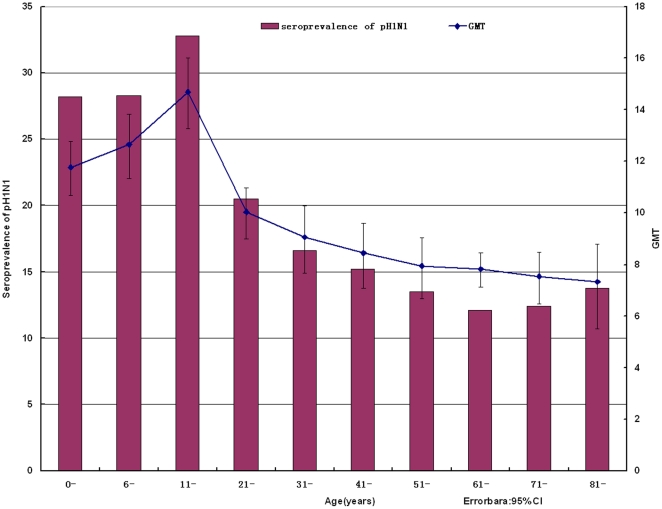
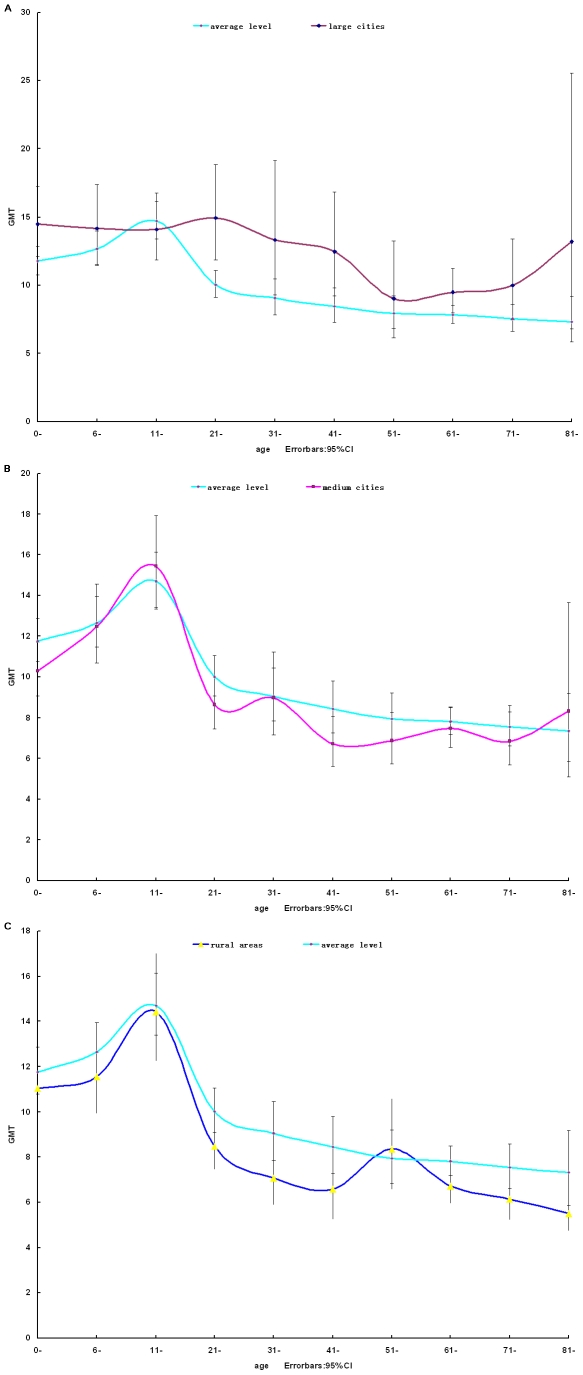
A total of 4,319 serum samples had been collected from subjects without vaccination with pH1N1 vaccine. The seroprevalence was 22.82% (985/4,319). By contrast, there was a marked spatial heterogeneity in prevalence. The seroprevalence was 27.3% in large city, 21.4% in medium cities, higher than that of 20.2% in rural areas. The seroprevalence was highest in 11-20 age group (32.8%), however, in those above 60 years of age group, which was 12.6%, lower than other age groups. On the other hand, antibody titers to pH1N1 virus were highest in school children, which were followed by a gradual decrease in adult. However, in the elderly groups from cities, especially from large city, the antibody titer to pH1N1 increased significantly and reached a much higher level.
Our results showed that the prevalence for pH1N1 was correlated with age and population density. Preexisting antibody may have protected the very old from pH1N1 infection, while original antigenic sin and immunosenescence may have contributed to greater severity once infected. These should be considered when studying the pathogenesis and transmission of influenza virus and formulating strategies on vaccination and treatment.
依靠对临床病例的监测限制了对疫情全面影响和严重程度的了解,这促使我们深入了解广东省大流行 H1N1 2009(pH1N1)病毒的血清学感染证据和传播特征。
在这项横断面血清学调查中,我们于 2010 年 1 月通过多阶段分层随机抽样采集血清样本。通过血凝抑制(HI)试验测量抗体滴度。根据 HI 试验结果(阳性,HI 滴度≥1:40)计算年龄特异性和地区特异性流行率。
共采集了 4319 份未接种 pH1N1 疫苗的人群血清样本。血清阳性率为 22.82%(985/4319)。相比之下,流行率存在明显的空间异质性。大城市的血清阳性率为 27.3%,中等城市为 21.4%,高于农村地区的 20.2%。11-20 岁年龄组的血清阳性率最高(32.8%),而 60 岁以上年龄组的血清阳性率为 12.6%,低于其他年龄组。另一方面,pH1N1 病毒的抗体滴度在学龄儿童中最高,随后逐渐下降至成人。然而,在城市老年人中,特别是在大城市老年人中,pH1N1 的抗体滴度显著增加,并达到了更高的水平。
我们的结果表明,pH1N1 的流行率与年龄和人口密度相关。预先存在的抗体可能使非常老年人免受 pH1N1 感染,而原始抗原性和免疫衰老可能导致一旦感染则病情更为严重。在研究流感病毒的发病机制和传播以及制定疫苗接种和治疗策略时,应考虑这些因素。