Department of Physics, University of Texas at San Antonio, San Antonio, TX 78249, USA.
Biochem Biophys Res Commun. 2011 Sep 9;412(4):654-9. doi: 10.1016/j.bbrc.2011.08.019. Epub 2011 Aug 12.
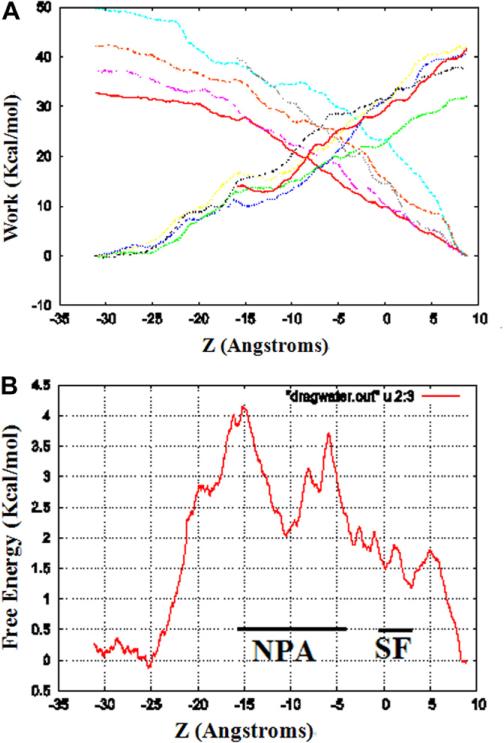
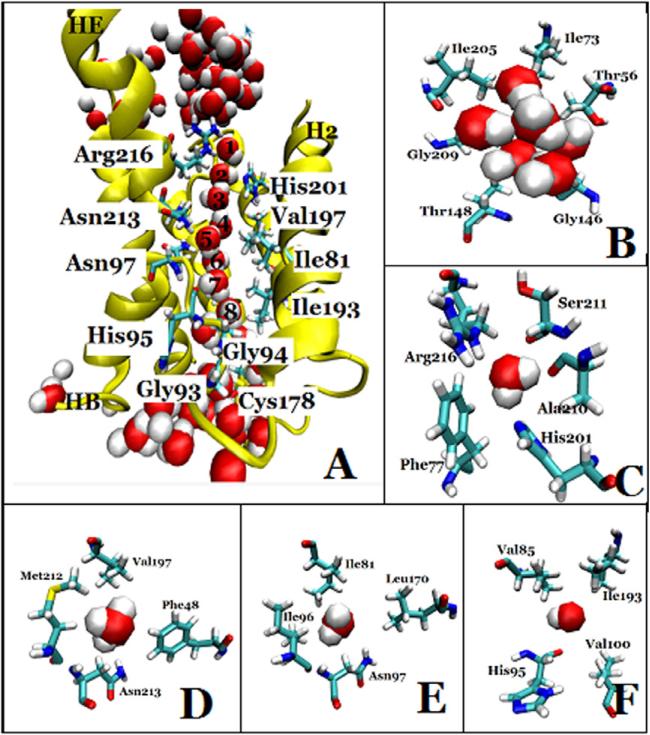
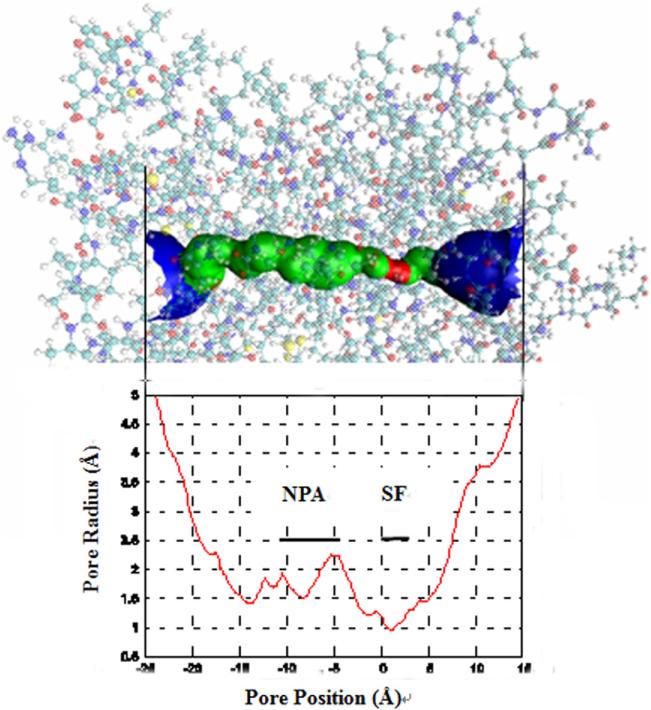
Aquaporin-4 (AQP4) is the predominant water channel in the central nervous system, where it has been reported to be involved in many pathophysiological roles including water transport. In this paper, the AQP4 tetramer was modeled from its PDB structure file, embedded in a palmitoyl-oleoyl-phosphatidyl-choline (POPC) lipid bilayer, solvated in water, then minimized and equilibrated by means of molecular dynamics simulations. Analysis of the equilibrated structure showed that the central pore along the fourfold axis of the tetramers is formed with hydrophobic amino acid residues. In particular, Phe-195, Leu-191 and Leu-75, form the narrowest part of the pore. Therefore water molecules are not expected to transport through the central pore, which was confirmed by MD simulations. Each monomer of the AQP4 tetramers forms a channel whose walls consist mostly of hydrophilic residues. There are eight water molecules in single file observed in each of the four channels, transporting through the selectivity filter containing Arg-216, His-201, Phe-77, Ala-210, and the two conserved Asn-Pro-Ala (NPA) motifs containing Asn-213 and Asn-97. By using Brownian dynamics fluctuation-dissipation-theorem (BD-FDT), the overall free-energy profile was obtained for water transporting through AQP4 for the first time, which gives a complete map of the entire channel of water permeation.
水通道蛋白 4(AQP4)是中枢神经系统中主要的水通道,据报道,它参与了许多病理生理作用,包括水转运。在本文中,我们根据其 PDB 结构文件对 AQP4 四聚体进行建模,将其嵌入棕榈酰-油酰-磷脂酰胆碱(POPC)脂质双层中,在水中进行溶剂化,然后通过分子动力学模拟进行最小化和平衡。对平衡结构的分析表明,沿着四聚体的四重轴的中央孔由疏水性氨基酸残基形成。特别是,Phe-195、Leu-191 和 Leu-75 形成了孔的最窄部分。因此,水分子预计不会通过中央孔运输,这通过 MD 模拟得到了证实。AQP4 四聚体的每个单体形成一个通道,其壁主要由亲水残基组成。在每个通道中都观察到 8 个水分子排成一行,通过包含 Arg-216、His-201、Phe-77、Ala-210 的选择性过滤器运输,并且包含 Asn-213 和 Asn-97 的两个保守的 Asn-Pro-Ala(NPA)基序。通过使用布朗动力学波动耗散定理(BD-FDT),我们首次获得了水通过 AQP4 运输的总自由能谱,这为整个水渗透通道提供了完整的图谱。