Research Group PLASMANT, Department of Chemistry, University of Antwerp, Universiteitsplein 1, B-2610 Antwerp, Belgium.
Centro de Ciências Naturais e Humanas, Universidade Federal do ABC, Avenida dos Estados 5001 CEP 09210-580 Santo André, SP, Brazil.
Oxid Med Cell Longev. 2019 Jun 17;2019:2930504. doi: 10.1155/2019/2930504. eCollection 2019.
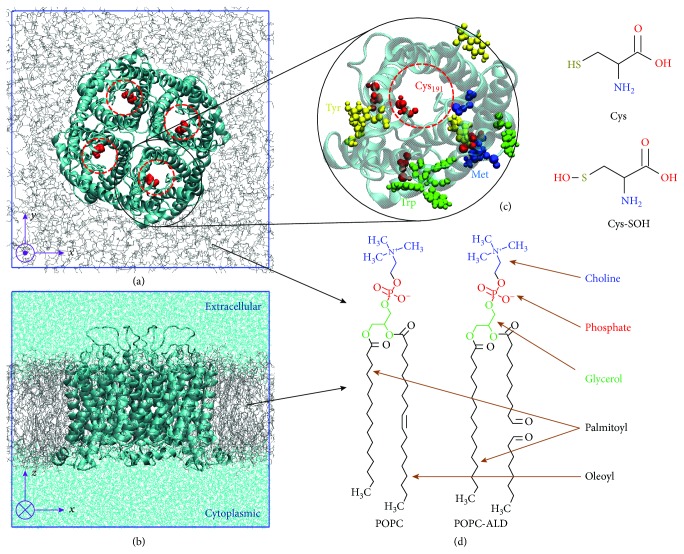
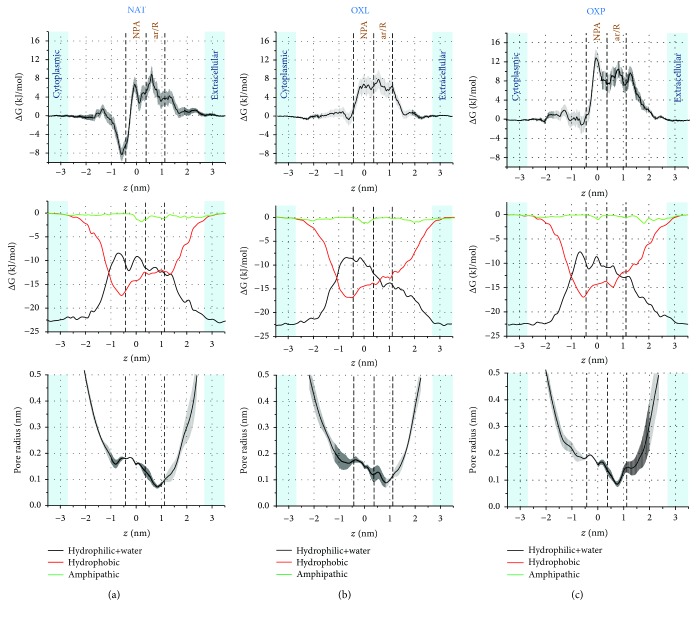
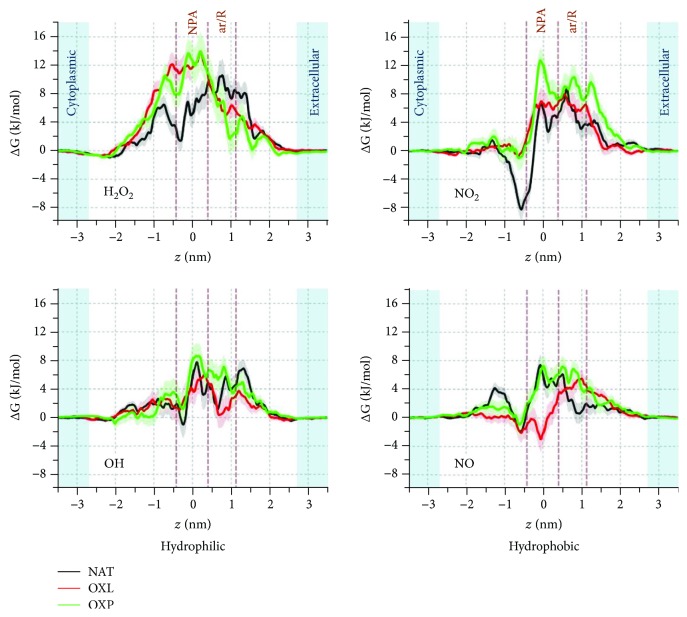
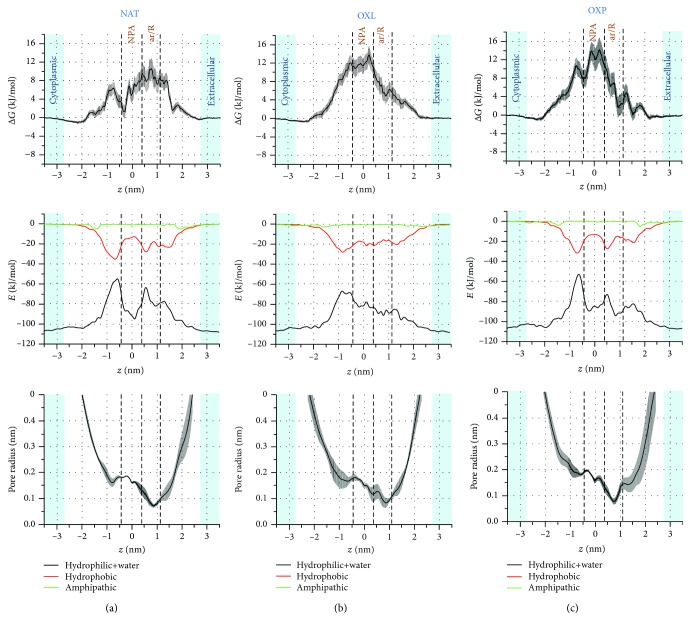
Aquaporins (AQPs) are transmembrane proteins that conduct not only water molecules across the cell membrane but also other solutes, such as reactive oxygen and nitrogen species (RONS), produced (among others) by cold atmospheric plasma (CAP). These RONS may induce oxidative stress in the cell interior, which plays a role in cancer treatment. The underlying mechanisms of the transport of RONS across AQPs, however, still remain obscure. We apply molecular dynamics simulations to investigate the permeation of both hydrophilic (HO and OH) and hydrophobic (NO and NO) RONS through AQP1. Our simulations show that these RONS can all penetrate across the pores of AQP1. The permeation free energy barrier of OH and NO is lower than that of HO and NO, indicating that these radicals may have easier access to the pore interior and interact with the amino acid residues of AQP1. We also study the effect of RONS-induced oxidation of both the phospholipids and AQP1 (i.e., sulfenylation of Cys) on the transport of the above-mentioned RONS across AQP1. Both lipid and protein oxidation seem to slightly increase the free energy barrier for HO and NO permeation, while for OH and NO, we do not observe a strong effect of oxidation. The simulation results help to gain insight in the underlying mechanisms of the noticeable rise of CAP-induced RONS in cancer cells, thereby improving our understanding on the role of AQPs in the selective anticancer capacity of CAP.
水通道蛋白(AQP)是跨膜蛋白,不仅可以将水分子穿过细胞膜,还可以将其他溶质(如活性氧和氮物种(RONS))穿过细胞膜,这些 RONS 是由冷等离体子体(CAP)产生的(除其他外)。这些 RONS 可能会在细胞内部引起氧化应激,这在癌症治疗中起着重要作用。然而,RONS 通过 AQP 转运的潜在机制仍不清楚。我们应用分子动力学模拟研究了亲水性(HO 和 OH)和疏水性(NO 和 NO)RONS 通过 AQP1 的渗透。我们的模拟表明,这些 RONS 都可以穿透 AQP1 的孔道。OH 和 NO 的渗透自由能障碍低于 HO 和 NO,这表明这些自由基可能更容易进入孔内部并与 AQP1 的氨基酸残基相互作用。我们还研究了 RONS 诱导的磷脂和 AQP1(即 Cys 的亚磺酰化)氧化对上述 RONS 通过 AQP1 转运的影响。脂质和蛋白质氧化似乎略微增加了 HO 和 NO 渗透的自由能障碍,而对于 OH 和 NO,我们没有观察到氧化的强烈影响。模拟结果有助于深入了解 CAP 诱导的 RONS 在癌细胞中明显增加的潜在机制,从而提高我们对 AQP 在 CAP 选择性抗癌能力中的作用的理解。