Princeton Neuroscience Institute and Department of Molecular Biology, Princeton University, Princeton, New Jersey, USA.
Nat Neurosci. 2011 Aug 21;14(9):1150-9. doi: 10.1038/nn.2888.
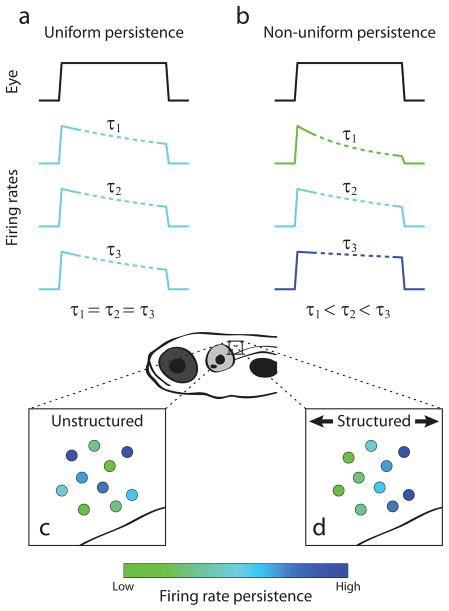
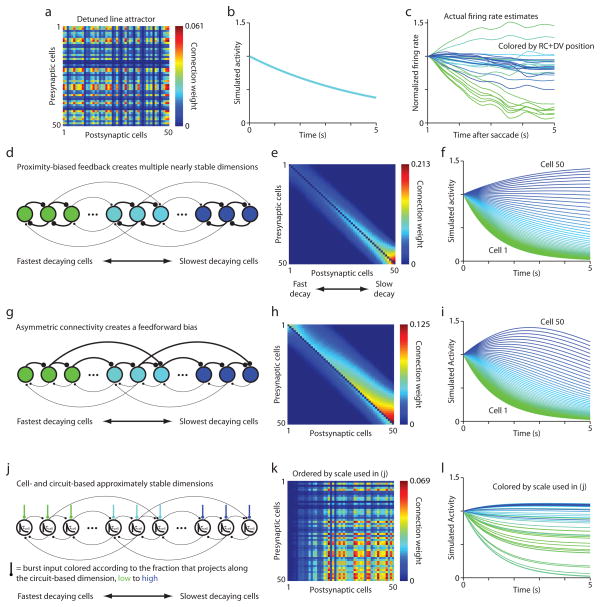
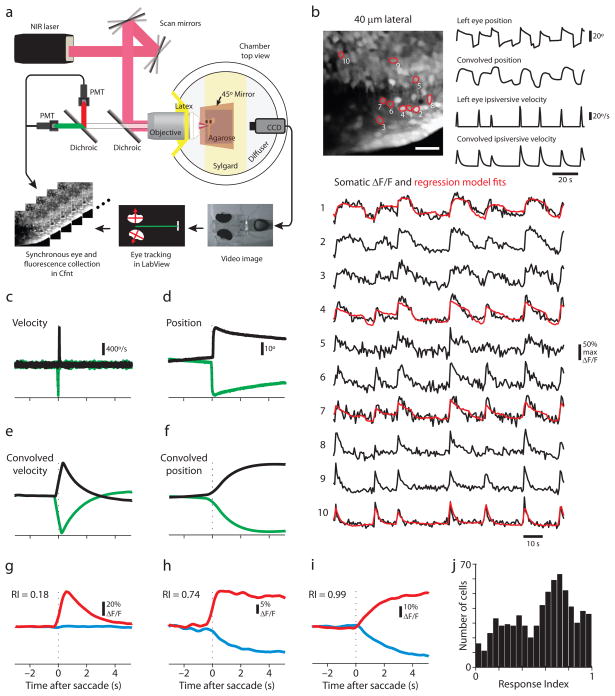
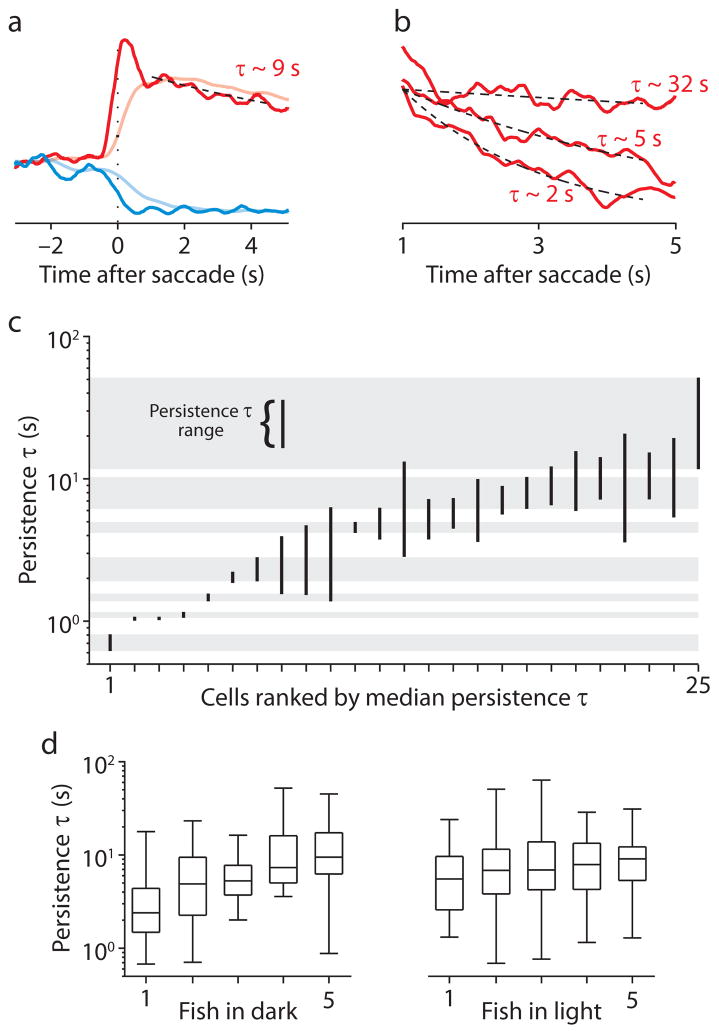
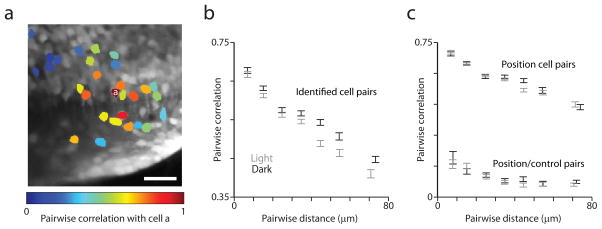
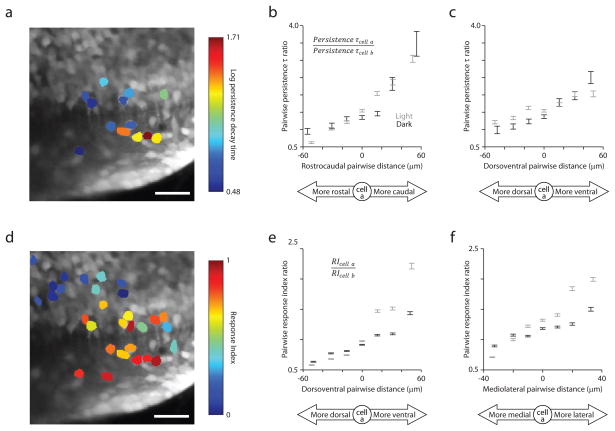
In a neural integrator, the variability and topographical organization of neuronal firing-rate persistence can provide information about the circuit's functional architecture. We used optical recording to measure the time constant of decay of persistent firing (persistence time) across a population of neurons comprising the larval zebrafish oculomotor velocity-to-position neural integrator. We found extensive persistence time variation (tenfold; coefficients of variation = 0.58-1.20) across cells in individual larvae. We also found that the similarity in firing between two neurons decreased as the distance between them increased and that a gradient in persistence time was mapped along the rostrocaudal and dorsoventral axes. This topography is consistent with the emergence of persistence time heterogeneity from a circuit architecture in which nearby neurons are more strongly interconnected than distant ones. Integrator circuit models characterized by multiple dimensions of slow firing-rate dynamics can account for our results.
在神经整合器中,神经元发放率持续性的可变性和地形组织可以提供有关电路功能结构的信息。我们使用光学记录来测量包括幼虫斑马鱼眼球运动速度到位置神经整合器的神经元群体的持久放电(持续时间)的衰减时间常数。我们发现单个幼虫的细胞之间存在广泛的持续性时间变化(十倍;变异系数= 0.58-1.20)。我们还发现,两个神经元之间的放电相似性随着它们之间距离的增加而降低,并且沿前后轴和背腹轴映射了持续性时间的梯度。这种地形与从电路结构中出现的持久性时间异质性一致,其中附近的神经元比远距离的神经元之间的连接更强。具有多个慢发放率动力学维度的整合器电路模型可以解释我们的结果。