Department of Infectious Diseases, Copenhagen University Hospital, Rigshospitalet, Denmark;
Clin Epidemiol. 2011;3:217-27. doi: 10.2147/CLEP.S19875. Epub 2011 Jul 21.
The mechanism for the increased risk of head and neck cancer (HNC) observed in HIV patients is controversial. We hypothesized that family-related risk factors increase the risk of HNC why we estimated the risk of this type of cancer in both HIV patients and their parents.
We estimated the cumulative incidence and incidence rate ratios (IRRs) of HNC in 1) a population of all Danish HIV patients identified from the Danish HIV Cohort Study (n = 5053) and a cohort of population controls matched on age and gender (n = 50,530) (study period; 1995-2009) and 2) the parents of HIV patients and population controls (study period 1978-2009). To assess the possible impact of human papilloma virus (HPV)-associated cancers, the sites of squamous cell HNCs were categorized as HPV related, potentially HPV related, and potentially HPV unrelated.
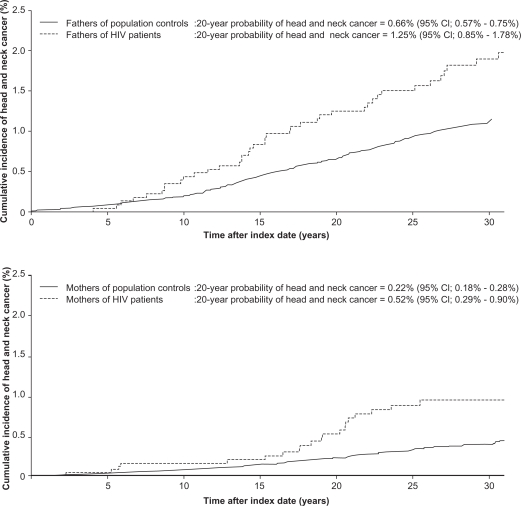
Seventeen (0.3%) HIV patients vs 80 (0.2%) population controls were diagnosed with HNC cancer in the observation period. HIV patients had an increased risk of HNC (IRR 3.05 [95% CI 1.81-5.15]). The IRR was considerably increased in HIV patients older than 50 years (adjusted IRR; 4.58 [95% CI 2.24-9.35]), diagnosed after 1995 (adjusted IRR 6.31 [95% CI 2.82-14.08]), previous or current smoker (adjusted IRR 4.51 [95% CI 2.47-8.23]), with baseline CD4 count 350 cells/μL (adjusted IRR; 3.89 [95% CI 1.95-7.78]), and men heterosexually infected with HIV (adjusted IRR 5.54 [95% CI 1.96-15.66]). Fifteen (83%) of the HIV patients diagnosed with HNC were current or former smokers. The IRR of squamous cell HNC in HIV patients was high at HPV-relate sites, potentially HPV-related sites, and potentially HPV-unrelated sites. Both fathers and mothers of HIV patients had an increased risk of HNC (adjusted IRR for fathers 1.78 [95% CI 1.28-2.48], adjusted IRR for mothers 2.07 [95% CI 1.05-4.09]).
HIV appears to be a marker of behavioral or family-related risk factors that affect the incidence of HNC in HIV patients.
在 HIV 患者中观察到的头颈部癌症(HNC)风险增加的机制存在争议。我们假设与家庭相关的风险因素会增加 HNC 的风险,因此我们估计了 HIV 患者及其父母患这种癌症的风险。
我们估计了 1)丹麦所有 HIV 患者的人群中(通过丹麦 HIV 队列研究确定,n=5053)和年龄和性别匹配的人群对照队列(n=50530)(研究期间;1995-2009 年)中 HNC 的累积发病率和发病率比(IRR),以及 2)HIV 患者和人群对照的父母(研究期间 1978-2009 年)中 HNC 的发病率。为了评估人乳头瘤病毒(HPV)相关癌症的可能影响,将鳞状细胞 HNC 的部位分类为 HPV 相关、可能 HPV 相关和可能 HPV 不相关。
在观察期内,17 名(0.3%)HIV 患者与 80 名(0.2%)人群对照被诊断患有 HNC 癌症。HIV 患者患 HNC 的风险增加(IRR 3.05 [95%CI 1.81-5.15])。年龄大于 50 岁的 HIV 患者的 IRR 显著增加(调整后的 IRR;4.58 [95%CI 2.24-9.35]),1995 年后诊断的(调整后的 IRR 6.31 [95%CI 2.82-14.08]),既往或当前吸烟者(调整后的 IRR 4.51 [95%CI 2.47-8.23]),基线 CD4 计数为 350 个/μL(调整后的 IRR;3.89 [95%CI 1.95-7.78]),和异性恋感染 HIV 的男性(调整后的 IRR 5.54 [95%CI 1.96-15.66])。15 名(83%)诊断患有 HNC 的 HIV 患者是当前或既往吸烟者。HIV 患者的鳞状细胞 HNC 的 IRR 在 HPV 相关部位、可能 HPV 相关部位和可能 HPV 不相关部位均较高。HIV 患者的父亲和母亲均有患 HNC 的风险增加(父亲的调整后的 IRR 为 1.78 [95%CI 1.28-2.48],母亲的调整后的 IRR 为 2.07 [95%CI 1.05-4.09])。
HIV 似乎是一种行为或与家庭相关的风险因素的标志物,这些因素会影响 HIV 患者 HNC 的发病率。