Department of Immunology, Chonbuk National University Medical School, Chonju 561-180, Korea.
Immune Netw. 2011 Jun;11(3):135-54. doi: 10.4110/in.2011.11.3.135. Epub 2011 Jun 30.
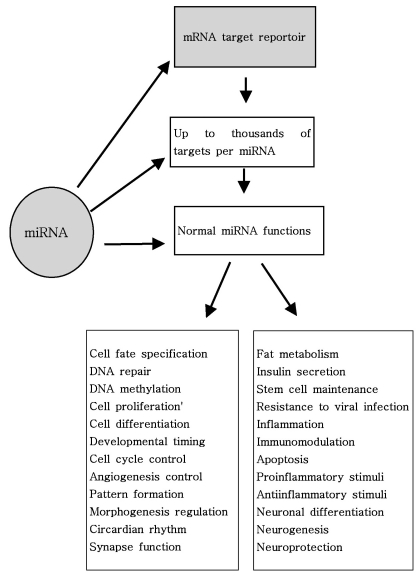
The great discovery of microRNAs (miRNAs) has revolutionized current cell biology and medical science. miRNAs are small conserved non-coding RNA molecules that post-transcriptionally regulate gene expression by targeting the 3' untranslated region of specific messenger RNAs for degradation or translational repression. New members of the miRNA family are being discovered on a daily basis and emerging evidence has demonstrated that miRNAs play a major role in a wide range of developmental process including cell proliferation, cell cycle, cell differentiation, metabolism, apoptosis, developmental timing, neuronal cell fate, neuronal gene expression, brain morphogenesis, muscle differentiation and stem cell division. Moreover, a large number of studies have reported links between alterations of miRNA homeostasis and pathological conditions such as cancer, psychiatric and neurological diseases, cardiovascular disease, and autoimmune disease. Interestingly, in addition, miRNA deficiencies or excesses have been correlated with a number of clinically important diseases ranging from cancer to myocardial infarction. miRNAs can repress the gene translation of hundreds of their targets and are therefore well-positioned to target a multitude of cellular mechanisms. As a consequence of extensive participation in normal functions, it is quite logical to ask the question if abnormalities in miRNAs should have importance in human diseases. Great discoveries and rapid progress in the past few years on miRNAs provide the hope that miRNAs will in the near future have a great potential in the diagnosis and treatment of many diseases. Currently, an explosive literature has focussed on the role of miRNA in human cancer and cardiovascular disease. In this review, I briefly summarize the explosive current studies about involvement of miRNA in various human cancers and cardiovascular disease.
微小 RNA(miRNA)的重大发现彻底改变了当前的细胞生物学和医学科学。miRNA 是小的保守非编码 RNA 分子,通过靶向特定信使 RNA 的 3'非翻译区来降解或翻译抑制,从而在后转录水平上调节基因表达。miRNA 家族的新成员每天都在被发现,新出现的证据表明 miRNA 在广泛的发育过程中发挥着重要作用,包括细胞增殖、细胞周期、细胞分化、代谢、细胞凋亡、发育定时、神经元细胞命运、神经元基因表达、脑形态发生、肌肉分化和干细胞分裂。此外,大量研究报告了 miRNA 动态平衡的改变与癌症、精神和神经疾病、心血管疾病和自身免疫性疾病等病理状况之间的联系。有趣的是,除此之外,miRNA 的缺乏或过剩与许多临床重要疾病有关,从癌症到心肌梗死。miRNA 可以抑制数百个靶基因的翻译,因此非常适合靶向多种细胞机制。由于广泛参与正常功能,我们很有理由问,如果 miRNA 异常是否会对人类疾病产生重要影响。miRNA 在过去几年中的重大发现和快速进展,为 miRNA 在许多疾病的诊断和治疗中具有巨大潜力提供了希望。目前,大量文献集中研究了 miRNA 在人类癌症和心血管疾病中的作用。在这篇综述中,我简要总结了目前关于 miRNA 在各种人类癌症和心血管疾病中的作用的大量研究。