Minnesota Department of Health, Emerging Infections Program, St. Paul, Minnesota, United States of America.
PLoS One. 2011;6(8):e22997. doi: 10.1371/journal.pone.0022997. Epub 2011 Aug 10.
Circulating strains of Staphylococcus aureus (SA) have changed in the last 30 years including the emergence of community-associated methicillin-resistant SA (MRSA). A report suggested staphylococcal toxic shock syndrome (TSS) was increasing over 2000-2003. The last population-based assessment of TSS was 1986.
Population-based active surveillance for TSS meeting the CDC definition using ICD-9 codes was conducted in the Minneapolis-St. Paul area (population 2,642,056) from 2000-2006. Medical records of potential cases were reviewed for case criteria, antimicrobial susceptibility, risk factors, and outcome. Superantigen PCR testing and PFGE were performed on available isolates from probable and confirmed cases.
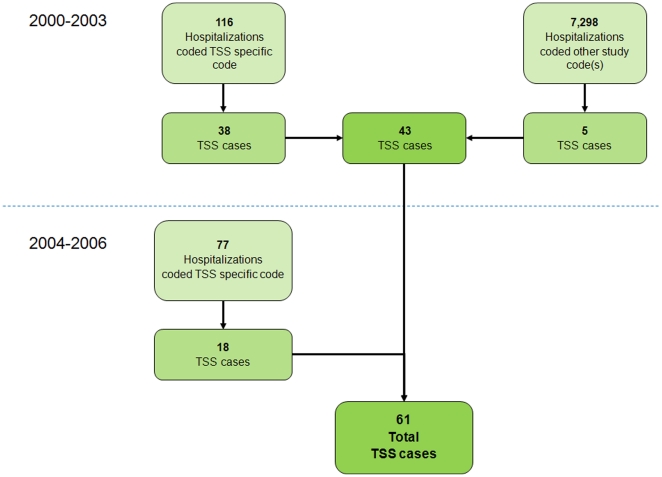
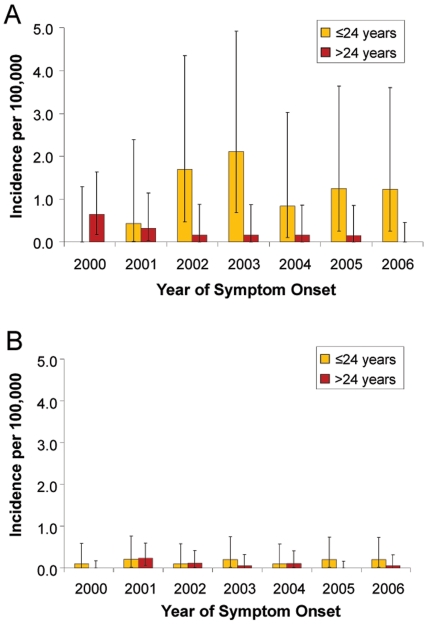
Of 7,491 hospitalizations that received one of the ICD-9 study codes, 61 TSS cases (33 menstrual, 28 non-menstrual) were identified. The average annual incidence per 100,000 of all, menstrual, and non-menstrual TSS was 0.52 (95% CI, 0.32-0.77), 0.69 (0.39-1.16), and 0.32 (0.12-0.67), respectively. Women 13-24 years had the highest incidence at 1.41 (0.63-2.61). No increase in incidence was observed from 2000-2006. MRSA was isolated in 1 menstrual and 3 non-menstrual cases (7% of TSS cases); 1 isolate was USA400. The superantigen gene tst-1 was identified in 20 (80%) of isolates and was more common in menstrual compared to non-menstrual isolates (89% vs. 50%, p = 0.07). Superantigen genes sea, seb and sec were found more frequently among non-menstrual compared to menstrual isolates [100% vs 25% (p = 0.4), 60% vs 0% (p<0.01), and 25% vs 13% (p = 0.5), respectively].
TSS incidence remained stable across our surveillance period of 2000-2006 and compared to past population-based estimates in the 1980s. MRSA accounted for a small percentage of TSS cases. tst-1 continues to be the superantigen associated with the majority of menstrual cases. The CDC case definition identifies the most severe cases and has been consistently used but likely results in a substantial underestimation of the total TSS disease burden.
在过去的 30 年中,金黄色葡萄球菌(SA)的循环株已经发生了变化,包括社区相关的耐甲氧西林金黄色葡萄球菌(MRSA)的出现。有报道称,葡萄球菌中毒性休克综合征(TSS)在 2000-2003 年期间呈上升趋势。最后一次基于人群的 TSS 评估是在 1986 年进行的。
在明尼阿波利斯-圣保罗地区(人口 2642056 人),使用 ICD-9 代码对符合 CDC 定义的 TSS 进行了基于人群的主动监测,监测时间为 2000-2006 年。对疑似病例和确诊病例的可能病例进行了病例标准、抗菌药物敏感性、危险因素和结果的回顾。对来自可能病例和确诊病例的分离物进行了超抗原 PCR 检测和 PFGE。
在接受 ICD-9 研究代码之一的 7491 例住院治疗中,发现了 61 例 TSS 病例(33 例月经性,28 例非月经性)。所有、月经性和非月经性 TSS 的每 100000 人年平均发病率分别为 0.52(95%CI,0.32-0.77)、0.69(0.39-1.16)和 0.32(0.12-0.67)。13-24 岁女性的发病率最高,为 1.41(0.63-2.61)。2000-2006 年期间未观察到发病率增加。1 例月经性 TSS 和 3 例非月经性 TSS 分离出耐甲氧西林金黄色葡萄球菌(MRSA)(TSS 病例的 7%);1 株为 USA400。在 20 株(80%)分离物中发现了 tst-1 超抗原基因,且月经性分离物比非月经性分离物更常见(89%比 50%,p=0.07)。非月经性分离物比月经性分离物更常发现超抗原基因 sea、seb 和 sec[100%比 25%(p=0.4)、60%比 0%(p<0.01)和 25%比 13%(p=0.5)]。
我们的监测期为 2000-2006 年,TSS 的发病率保持稳定,与 20 世纪 80 年代基于人群的估计相比。耐甲氧西林金黄色葡萄球菌仅占 TSS 病例的一小部分。tst-1 仍然是与大多数月经性病例相关的超抗原。CDC 的病例定义确定了最严重的病例,并一直被一致使用,但可能导致对 TSS 总疾病负担的严重低估。