Faculty of Infectious and Tropical Diseases, London School of Hygiene and Tropical Medicine, Keppel Street, London WC1E7HT, UK.
Confl Health. 2011 Aug 23;5:13. doi: 10.1186/1752-1505-5-13.
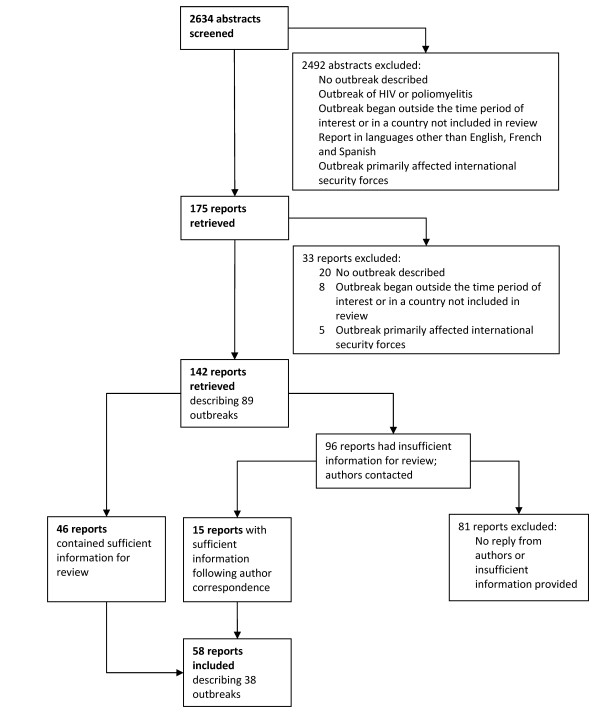
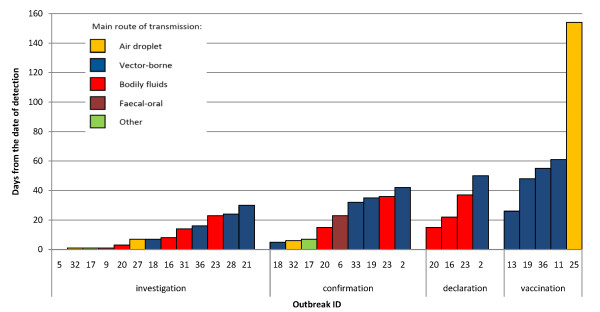
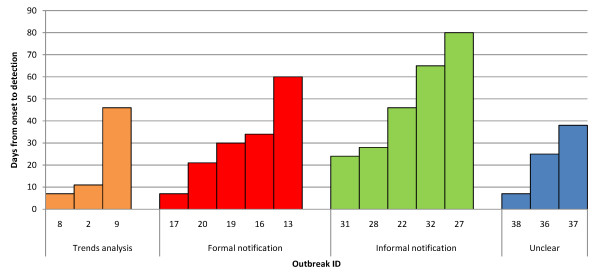
Fragile states are home to a sixth of the world's population, and their populations are particularly vulnerable to infectious disease outbreaks. Timely surveillance and control are essential to minimise the impact of these outbreaks, but little evidence is published about the effectiveness of existing surveillance systems. We did a systematic review of the circumstances (mode) of detection of outbreaks occurring in 22 fragile states in the decade 2000-2010 (i.e. all states consistently meeting fragility criteria during the timeframe of the review), as well as time lags from onset to detection of these outbreaks, and from detection to further events in their timeline. The aim of this review was to enhance the evidence base for implementing infectious disease surveillance in these complex, resource-constrained settings, and to assess the relative importance of different routes whereby outbreak detection occurs.We identified 61 reports concerning 38 outbreaks. Twenty of these were detected by existing surveillance systems, but 10 detections occurred following formal notifications by participating health facilities rather than data analysis. A further 15 outbreaks were detected by informal notifications, including rumours.There were long delays from onset to detection (median 29 days) and from detection to further events (investigation, confirmation, declaration, control). Existing surveillance systems yielded the shortest detection delays when linked to reduced barriers to health care and frequent analysis and reporting of incidence data.Epidemic surveillance and control appear to be insufficiently timely in fragile states, and need to be strengthened. Greater reliance on formal and informal notifications is warranted. Outbreak reports should be more standardised and enable monitoring of surveillance systems' effectiveness.
脆弱国家占世界人口的六分之一,其人民特别容易受到传染病爆发的影响。及时监测和控制对于最大限度地减少这些爆发的影响至关重要,但很少有证据表明现有的监测系统的有效性。我们对 2000-2010 年期间 22 个脆弱国家爆发的情况(模式)进行了系统回顾,这些国家在审查期间一直符合脆弱性标准),以及从爆发开始到发现这些爆发的时间滞后,以及从发现到其时间线上的进一步事件的时间滞后。本综述的目的是增强在这些复杂、资源有限的环境中实施传染病监测的证据基础,并评估不同途径在爆发检测中的相对重要性。我们确定了 61 份关于 38 起疫情的报告。其中 20 起是通过现有监测系统发现的,但有 10 起是在参与卫生机构正式发出通知后发现的,而不是通过数据分析发现的。另外 15 起疫情是通过非正式通知发现的,包括谣言。从爆发开始到发现(中位数为 29 天)以及从发现到进一步事件(调查、确认、宣布、控制)都存在很长的时间滞后。当与减少医疗保健障碍以及更频繁地分析和报告发病率数据相关联时,现有监测系统产生的检测延迟最短。脆弱国家的流行病监测和控制似乎不够及时,需要加强。有必要更多地依赖正式和非正式的通知。爆发报告应该更加标准化,并能够监测监测系统的有效性。