Institute of Environmental Medicine, Karolinska Institutet, Stockholm, Sweden.
Environ Health Perspect. 2012 Feb;120(2):284-9. doi: 10.1289/ehp.1103711. Epub 2011 Aug 23.
Cadmium (Cd) is an embryotoxic and teratogenic metal in a variety of animal species, but data from humans are limited.
The aim of the present study was to assess the effects of maternal Cd exposure in pregnancy on size at birth.
This prospective cohort study was nested in a population-based nutritional supplementation trial in pregnancy conducted in rural Bangladesh. We selected women recruited from February 2002 through January 2003 who had a singleton birth with measurements of size at birth and had donated a urine sample in early pregnancy for Cd analyses (n = 1,616). Urinary Cd was measured with inductively coupled plasma mass spectrometry and adjusted for specific gravity.
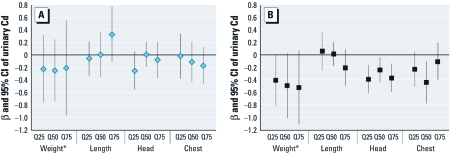
Multiple linear regression analyses adjusted for sex and other potential confounders showed that maternal urinary Cd (median, 0.63 μg/L) was significantly negatively associated with birth weight [unstandardized regression coefficient B = -31.0; 95% confidence interval (CI): -59, -2.8] and head circumference (B = -0.15; 95% CI: -0.27, -0.026). However, associations appeared to be limited to girls, with little evidence of effects in boys. A 1-μg/L increase in Cd in maternal urine was associated with a 0.26-cm (95% CI: -0.43, -0.088 cm) and 0.24-cm (95% CI: -0.44, -0.030 cm) decrease in girls' head and chest circumferences, respectively, and a 45-g (95% CI: -82.5, 7.3 g) decrease in birth weight. Quantile regression analyses indicated that associations with maternal Cd were similar for girls of smaller (25th percentile) and larger (50th and 75th percentiles) sizes at birth.
We found evidence of a sex difference in the association between maternal Cd exposure and birth size, which was apparent only in girls. Results add support for the need to reduce Cd pollution to improve public health.
镉(Cd)是多种动物物种的胚胎毒性和致畸金属,但人类的数据有限。
本研究旨在评估妊娠期间母体镉暴露对出生时大小的影响。
这项前瞻性队列研究嵌套在 2002 年 2 月至 2003 年 1 月期间在孟加拉国农村进行的基于人群的妊娠营养补充试验中。我们选择了 2002 年 2 月至 2003 年 1 月期间招募的、具有出生时大小测量值且在妊娠早期捐献了尿液样本进行 Cd 分析的单胎出生妇女(n=1616)。使用电感耦合等离子体质谱法测量尿镉,并根据比重进行调整。
经性别和其他潜在混杂因素调整的多元线性回归分析显示,母体尿镉(中位数,0.63μg/L)与出生体重呈显著负相关[未标准化回归系数 B=-31.0;95%置信区间(CI):-59,-2.8]和头围(B=-0.15;95%CI:-0.27,-0.026)。然而,这种关联似乎仅限于女孩,男孩的证据很少。母体尿液中 Cd 增加 1μg/L,与女孩头围和胸围分别减少 0.26cm(95%CI:-0.43,-0.088cm)和 0.24cm(95%CI:-0.44,-0.030cm)以及出生体重减少 45g(95%CI:-82.5,7.3g)相关。分位数回归分析表明,母体 Cd 与出生时体型较小(第 25 百分位)和较大(第 50 百分位和第 75 百分位)的女孩之间的关联存在性别差异。
我们发现妊娠期间母体 Cd 暴露与出生大小之间的关联存在性别差异,这种差异仅在女孩中表现明显。结果为需要减少 Cd 污染以改善公共健康提供了支持。