Coxiella Pathogenesis Section, Laboratory of Intracellular Parasites, Rocky Mountain Laboratories, National Institute of Allergy and Infectious Diseases, National Institutes of Health, Hamilton, Montana, USA.
mBio. 2011 Sep 1;2(4):e00175-11. doi: 10.1128/mBio.00175-11. Print 2011.
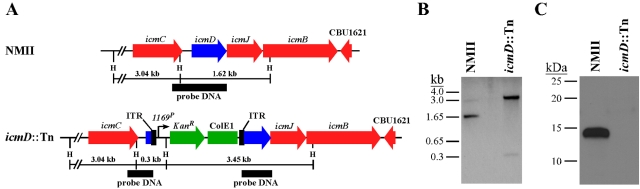
Central to Q fever pathogenesis is replication of the causative agent, Coxiella burnetii, within a phagolysosome-like parasitophorous vacuole (PV) in mononuclear phagocytes. C. burnetii modulates PV biogenesis and other host cell functions, such as apoptotic signaling, presumably via the activity of proteins delivered to the host cytosol by a Dot/Icm type IVB secretion system (T4BSS). In this study, we utilized a C. burnetii strain carrying IcmD inactivated by the Himar1 transposon to investigate the requirements for Dot/Icm function in C. burnetii parasitism of human THP-1 macrophage-like cells. The icmD::Tn mutant failed to secrete characterized T4BSS substrates, a defect that correlated with deficient replication, PV development, and apoptosis protection. Restoration of type IVB secretion and intracellular growth of the icmD::Tn mutant required complementation with icmD, -J, and -B, indicating a polar effect of the transposon insertion on downstream dot/icm genes. Induction of icmDJB expression at 1 day postinfection resulted in C. burnetii replication and PV generation. Collectively, these data prove that T4BSS function is required for productive infection of human macrophages by C. burnetii. However, illustrating the metabolic flexibility of C. burnetti, the icmD::Tn mutant could replicate intracellularly when sequestered in a PV generated by wild-type bacteria, where Dot/Icm function is provided in trans, and within a phenotypically similar PV generated by the protozoan parasite Leishmania amazonensis, where host cells are devoid of Dot/Icm T4BSS effector proteins.
致病因子贝氏柯克斯体在单核吞噬细胞的吞噬溶酶体样寄生空泡(PV)内复制是 Q 热发病机制的核心。贝氏柯克斯体调节 PV 的生物发生和其他宿主细胞功能,如凋亡信号,推测是通过由 Dot/Icm 型 IVB 分泌系统(T4BSS)递送到宿主细胞质的蛋白质的活性。在这项研究中,我们利用携带 IcmD 失活的 Himar1 转座子的贝氏柯克斯体菌株来研究 Dot/Icm 功能在贝氏柯克斯体寄生人类 THP-1 巨噬细胞样细胞中的要求。icmD::Tn 突变体不能分泌特征性的 T4BSS 底物,这一缺陷与复制缺陷、PV 发育和凋亡保护相关。icmD::Tn 突变体的 IVB 型分泌和细胞内生长的恢复需要与 icmD、-J 和 -B 互补,表明转座子插入对下游 dot/icm 基因具有极性效应。在感染后 1 天诱导 icmDJB 表达导致贝氏柯克斯体的复制和 PV 的生成。总之,这些数据证明 T4BSS 功能是 C. burnetii 感染人类巨噬细胞的必要条件。然而,说明了 C. burnetti 的代谢灵活性,icmD::Tn 突变体可以在由野生型细菌产生的 PV 中被隔离时在细胞内复制,在该 PV 中 Dot/Icm 功能是通过转位提供的,并且在原生动物寄生虫利什曼原虫产生的表型相似的 PV 中复制,其中宿主细胞缺乏 Dot/Icm T4BSS 效应蛋白。