Barker Stephen C, Altman Phillip M
Parasitology Section, School of Chemistry & Molecular Biosciences, and UniQuest Pty Ltd, University of Queensland, Brisbane, QLD, Australia.
BMC Dermatol. 2011 Aug 24;11:14. doi: 10.1186/1471-5945-11-14.
There are two components to the clinical efficacy of pediculicides: (i) efficacy against the crawling-stages (lousicidal efficacy); and (ii) efficacy against the eggs (ovicidal efficacy). Lousicidal efficacy and ovicidal efficacy are confounded in clinical trials. Here we report on a trial that was specially designed to rank the clinical ovicidal efficacy of pediculicides. Eggs were collected, pre-treatment and post-treatment, from subjects with different types of hair, different coloured hair and hair of different length.
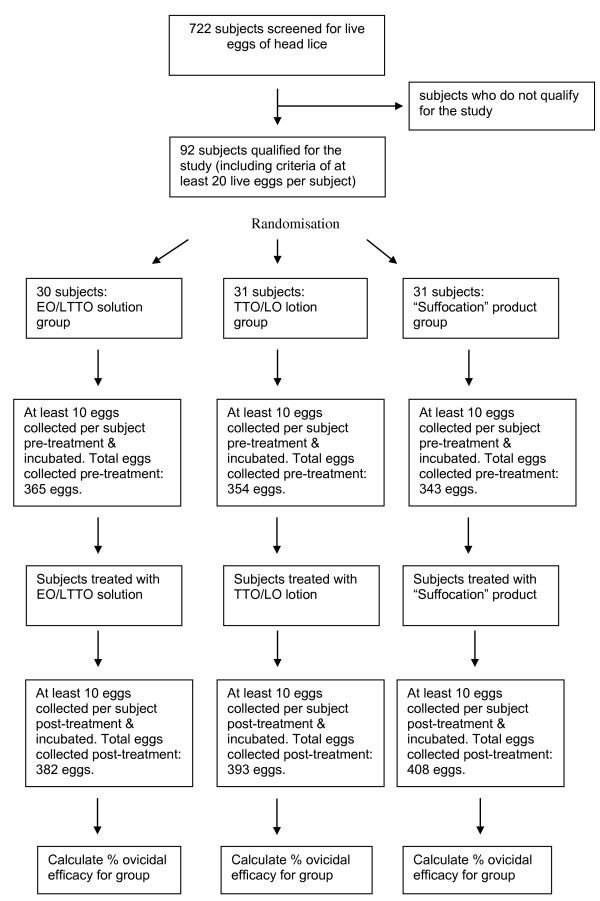
Subjects with at least 20 live eggs of Pediculus capitis (head lice) were randomised to one of three treatment-groups: a melaleuca oil (commonly called tea tree oil) and lavender oil pediculicide (TTO/LO); a eucalyptus oil and lemon tea tree oil pediculicide (EO/LTTO); or a "suffocation" pediculicide. Pre-treatment: 10 to 22 live eggs were taken from the head by cutting the single hair with the live egg attached, before the treatment (total of 1,062 eggs).
The subjects then received a single treatment of one of the three pediculicides, according to the manufacturers' instructions. Post-treatment: 10 to 41 treated live eggs were taken from the head by cutting the single hair with the egg attached (total of 1,183 eggs). Eggs were incubated for 14 days. The proportion of eggs that had hatched after 14 days in the pre-treatment group was compared with the proportion of eggs that hatched in the post-treatment group. The primary outcome measure was % ovicidal efficacy for each of the three pediculicides.
722 subjects were examined for the presence of eggs of head lice. 92 of these subjects were recruited and randomly assigned to: the "suffocation" pediculicide (n = 31); the melaleuca oil and lavender oil pediculicide (n = 31); and the eucalyptus oil and lemon tea tree oil pediculicide (n = 30 subjects). The group treated with eucalyptus oil and lemon tea tree oil had an ovicidal efficacy of 3.3% (SD 16%) whereas the group treated with melaleuca oil and lavender oil had an ovicidal efficacy of 44.4% (SD 23%) and the group treated with the "suffocation" pediculicide had an ovicidal efficacy of 68.3% (SD 38%).
Ovicidal efficacy varied substantially among treatments, from 3.3% to 68.3%. The "suffocation" pediculicide and the melaleuca oil and lavender oil pediculicide (TTO/LO) were significantly more ovicidal than eucalyptus oil and lemon tea tree oil pediculicide (EO/LTTO) (P < 0.0001). Ranking: 1. "Suffocation" pediculicide (68.3% efficacy against eggs); 2. Melaleuca oil and lavender oil (44.4%) pediculicide; 3. Eucalyptus oil and lemon tea tree oil (3.3%) pediculicide. The "suffocation" pediculicide and TTO/LO are also highly efficacious against the crawling-stages. Thus, the "suffocation" pediculicide and TTO/LO should be recommended as first line treatments.
杀虱剂的临床疗效有两个组成部分:(i)对爬行阶段的疗效(杀虱效力);以及(ii)对卵的疗效(杀卵效力)。在临床试验中,杀虱效力和杀卵效力相互混淆。在此,我们报告一项专门设计用于对杀虱剂的临床杀卵效力进行排名的试验。在治疗前和治疗后,从具有不同发质、不同发色和不同长度头发的受试者处收集卵。
有至少20颗头虱活卵的受试者被随机分配到三个治疗组之一:一种白千层油(通常称为茶树油)和薰衣草油杀虱剂(TTO/LO);一种桉叶油和柠檬茶树油杀虱剂(EO/LTTO);或一种“窒息”杀虱剂。治疗前:在治疗前,通过剪下附着有活卵的单根头发,从头部获取10至22颗活卵(共1062颗卵)。
然后,受试者根据制造商的说明接受三种杀虱剂之一的单次治疗。治疗后:通过剪下附着有卵的单根头发,从头部获取10至41颗经处理的活卵(共1183颗卵)。将卵孵化14天。将治疗前组中14天后孵化的卵的比例与治疗后组中孵化的卵的比例进行比较。主要结局指标是三种杀虱剂各自的杀卵效力百分比。
检查了722名受试者是否存在头虱卵。其中92名受试者被招募并随机分配到:“窒息”杀虱剂组(n = 31);白千层油和薰衣草油杀虱剂组(n = 31);以及桉叶油和柠檬茶树油杀虱剂组(n = 30名受试者)。用桉叶油和柠檬茶树油治疗的组的杀卵效力为3.3%(标准差16%),而用白千层油和薰衣草油治疗的组的杀卵效力为44.4%(标准差23%),用“窒息”杀虱剂治疗的组的杀卵效力为68.3%(标准差38%)。
不同治疗方法的杀卵效力差异很大,从3.3%到68.3%不等。“窒息”杀虱剂以及白千层油和薰衣草油杀虱剂(TTO/LO)的杀卵效力明显高于桉叶油和柠檬茶树油杀虱剂(EO/LTTO)(P < 0.0001)。排名:1. “窒息”杀虱剂(对卵的效力为68.3%);2. 白千层油和薰衣草油(44.4%)杀虱剂;3. 桉叶油和柠檬茶树油(3.3%)杀虱剂。“窒息”杀虱剂和TTO/LO对爬行阶段也非常有效。因此,应推荐“窒息”杀虱剂和TTO/LO作为一线治疗方法。
